All species › Falcons › Falcons and caracaras › Orange-breasted Falcon
Orange-breasted Falcon | Falco deiroleucus
Bonte slechtvalk | Halcón pecho rufo | Falcão-de-peito-laranja
The Orange-breasted Falcon is a powerful, rare falcon of forested hills and lower mountain slopes, nesting on tall cliffs above the forest. It closely resembles the much commoner Bat Falcon, but is larger and more heavily built. Throughout its range it occurs locally and at low density.
Voice
A loud, repeated series kek-kek-kek, mainly near the nest site.
Recording: Dante Buzzetti — CC BY-NC-SA 4.0 · xeno-canto
Identification
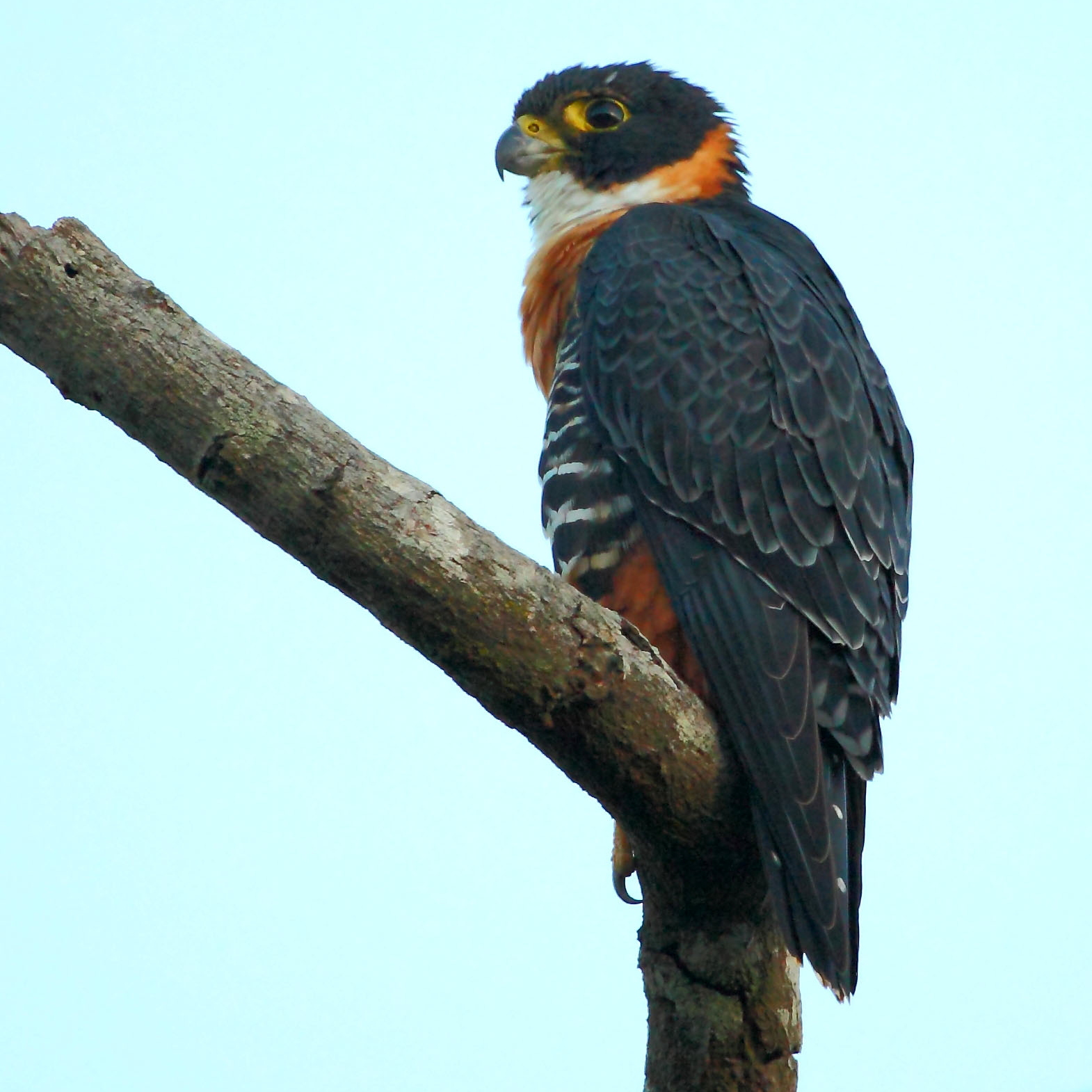
33–40 cm; the female is distinctly larger than the male. Upperparts slate-blue to blackish, the head black. The throat is white to cream and merges into a rufous-orange band on the upper breast and the sides of the neck. Below this a black vest with coarse, cream to pale orange barring. The belly, thighs and undertail coverts are rufous-orange. Bill and feet are heavy, the legs yellow. Juveniles are browner above, with buffy tones below.
Confusion species
Bat Falcon Falco rufigularis is smaller and slimmer, with a smaller head and lighter feet; the throat is usually buffier or browner without a sharp white border, the orange band on the upper breast is absent or narrow, and the black vest is more finely barred with white. Female Bat Falcons and male Orange-breasted Falcons overlap in size; note the proportions of head and feet. Peregrine Falcon Falco peregrinus has pale, streaked or barred underparts without orange.
Habitat
Tall cliffs, gorges and steep slopes in humid foothill and lower montane forest, also river valleys with cliffs in the lowlands; mostly between about 300 and 2000 m. It hunts medium-sized birds such as pigeons, parrots and also swifts, from a high perch or in a fast stoop. It nests in a hole or on a ledge in a cliff.
Where the bird is most at home, classified by the vegetation units of the Andes and the west coast.


Range and movements
In Colombia very local, with few records. In Ecuador rare on the eastern slope and in the adjacent lowlands, formerly also in the west. In Peru locally along the eastern slope of the Andes. In Bolivia locally in the foothills and the Yungas. Not on the Galápagos. Outside the guide area from southern Mexico to northern Argentina, everywhere rare and local.
How and when to look
Known nesting cliffs in the foothills of the eastern slope are occupied year after year; there the bird often sits for long periods on a projecting ledge or a dead tree above the forest. Check any Bat Falcon with a heavy head and large feet carefully.
Conservation status
Near Threatened. The species occurs at low density and depends on forest around suitable cliffs; deforestation and disturbance of nest sites are the main threats.
Scientific name
Falco deiroleucus | Temminck, 1825
Temminck described the species in 1825 and placed it straight away in the genus where it still stands. The genus Falco was introduced in 1758 by Linnaeus. The genus name is Late Latin falco, 'falcon', possibly from falx, 'sickle', after the talons or wing shape. The species name comes from Greek deirē, 'throat, neck', and leukos, 'white'. The specimen the first description was based on came from São Francisco Island, Santa Catarina, Brazil.