All species › Falcons › Falcons and caracaras › Bat Falcon
Bat Falcon | Falco rufigularis
Vleermuisvalk | Halcón murcielaguero | Cauré
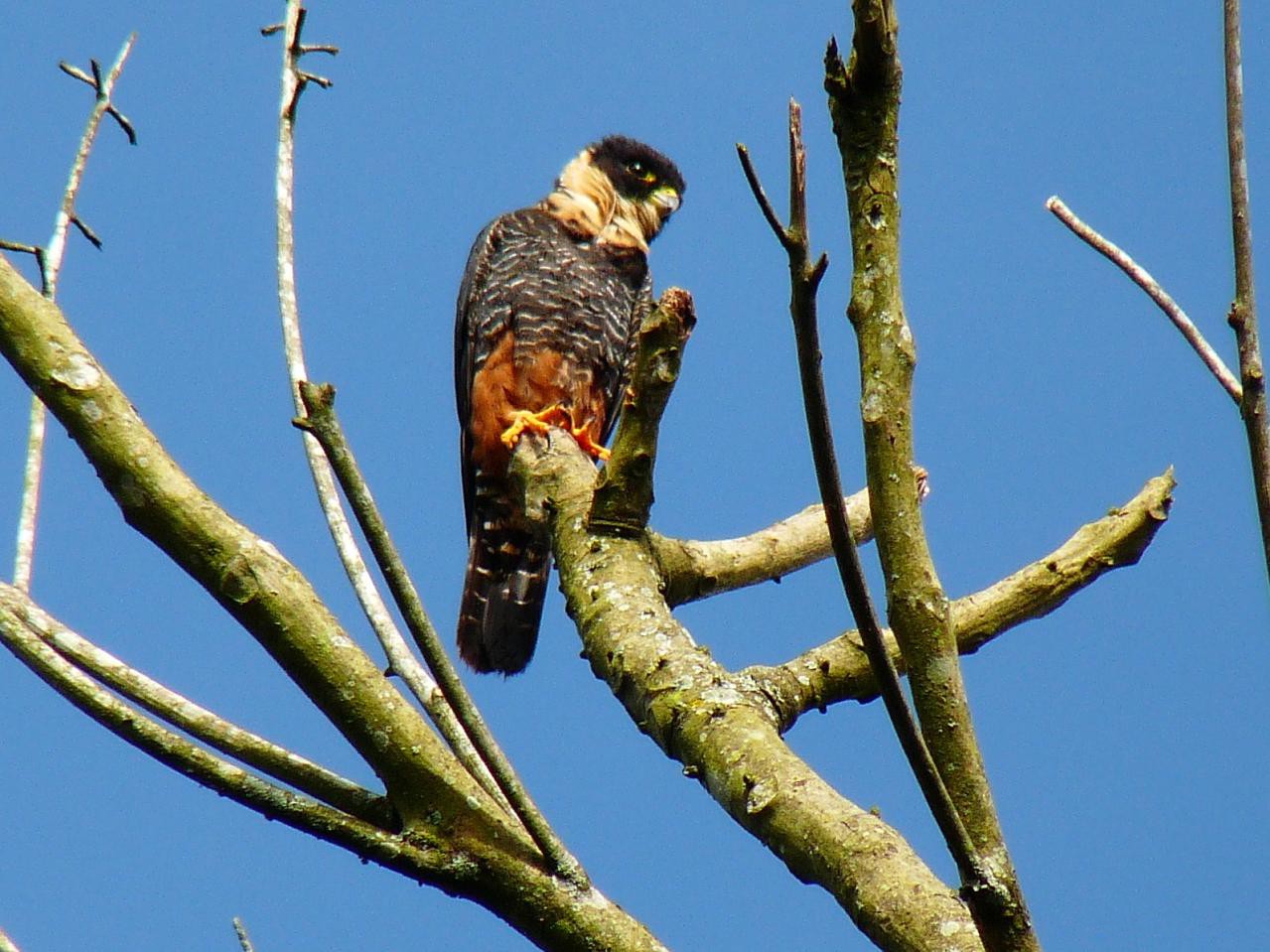
The Bat Falcon is a small, dark falcon of forest edges and clearings in the lowlands and foothills. It often sits for long periods on a high dead branch above the forest and hunts mainly at dusk, taking bats, swifts and large insects. Pairs stay in their territory all year.
Voice
A high, rapid series kee-kee-kee-kee, often in duet and mainly at the perch.
Recording: JAYRSON ARAUJO DE OLIVEIRA — CC BY-NC-SA 4.0 · xeno-canto
Identification
23–30 cm, compact, with long, pointed wings and a fairly short tail; the female is distinctly larger. Upperparts slaty black, the head black. Throat, sides of the neck and upper breast white to buff or pale brown. Below this a black vest with fine white bars. Belly, thighs and undertail coverts rufous. The legs are yellow. Juveniles are browner, with a buffier throat and more barred undertail coverts.
Confusion species
Orange-breasted Falcon Falco deiroleucus is larger and heavier, with large feet, a white throat sharply set off against a rufous-orange band on the upper breast and a more coarsely barred vest. Aplomado Falcon Falco femoralis is larger and slimmer, with a long tail and a white supercilium, and lives in open country. Barred Forest Falcon Micrastur ruficollis has short, rounded wings and a long barred tail and stays inside the forest.
Habitat
Forest edges, riverbanks, clearings and cleared land with tall dead trees in humid and semi-humid forest, also plantations and village edges; from sea level to about 1500 m, locally higher. It hunts from a high perch in fast flight, taking bats, swifts, swallows and small birds, and large insects such as dragonflies and beetles. It nests in tree cavities, also in old nests of other birds or on buildings.
Where the bird is most at home, classified by the vegetation units of the Andes and the west coast.


Range and movements
In Colombia in the lowlands and foothills almost everywhere, except in the high Andes. In Ecuador on both sides of the Andes in the lowlands and foothills. In Peru in Amazonia and the foothills of the eastern slope, and in the north-west. In Bolivia in the lowlands and foothills. Not on the Galápagos. Outside the guide area from Mexico to northern Argentina.
- Resident
- dark = core range, pale = thinly spread
How and when to look
Along rivers in Amazonia and at lodges with clearings in the forest it often sits on the same tall, bare tree. Watch at dusk, when it hunts bats and swifts.
Conservation status
Least Concern. The species adapts to forest edges and semi-open, cleared landscapes.
Scientific name
Falco rufigularis | Daudin, 1800
Daudin described the species in 1800 and placed it straight away in the genus where it still stands. The genus Falco was introduced in 1758 by Linnaeus. The genus name is Late Latin falco, 'falcon', possibly from falx, 'sickle', after the talons or wing shape. The species name comes from Latin rufus, 'red', and gula, 'throat'. The specimen the first description was based on came from Cayenne, French Guiana.