All species › Falcons › Falcons and caracaras › Aplomado Falcon
Aplomado Falcon | Falco femoralis
Aplomadovalk | Halcón aplomado | Falcão-de-coleira
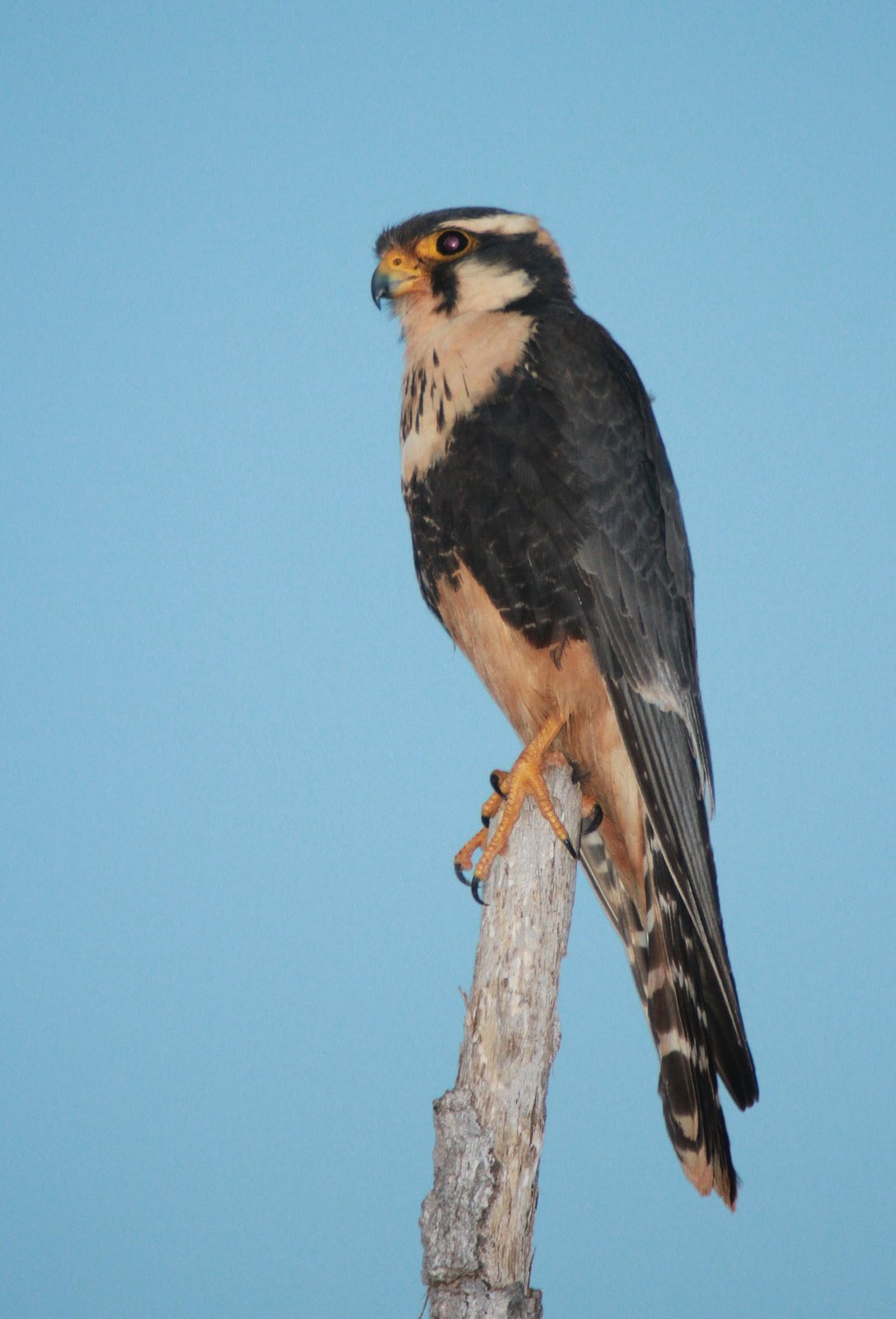
The Aplomado Falcon is a slender falcon with long wings and a long tail, found in open grassland from the high puna to the lowland savannas. It hunts birds and insects in fast flight and pairs sometimes cooperate to flush prey. In the guide area it is mainly a bird of the altiplano and the eastern savannas.
Voice
A rapid, shrill series kek-kek-kek or kee-kee-kee, mainly at the nest.
Recording: JAYRSON ARAUJO DE OLIVEIRA — CC BY-NC-SA 4.0 · xeno-canto
Identification
35–45 cm, slender, with long, pointed wings and a long tail; the female is larger. Upperparts slate-grey. The head has a dark crown, a distinct white to buff supercilium extending to the nape, and a narrow black moustache. Throat and breast white to buff, sometimes finely streaked. A broad blackish band runs across the belly, often with fine white streaks. Lower belly, thighs and undertail coverts rufous. The tail is dark with narrow white bands. Juveniles are browner, with a more heavily streaked breast.
Confusion species
Peregrine Falcon Falco peregrinus is heavier, with a shorter tail, broader wing base, a broad moustache and no white supercilium or rufous thighs. American Kestrel Falco sparverius is much smaller, with a rufous back and tail. Bat Falcon Falco rufigularis is smaller, with a black vest and a short tail, and lives near forest.
Habitat
Open country: puna and altiplano with bunchgrass and shrubs, savannas with scattered trees in the lowlands, coastal desert and farmland, also marshy grassland; from sea level to above 4500 m. It hunts from a perch or in fast pursuit, taking small and medium-sized birds, large insects and sometimes rodents and bats; pairs sometimes hunt together. It nests in old nests of other birds in trees, shrubs or on poles.
Where the bird is most at home, classified by the vegetation units of the Andes and the west coast.


Range and movements
In Colombia in the Llanos, the Caribbean lowlands and locally in open highlands of the Andes. In Ecuador scarce and local in the highlands. In Peru on the puna and locally along the coast. In Bolivia on the altiplano and in the savannas of Beni and the east. Not on the Galápagos. Outside the guide area from Mexico, with a small population in the southern United States, to Tierra del Fuego.
- Resident
- dark = core range, pale = thinly spread
How and when to look
On the altiplano of Peru and Bolivia it often sits on a post, a boulder or a low shrub in open grassland. Look for a slender falcon with a white supercilium and a long tail hunting low over the plain.
Conservation status
Least Concern. Locally declined through conversion of grassland and savanna and through pesticides.
Scientific name
Falco femoralis | Temminck, 1822
Temminck described the species in 1822 and placed it straight away in the genus where it still stands. The genus Falco was introduced in 1758 by Linnaeus. The genus name is Late Latin falco, 'falcon', possibly from falx, 'sickle', after the talons or wing shape. The species name comes from Latin femur, 'thigh', after the rufous thighs. The specimen the first description was based on came from Brazil.