All species › Falcons › Falcons and caracaras › Peregrine Falcon
Peregrine Falcon | Falco peregrinus
Slechtvalk | Halcón peregrino | Falcão-peregrino
The Peregrine Falcon is a large, powerful falcon found almost worldwide that strikes its prey, usually a bird, in a steep stoop. In the guide area a small, dark Andean subspecies breeds on cliffs in the mountains and along the coast, while North American birds winter or pass through. Winter visitors often frequent concentrations of shorebirds and gulls along the coast.
Voice
At the nest a loud, grating series kek-kek-kek and a wailing ee-chip; usually silent outside the breeding season.
Recording: Timeo CONSTANT — CC BY-NC-SA 4.0 · xeno-canto
Identification
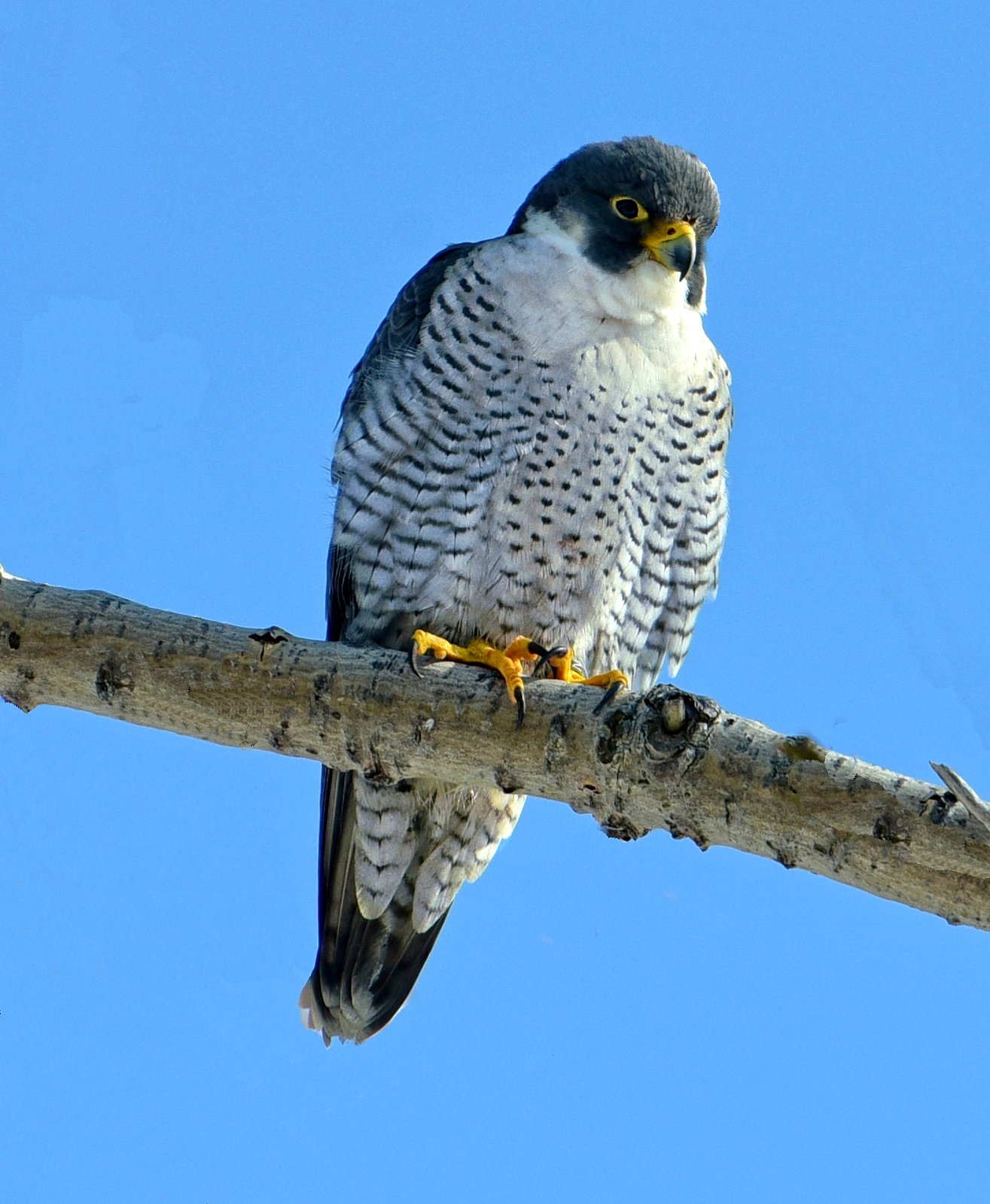
38–48 cm; the female is distinctly larger than the male. Heavily built, with a broad wing base, pointed wings and a medium-length tail. Upperparts slate-grey to blue-grey, the head with a dark hood and a broad black moustache. Throat and upper breast white to cream, the rest of the underparts finely barred dark. Legs and cere yellow. Juveniles are brown above, with streaked underparts. North American tundra birds wintering here are paler, with a narrower moustache; the Andean breeding birds are smaller and darker.
Confusion species
Aplomado Falcon Falco femoralis is slimmer, with a longer tail, a white supercilium, a dark belly band and rufous thighs. Merlin Falco columbarius is much smaller, with a faint moustache. Orange-breasted Falcon Falco deiroleucus has a black vest and rufous-orange underparts.
Habitat
Coasts, lagoons, estuaries and tidal flats with shorebirds, cities with tall buildings, cliffs and gorges in the Andes, high-plateau lakes and open country; from sea level to above 4000 m. It hunts mainly birds, from songbirds to ducks and pigeons, striking them in the air after a steep stoop. It nests on a cliff ledge, locally on buildings.
Where the bird is most at home, classified by the vegetation units of the Andes and the west coast.


Range and movements
In Colombia mainly a winter visitor and passage migrant, along the coasts and in the Andes. In Ecuador a winter visitor throughout, with a small breeding population in the Andes. In Peru a breeding bird in the Andes and along the coastal desert and a common winter visitor along the coast. In Bolivia a breeding bird in the Andes and a winter visitor mainly in the lowlands. On the Galápagos a scarce winter visitor. Outside the guide area on all continents except Antarctica.
- Resident
- dark = core range, pale = thinly spread
How and when to look
Between October and April search lagoons and beaches with many shorebirds along the coasts of Peru and Ecuador, or tall buildings in cities such as Lima. When shorebirds suddenly take flight, look up.
Conservation status
Least Concern. After a steep decline caused by pesticides (DDT) in the twentieth century, the species recovered in North America.
Scientific name
Falco peregrinus | Tunstall, 1771
Tunstall described the species in 1771 and placed it straight away in the genus where it still stands. The genus Falco was introduced in 1758 by Linnaeus. The genus name is Late Latin falco, 'falcon', possibly from falx, 'sickle', after the talons or wing shape. The species name is Latin peregrinus, 'foreigner, wanderer'. The specimen the first description was based on came from Northamptonshire, England.