All species › Falcons › Falcons and caracaras › Red-throated Caracara
Red-throated Caracara | Ibycter americanus
Roodkeelcaracara | Caracara comecacao | Cancão
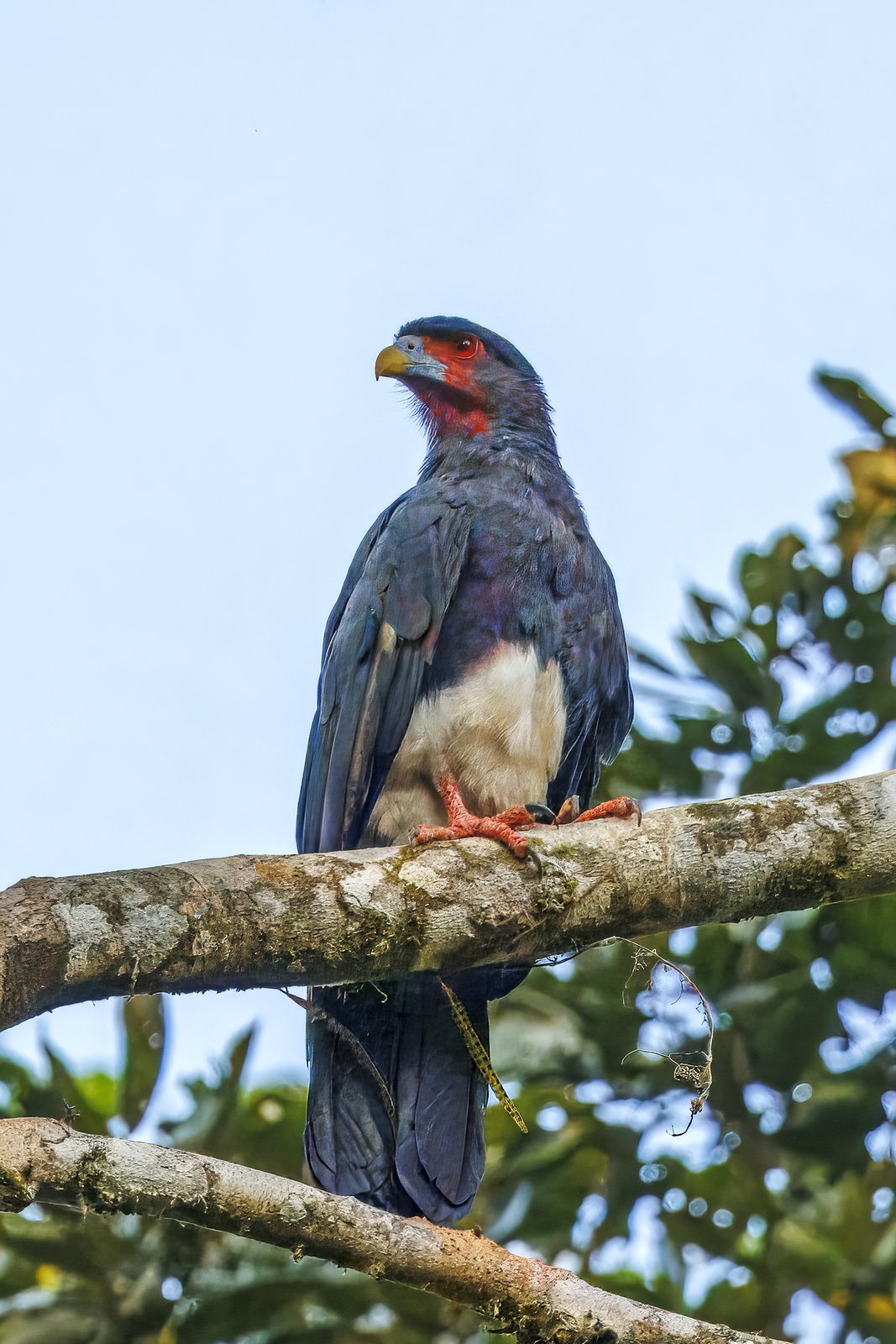
The Red-throated Caracara is a black-and-white caracara of the high Amazonian forest canopy that lives in noisy groups. It specialises in tearing open the nests of wasps and bees to eat the larvae. The raucous chorus of a group carries far through lowland forest.
Voice
A loud, raucous group chorus, a series of harsh cries such as ka-ka-ka-kaw and ka-ka-o, often repeated at length.
Recording: Jacob Wijpkema — CC BY-NC-SA 4.0 · xeno-canto
Identification
50–56 cm, with a long tail and broad wings. The adult is glossy black, with a white belly, white thighs and white undertail coverts. The throat and face are bare and red; the red skin extends around the eye. The bill is yellowish with a grey base, and the legs are red to orange-red. The sexes are alike. Juveniles have a duller face and a blackish or mottled belly.
Confusion species
Black Caracara Daptrius ater is smaller and all black, with an orange face, a white band at the base of the tail and yellow legs, and lives mainly along rivers. Great Black Hawk Buteogallus urubitinga has a white tail base, yellow legs and no bare red face.
Habitat
Tall humid lowland forest on terra firme and in várzea, also forest edges and clearings with tall trees; mainly below 1000 m, locally higher in the foothills. It lives in groups of three to ten birds that move through the canopy. It tears open the nests of wasps and bees and eats the larvae and pupae; it also eats fruit, seeds and invertebrates. It nests in a cavity or on an epiphyte high in a tree; helpers from the group assist in raising the young.
Where the bird is most at home, classified by the vegetation units of the Andes and the west coast.


Range and movements
In Colombia in the Amazonian lowlands east of the Andes and very locally in the Pacific lowlands of the north-west. In Ecuador in the eastern lowlands; formerly present in the west, where it has now almost disappeared. In Peru in the Amazonian lowlands throughout the east of the country. In Bolivia in the lowlands of the north and centre. Absent from the Galápagos. Outside the guide area in the Amazon basin and the Guianas; formerly widespread in Central America, where it has now largely disappeared.
- Resident
- dark = core range, pale = thinly spread
How and when to look
Listen in extensive lowland forest for the raucous chorus of a group; the birds often sit in the crowns of tall trees along a forest edge or river and can be followed from a canoe or a canopy tower.
Conservation status
Least Concern. Still common in large parts of Amazonia, but strongly declined in Central America and at the edges of its range through deforestation.
Scientific name
Ibycter americanus | (Boddaert, 1783)
Boddaert described the species in 1783 as Falco americanus; because it was later moved to another genus, the author and year stand in brackets. The genus Ibycter was introduced in 1816 by Vieillot. The genus name comes from Greek ibuktēr, 'singer of war songs', after the loud calls. The species name refers to America. The specimen the first description was based on came from Cayenne, French Guiana.