All species › Falcons › Falcons and caracaras › Spot-winged Falconet
Spot-winged Falconet | Spiziapteryx circumcincta
Witstuitvalk | Halconcito gris | Falcãozinho-de-asa-pintada
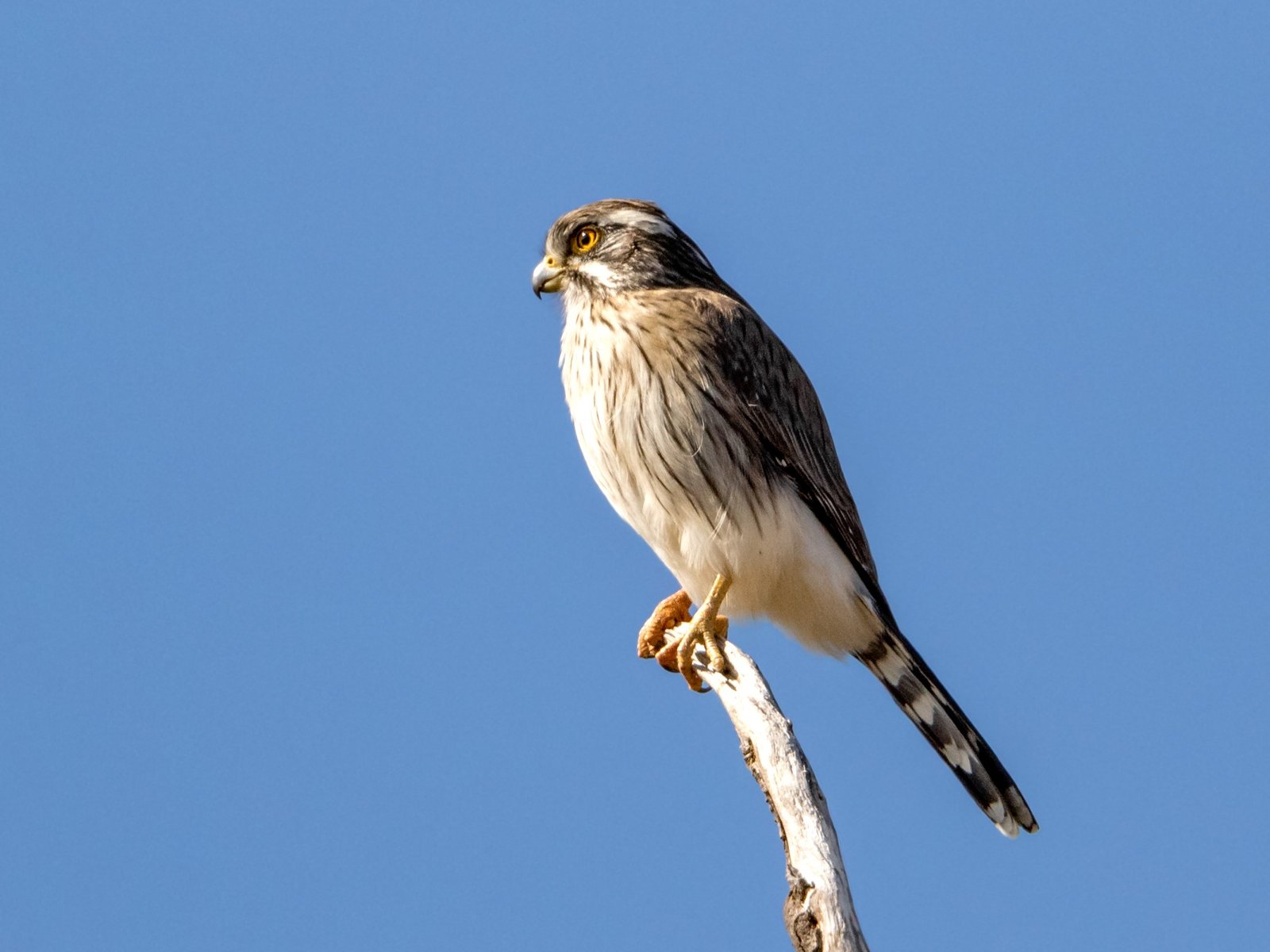
The Spot-winged Falconet is a small, grey falcon of the dry Chaco, the only species in its genus. The core of its range lies in Argentina; in the guide area it reaches only the far south-east of Bolivia, where it is very rare. It hunts from cover in thorn forest and breeds in the old nests of other birds.
Voice
A series of high, shrill notes, kwee-kwee-kwee, mainly near the nest.
Recording: Jacob Wijpkema — CC BY-NC-SA 4.0 · xeno-canto
Identification
25–29 cm, with a rather large head, short, rounded wings and a long tail. The upperparts are brownish grey, with white spots on the wing coverts and flight feathers. The rump and uppertail coverts are white. The head shows a white supercilium and a narrow dark moustachial stripe. The underparts are white to pale grey with fine dark streaks on the breast. The tail is blackish with narrow white bands. Cere and legs are yellow to orange. The sexes are alike.
Confusion species
American Kestrel Falco sparverius has a rufous back and tail, two black facial stripes and pointed wings. Aplomado Falcon Falco femoralis is larger, with a dark breast band and a rufous belly, and lacks a white rump. Roadside Hawk Rupornis magnirostris is larger, with a rufous wing panel and a barred belly.
Habitat
Dry Chaco forest, thorn scrub and open woodland with tall cacti and scattered trees, in the lowlands and on low slopes. It hunts from a branch or in fast, low flight through the scrub for small birds, lizards, small mammals and large insects. It breeds in old or taken-over nests of other birds, such as the large stick nests of Monk Parakeet.
Where the bird is most at home, classified by the vegetation units of the Andes and the west coast.

Range and movements
In the guide area known only from the Chaco lowlands in the far south-east of Bolivia, with few records; the species is absent or nearly so there. Absent from Colombia, Ecuador, Peru and the Galápagos. Outside the guide area in the dry Chaco and scrub of Argentina and western Paraguay.
- Resident
- dark = core range, pale = thinly spread
How and when to look
In the guide area to be expected only in dry Chaco forest in south-eastern Bolivia. Watch for a small grey falcon that flies off low through the scrub, showing the white rump.
Conservation status
Least Concern. The conversion of Chaco forest to cropland and pasture is a local threat.
Scientific name
Spiziapteryx circumcincta | (Kaup, 1852)
Kaup described the species in 1852 as Harpagus circumcinctus; because it was later moved to another genus, the author and year stand in brackets. The genus Spiziapteryx was introduced in 1852 by Kaup. The genus name comes from Greek spizias, 'hawk', and pterux, 'wing'. The species name comes from Latin circumcinctus, 'girdled all around'. The specimen the first description was based on came from Mendoza, Argentina.