All species › Falcons › Falcons and caracaras › Yellow-headed Caracara
Yellow-headed Caracara | Daptrius chimachima
Geelkopcaracara | Caracara chimachima | Carrapateiro
The Yellow-headed Caracara is a medium-sized, lightly built caracara of open lowlands, with a buff head and underparts. It often sits on the backs of cattle or capybaras, picking off ticks and other parasites. Like the Crested Caracara, it is spreading with deforestation.
Voice
A high, shrill, hoarse scream, shreeeh, often repeated, and a softer, scratchy chatter.
No recording with a suitable Creative Commons licence is available for this species yet.
Identification
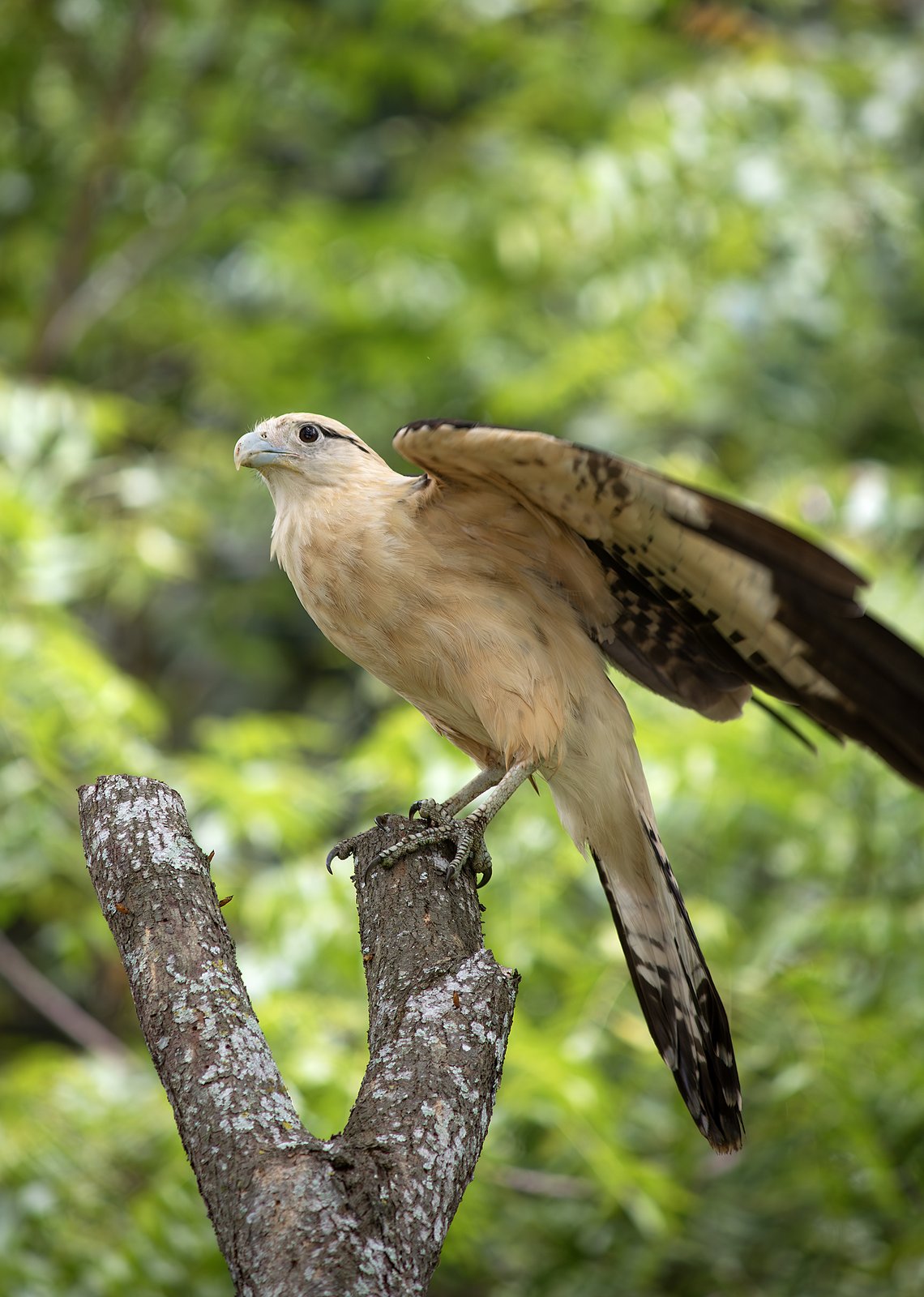
40–46 cm, with a long tail and a small, round head. The adult has a creamy buff head, neck and underparts, with a narrow dark stripe behind the eye. The back and wings are dark brown; in flight a pale patch at the base of the primaries stands out. The tail is buff with fine dark bars and a dark terminal band. Bare skin around the eye and legs are yellow. The sexes are alike. Juveniles are browner, with dense dark streaks on the head and underparts.
Confusion species
Crested Caracara Caracara plancus is much larger, with a black cap and a red face. Laughing Falcon Herpetotheres cachinnans also has a pale head, but wears a broad black mask that extends onto the nape, and sits still on a branch. Juveniles may resemble the juvenile Savanna Hawk Buteogallus meridionalis, which has longer legs, broader wings and a rufous tinge.
Habitat
Open country with scattered trees: pastures, savannas, riverbanks, sandbars, marsh edges and villages, mainly in the lowlands and locally up to about 1800 m. It eats carrion, insects, small vertebrates, fruit and parasites of livestock, and sometimes follows ploughing machinery. The nest is a stick nest in a tree or palm.
Where the bird is most at home, classified by the vegetation units of the Andes and the west coast.


Range and movements
In Colombia widespread in open lowlands, in the Caribbean region, the Magdalena and Cauca valleys, the Llanos and Amazonia, and spreading in the Pacific lowlands. In Ecuador in the eastern lowlands and spreading in the west. In Peru in the eastern lowlands, where it is increasing with deforestation. In Bolivia widespread in the lowlands. Absent from the Galápagos. Outside the guide area from Panama to northern Argentina.
How and when to look
Search pastures, savannas and riversides; birds sit on posts, on cattle or on dead trees, and are a regular sight in the Llanos and the lowlands of Bolivia.
Conservation status
Least Concern. The species is increasing in large parts of the guide area as forest is converted to pasture.
Scientific name
Daptrius chimachima | (Vieillot, 1816)
Vieillot described the species in 1816 as Polyborus chimachima; because it was later moved to another genus, the author and year stand in brackets. The genus Daptrius was introduced in 1816 by Vieillot. The genus name comes from Greek daptēs, 'eater, devourer', from daptō, 'to devour'. The species name comes from chimachima, an onomatopoeic local Argentine name for a caracara. The specimen the first description was based on came from Paraguay.