All species › Falcons › Falcons and caracaras › Black Caracara
Black Caracara | Daptrius ater
Zwarte caracara | Caracara negro | Gavião-de-anta
The Black Caracara is a slender, black caracara of the rivers of the Amazonian lowlands. It perches a lot on branches along the bank and on sandbars, often in pairs or small groups. It eats almost anything, from carrion and fish to fruit, and sometimes picks ticks and other parasites from tapirs and capybaras.
Voice
A long, shrill, hoarse scream, kraaaah, often given in flight or from a lookout perch.
Recording: JAYRSON ARAUJO DE OLIVEIRA — CC BY-NC-SA 4.0 · xeno-canto
Identification
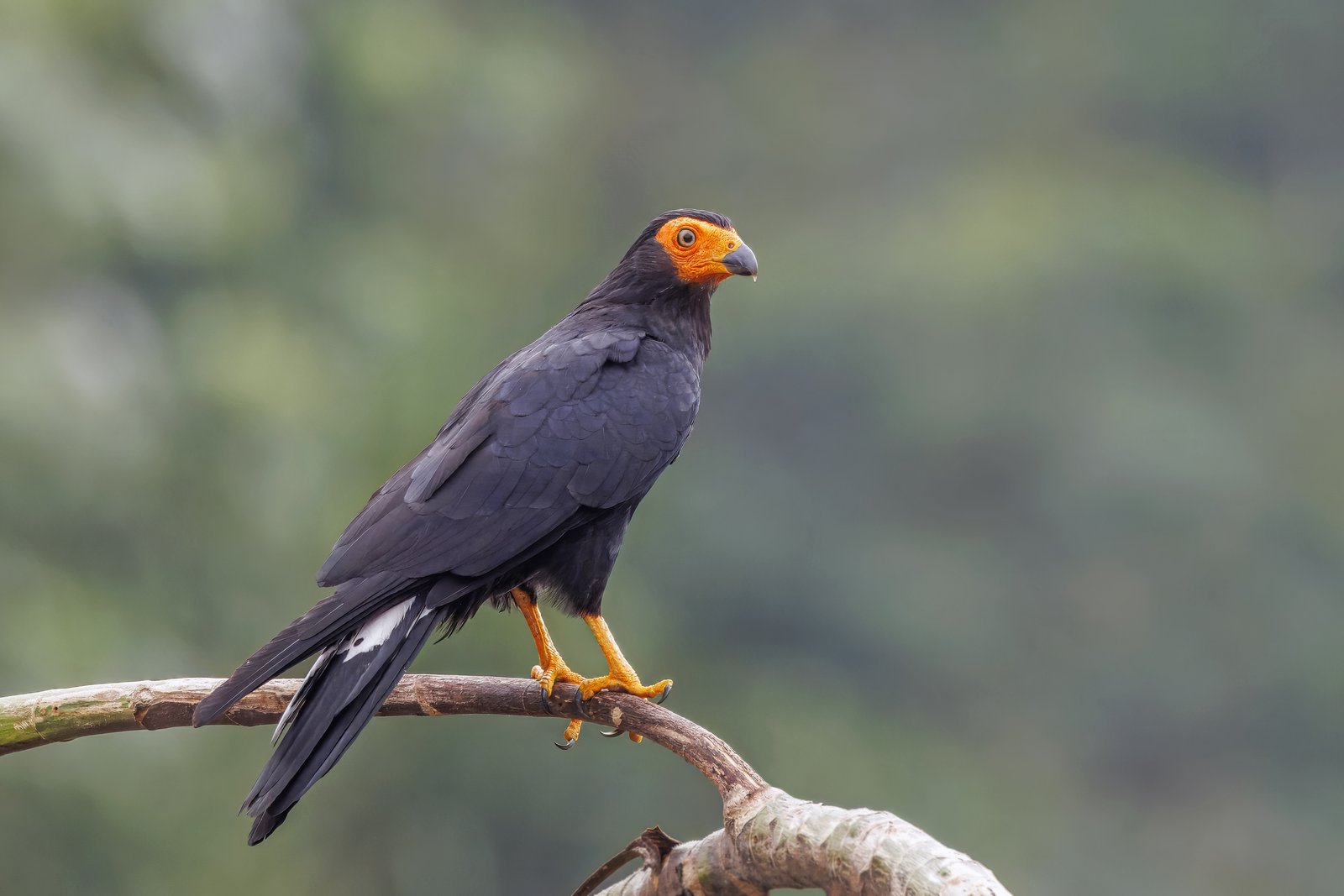
41–48 cm, with a long tail and rather long wings. The adult is entirely glossy black, with a broad white band at the base of the tail. The face and throat are bare and orange to orange-red. The bill is yellowish, and the legs are yellow to orange-yellow. The sexes are alike. Juveniles are duller blackish brown, with a yellowish face, narrow pale bars in the tail and pale feather edges.
Confusion species
Red-throated Caracara Ibycter americanus is larger, with a white belly, a red throat and red legs, and lives in groups high in the canopy. Great Black Hawk Buteogallus urubitinga lacks a bare orange face and has broader wings and a white tail with a black terminal band. Black Vulture Coragyps atratus has a bare grey head and a short tail.
Habitat
Banks of large and medium-sized rivers, sandbars, river islands, várzea and forest edges, also clearings and pastures by water; mainly below 600 m, locally higher along rivers in the foothills. It forages on the ground, on sandbars and in trees: carrion, fish, insects, small vertebrates, fruit and palm nuts. The nest is a stick nest high in a tree.
Where the bird is most at home, classified by the vegetation units of the Andes and the west coast.


Range and movements
In Colombia in the lowlands east of the Andes, in Amazonia, along the Orinoco and at the edge of the Llanos. In Ecuador in the eastern lowlands. In Peru in the Amazonian lowlands throughout the east of the country. In Bolivia in the lowlands of the north and centre. Absent west of the Andes and from the Galápagos. Outside the guide area in the Amazon basin and the Guianas.
- Resident
- dark = core range, pale = thinly spread
How and when to look
On a boat trip along Amazonian rivers it often sits on dead branches along the bank or walks on sandbars; the white tail base is the first feature in flight.
Conservation status
Least Concern. Common along the large rivers; the species tolerates a degree of clearing along the banks.
Scientific name
Daptrius ater | Vieillot, 1816
Vieillot described the species in 1816 and placed it straight away in the genus where it still stands. He introduced the genus Daptrius in that same work. The genus name comes from Greek daptēs, 'eater, devourer', from daptō, 'to devour'. The species name is Latin ater, 'black'. The specimen the first description was based on came from Brazil.