All species › Falcons › Falcons and caracaras › Carunculated Caracara
Carunculated Caracara | Daptrius carunculatus
Lelcaracara | Caracara curiquingue | Caracará-carunculado
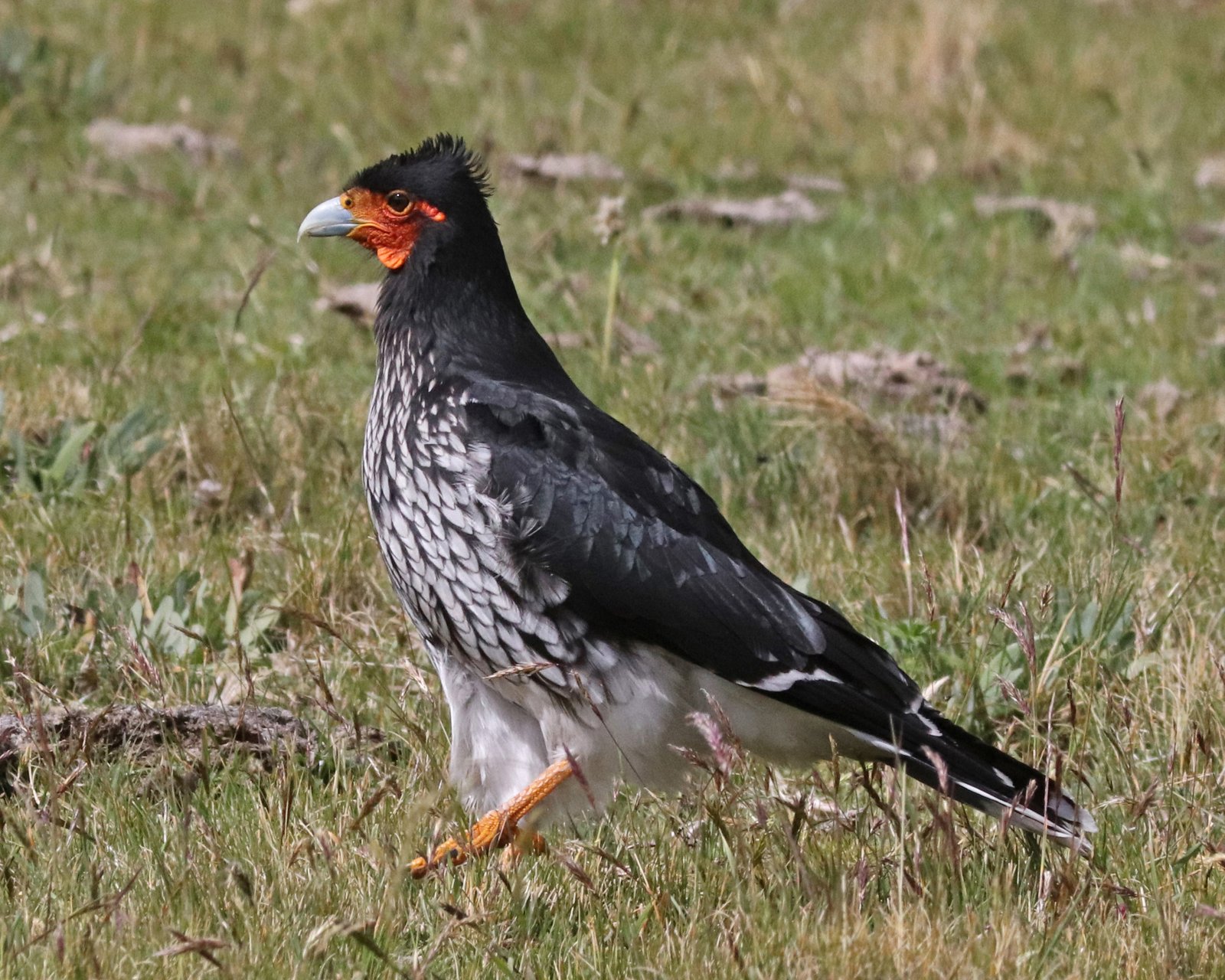
The Carunculated Caracara is a black-and-white caracara of the páramo of Ecuador and southern Colombia, with a bare, orange-red face and wattles on the throat. It spends much time walking on the ground and forages in small groups in grassland and on ploughed fields. It is the northern counterpart of Mountain Caracara, which lives further south in the Andes.
Voice
Usually silent. Sometimes a hoarse, grating call, especially when squabbling over food.
No recording with a suitable Creative Commons licence is available for this species yet.
Identification
51–56 cm, with long legs. The adult is glossy black above and on the breast, with white streaks on the breast and flanks. The belly, thighs and underwing coverts are white. The face and throat are bare and orange-red, with skin folds and wattles on the throat. The bill is pale grey to horn-coloured, the legs yellow to orange. In flight the white underwing and a pale patch at the base of the primaries stand out. Juveniles are dark brown with pale streaks and a duller, yellowish face.
Confusion species
Mountain Caracara Daptrius megalopterus, found from northern Peru southwards, has a plain black breast without white streaks; juveniles of the two species are very similar. Crested Caracara Caracara plancus is brown with a black crown, a white neck and a long tail, and lives mainly lower in open country.
Habitat
Páramo and humid grassland in the high Andes, also pastures and fields, where it likes to walk on freshly ploughed ground, and the edges of bogs. Mainly between about 3000 and 4000 m. It forages on foot, turning over dung and clods in search of insects and worms, and also eats small vertebrates and carrion. Often in pairs or small groups. The nest is on a rock ledge or in a steep bank.
Where the bird is most at home, classified by the vegetation units of the Andes and the west coast.


Range and movements
In Colombia only in the extreme south-west, in Nariño. In Ecuador in the highlands along the whole Andes. In Peru only in the extreme north. Absent from Bolivia. Does not occur outside the guide area.
How and when to look
In the páramo of the Ecuadorian highlands it can often be seen from the road, walking in grassland or on fields. Check for the black breast with white streaks to separate it from Mountain Caracara where both occur.
Conservation status
Least Concern. Fairly common in suitable open high country; locally the species benefits from pastures and fields.
Scientific name
Daptrius carunculatus | (des Murs, 1853)
Des Murs described the species in 1853 as Phalcoboenus carunculatus; because it was later moved to another genus, the author and year stand in brackets. The genus Daptrius was introduced in 1816 by Vieillot. The genus name comes from Greek daptēs, 'eater, devourer', from daptō, 'to devour'. The species name comes from Latin caruncula, 'fleshy outgrowth', after the wattles on the head. The specimen the first description was based on came from Colombia.