All species › Woodpeckers and allies › Toucans › Black-necked Aracari
Black-necked Aracari | Pteroglossus aracari
Zwartnekarassari | Arasarí cuellinegro | Araçari-de-bico-branco
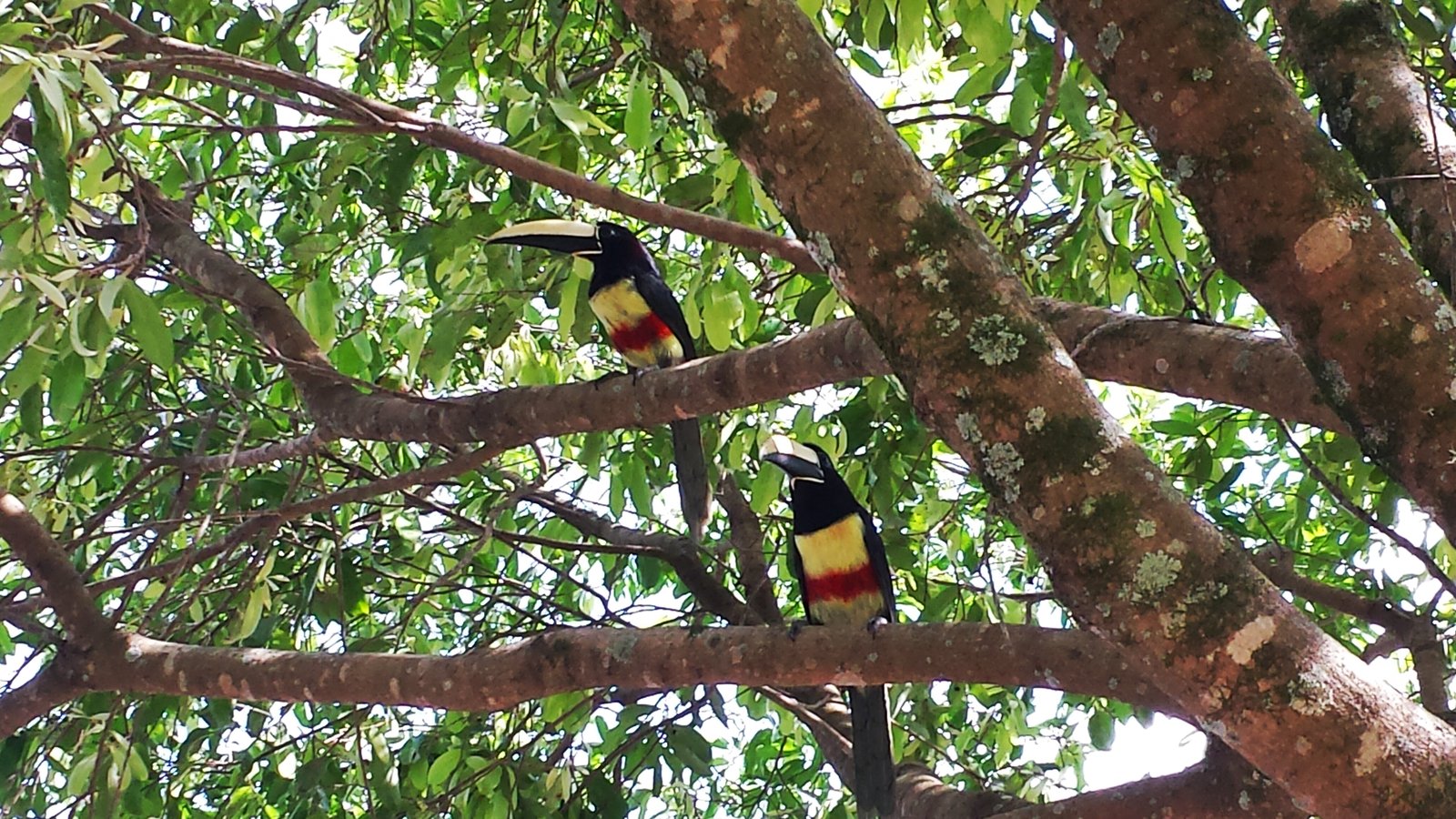
The Black-necked Aracari is an aracari of eastern Amazonia, the Guianas and the Atlantic Forest of Brazil. In the guide area it is only a very rare vagrant on the eastern edge, with hardly any confirmed records. It has a black head and neck and a single red band across the yellow belly.
Voice
A high, sharp, somewhat hoarse call, like pseek or kseek, often in series.
Recording: JAYRSON ARAUJO DE OLIVEIRA — CC BY-NC-SA 4.0 · xeno-canto
Identification
43–46 cm, with a long tail. The head, neck and throat are black, the ear area sometimes brownish. The back, wings and tail are dark green, the rump is red. The underparts are yellow, with a broad red band across the belly, often with black along it. The upper mandible is ivory-white with a black ridge, the lower mandible black. Bare, dark skin surrounds the eye. The sexes are nearly alike.
Confusion species
Many-banded Aracari Pteroglossus pluricinctus has two bands across the underparts, the upper one black across the breast, and a yellow-orange upper mandible. Chestnut-eared Aracari Pteroglossus castanotis has chestnut sides to the head and throat and a largely dark bill. Green Aracari Pteroglossus viridis is much smaller, without a band across the underparts.
Habitat
Humid lowland forest, forest edges, riverine forest, secondary forest and semi-open country with tall trees, mostly in the lowlands. It lives in pairs or small groups. It eats mainly fruit, also insects and eggs. It nests in tree cavities.
Where the bird is most at home, classified by the vegetation units of the Andes and the west coast.


Range and movements
In the guide area only as a very rare vagrant, at most on the eastern edge of Colombia; not known from Ecuador, Peru, Bolivia or the Galápagos. Outside the guide area in eastern Venezuela, the Guianas and northern and eastern Brazil, with a separate range in the Atlantic Forest.
How and when to look
An aracari with a black head, an ivory-white upper mandible and a single red belly band in eastern Colombia deserves careful documentation with photographs; confusion with Many-banded Aracari is the obvious pitfall.
Conservation status
Least Concern. The species is widespread within its own range, but is declining locally through deforestation, especially in the Atlantic Forest.
Scientific name
Pteroglossus aracari | (Linnaeus, 1758)
Linnaeus described the species in 1758 as Ramphastos Aracari; because it was later moved to another genus, the author and year stand in brackets. The genus Pteroglossus was introduced in 1811 by Illiger. The genus name comes from Greek pteron, 'feather', and glōssa, 'tongue', after the frayed, feather-like tongue of these birds. The species name aracari is the Tupi name araçari for these small toucans. The specimen the first description was based on came from Brazil.