All species › Woodpeckers and allies › Toucans › Spot-billed Toucanet
Spot-billed Toucanet | Selenidera maculirostris
Vleksnavelpepervreter | Tucanete piquimaculado | Araçari-poca
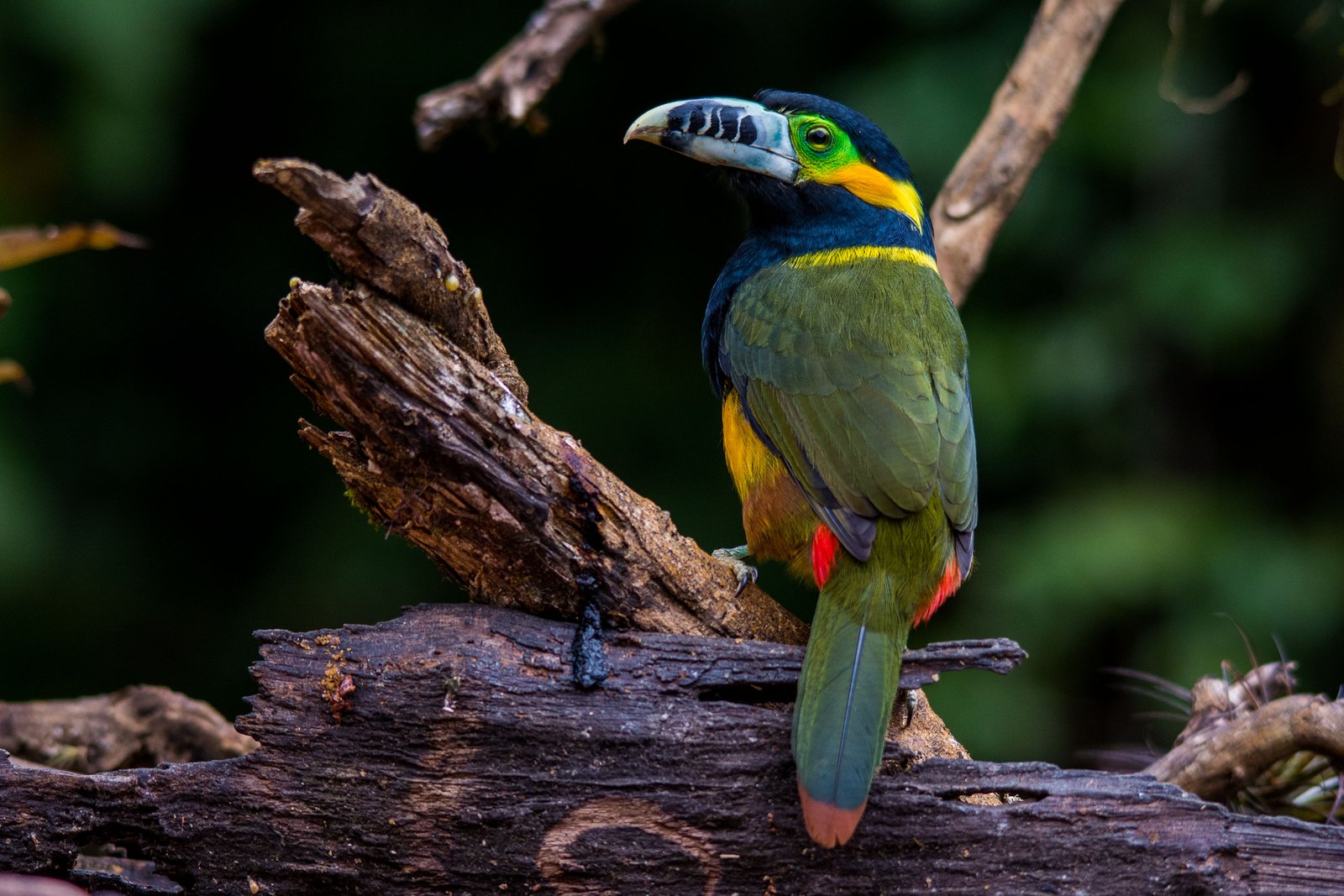
The Spot-billed Toucanet is a small toucan of the Atlantic Forest of south-eastern Brazil and neighbouring countries. It is listed in this guide as a vagrant, but its range lies far outside the guide area. The name refers to the pale bill with black spots and bars.
Voice
A series of low, croaking notes, similar to those of other Selenidera toucanets.
Recording: Mateus Gonçalves Santos — CC BY-NC-SA 4.0 · xeno-canto
Identification
33–35 cm. The male has a black head, throat and breast, a yellow tuft behind the eye and bare, pale skin around the eye. The upperparts are green, the flanks yellow and the undertail coverts red. In the female the black parts are chestnut. The bill is pale green to ivory, with black spots and bars; the amount of black varies between birds.
Confusion species
Gould's Toucanet Selenidera gouldii, in eastern Bolivia, has a black and ivory bill with an orange-yellow tip and is sometimes treated as the same species. Golden-collared Toucanet Selenidera reinwardtii has a red or a black and green bill, without spots.
Habitat
Humid lowland and hill forest of the Atlantic Forest, mainly in the mid-storey and canopy. It eats mainly fruit, also insects. It nests in a tree cavity.
Where the bird is most at home, classified by the vegetation units of the Andes and the west coast.


Range and movements
Listed for the guide area only as a vagrant; no confirmed records are known from Colombia, Ecuador, Peru, Bolivia or the Galápagos. Outside the guide area in the Atlantic Forest of south-eastern Brazil, eastern Paraguay and north-eastern Argentina.
How and when to look
There is no regular site in the guide area. A toucanet with a spotted bill in eastern Bolivia should first be checked against Gould's Toucanet.
Conservation status
Least Concern, but the Atlantic Forest has largely been cleared and fragmented.
Scientific name
Selenidera maculirostris | (Lichtenstein, 1823)
Lichtenstein described the species in 1823 as Pteroglossus maculirostris; because it was later moved to another genus, the author and year stand in brackets. The genus Selenidera was introduced in 1837 by Gould. The genus name comes from Greek selēnē, 'moon', and deirē, 'neck', after the yellow crescent on the male's nape. The species name maculirostris comes from Latin macula, 'spot', and rostrum, 'bill', after the spotted bill. The specimen the first description was based on came from Brazil.