All species › Passerines › Tyrant flycatchers and allies › Black Phoebe
Black Phoebe | Sayornis nigricans
Zwarte phoebe | Mosquero negro | Papa-moscas-preto
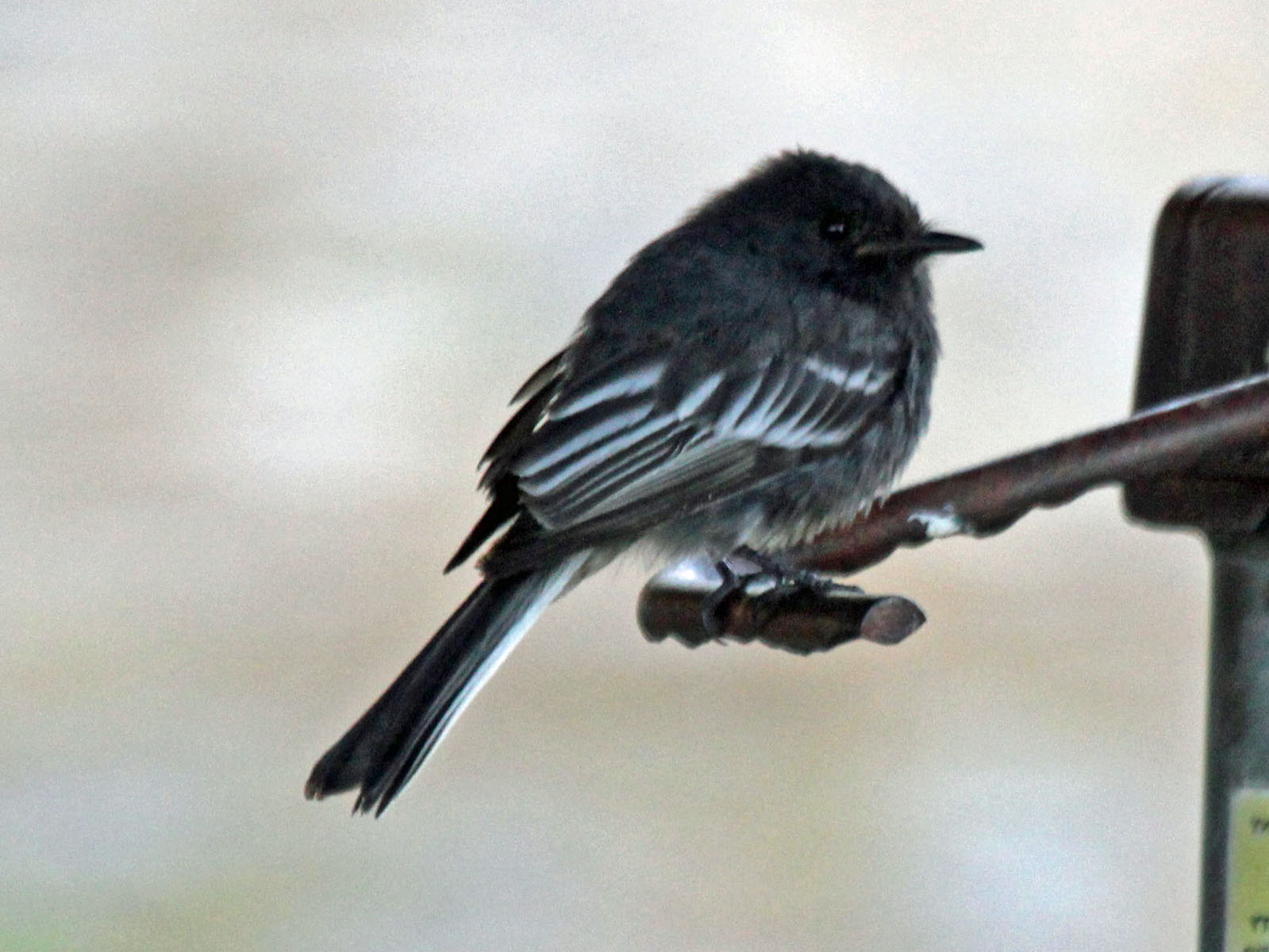
The Black Phoebe is a dark tyrant with a white belly that in the Andes is almost always found by running water. It perches on rocks, branches, bridges and walls along streams and rivers and constantly flicks its tail. It is the only phoebe in the guide area.
Voice
A sharp, high tseep. The song consists of two alternating thin phrases, tee-wee, tee-weee, often in the early morning.
Recording: Ed Pandolfino — CC BY-NC-SA 4.0 · xeno-canto
Identification
17–18 cm, with a fairly long tail and a straight black bill. The head, breast, upperparts and tail are sooty black; the belly and undertail coverts are bright white, sharply demarcated from the black breast. The wing coverts and secondaries have white edges, forming a pale wing panel or wing bars; the outer tail feathers have a white edge. The sexes are alike. Young birds are browner, with rusty wing bars.
Confusion species
Torrent Tyrannulet Serpophaga cinerea is smaller, pale grey with a black head and white underparts, and lives along the same streams. White-capped Dipper Cinclus leucocephalus is chunky, with a white crown and a short tail, and perches on stones in the middle of the current. The male White-winged Black Tyrant Knipolegus aterrimus is entirely black, with a white wing band visible mainly in flight, and lacks the white belly.
Habitat
Fast-flowing streams and rivers, waterfalls, banks with rocks and bridges, irrigation channels, and villages and towns near water in the Andes, mostly between 500 and 2800 m, locally lower or higher. It catches insects in short flights over the water and returns to the same perch. The nest is a cup of mud and plant material attached to a rock face, a bridge or a building, usually above water.
Where the bird is most at home, classified by the vegetation units of the Andes and the west coast.


Range and movements
Colombia: in all three Andean ranges and in the Sierra Nevada de Santa Marta. Ecuador: on both slopes of the Andes and in the inter-Andean valleys. Peru: along the Andes, mainly on the eastern slope and in the inter-Andean valleys. Bolivia: in the Andes, south to the south of the country. Absent from the Galápagos. Outside the guide area from the south-western United States through Mexico and Central America to Venezuela, and in north-western Argentina.
- Resident
- dark = core range, pale = thinly spread
How and when to look
Search mountain streams, bridges and waterfalls in the Andes for a black-and-white bird perched on a rock or branch above the water, flicking its tail.
Conservation status
Least Concern. Widespread and common along running water; adapts well to bridges, buildings and channels.
Scientific name
Sayornis nigricans | (Swainson, 1827)
Swainson described the species in 1827 as Tyrannula nigricans; because it was later moved to another genus, the author and year stand in brackets. The genus Sayornis was introduced in 1854 by Bonaparte. The genus name combines saya, Bonaparte's species name for Say's Phoebe honouring the American naturalist Thomas Say (1787–1834), with Greek ornis, 'bird'. The species name comes from Latin nigricans, 'blackish'. The specimen the first description was based on came from Valley of Mexico, Mexico.