All species › Swifts › Hummingbirds › Black-thighed Puffleg
Black-thighed Puffleg | Eriocnemis derbyi
Zwartflankpluimbroekje | Calzadito patinegro | Calçudo-de-coxa-preta
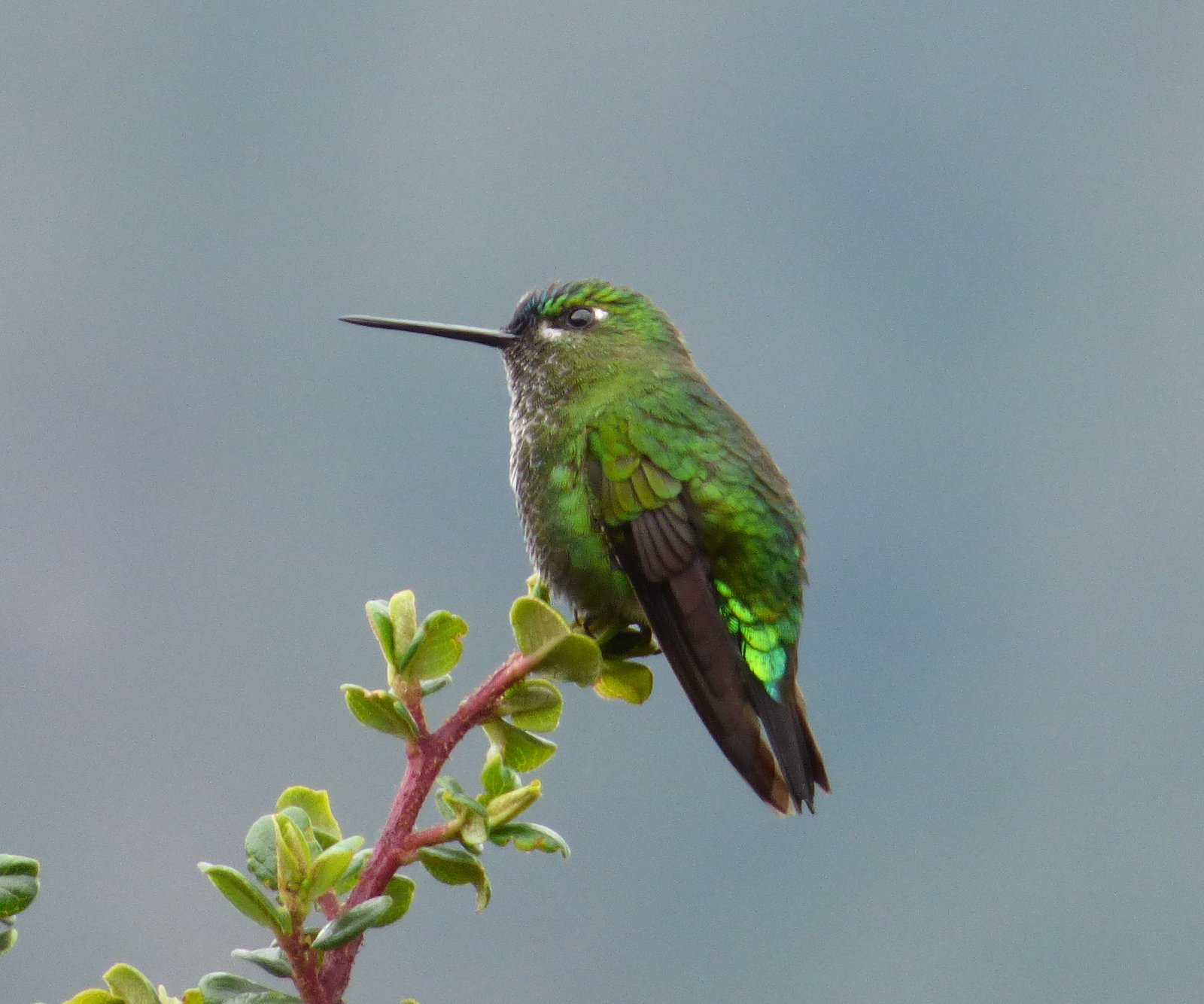
The Black-thighed Puffleg is a dark green hummingbird of the upper edge of cloud forest, just below the páramo, in Colombia and northern Ecuador. Like all pufflegs it has thick, downy feather tufts around the legs; in this species they are black, whereas in most relatives they are white.
Voice
A high, dry tseet and a rapid twitter in chases.
Recording: Paul Coopmans — CC BY-NC-SA 4.0 · xeno-canto
Identification
9–10 cm, with a short, straight black bill. The male is dark glossy green, with a glittering green rump and undertail coverts and a black, forked tail. The large, black, downy tufts around the legs are striking. The female is green above and paler below, spotted green, and also has leg puffs.
Confusion species
Glowing Puffleg Eriocnemis vestita and Sapphire-vented Puffleg Eriocnemis luciani live in the same kind of forest but have white leg puffs; Sapphire-vented is also larger, with a longer tail and blue undertail coverts. Metaltails such as Tyrian Metaltail Metallura tyrianthina are smaller, with a rufous or coppery tail and no conspicuous leg puffs.
Habitat
High cloud forest and elfin forest at the treeline, forest edges, scrub and thickets in the transition to páramo, and Polylepis groves, roughly between 2500 and 3600 m. It feeds at flowering shrubs at the forest edge, often low down, and defends a flowering shrub against other hummingbirds.
Where the bird is most at home, classified by the vegetation units of the Andes and the west coast.


Range and movements
In Colombia in the Central Cordillera and in the Andes of the south of the country. In Ecuador only in the Andes of the north. Absent from Peru, Bolivia and the Galápagos. Does not occur outside the guide area.
- Resident
- dark = core range, pale = thinly spread
How and when to look
At flowering shrubs along the edge of elfin forest just below the páramo, where birds often defend a particular shrub. In good light the black leg puffs can be seen at a distance.
Conservation status
Near Threatened. Its treeline habitat is small and fragmented and is affected by logging, fires and the expansion of pasture and fields.
Scientific name
Eriocnemis derbyi | (Delattre & Bourcier, 1846)
Delattre & Bourcier described the species in 1846 as Trochilus Derbyi; because it was later moved to another genus, the author and year stand in brackets. The genus Eriocnemis was introduced in 1849 by Reichenbach. The genus name combines Greek erion, 'wool', with knēmis, 'legging', after the downy feather tufts on the legs. The species name honours Edward Smith-Stanley, 13th Earl of Derby (1775–1851), a British naturalist and patron with a large animal collection at Knowsley. The specimen the first description was based on came from Volcán Puracé, Cauca, Colombia.