All species › Swifts › Hummingbirds › Black-throated Brilliant
Black-throated Brilliant | Heliodoxa schreibersii
Zwartkeelbriljantkolibrie | Brillante gorginegro | Brilhante-de-garganta-preta
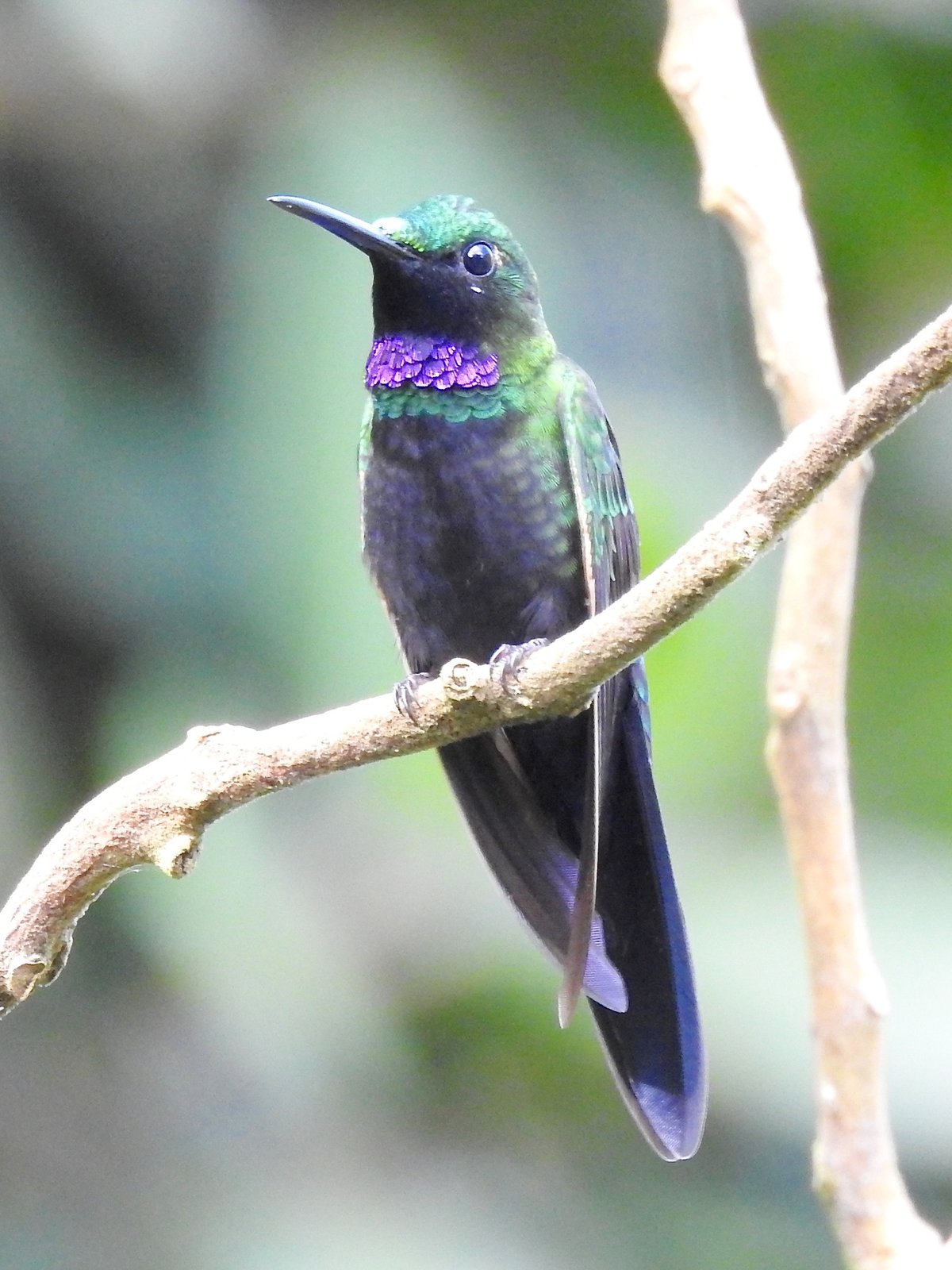
The Black-throated Brilliant is a large, dark brilliant of foothill forest and adjacent lowlands at the eastern base of the Andes. The male is almost black, with a glittering violet patch at the base of the throat and a long, deeply forked tail. The birds live in the lower strata of the forest, often near streams.
Voice
A sharp, repeated chip and a dry, rattling twitter in chases.
Recording: Juan Freile — CC BY-NC-SA 4.0 · xeno-canto
Identification
11–13 cm, with a straight black bill of medium length and a small white spot behind the eye. The male is very dark green, with a glittering green forehead, a black throat with a glittering violet patch along its lower edge, and a dark breast and belly. The tail is long, blue-black and deeply forked. The female is green above and dark below, with a distinct white or buff malar stripe and a less deeply forked tail. Males from northern and central Peru have a blacker breast.
Confusion species
Violet-fronted Brilliant Heliodoxa leadbeateri has a violet forehead and a glittering green throat and breast in the male, and usually lives higher. Gould's Jewelfront Heliodoxa aurescens has a rufous breast band and a rufous tail. Pink-throated Brilliant Heliodoxa gularis is smaller, with a pink throat patch and a short, slightly forked tail.
Habitat
The interior of humid foothill forest and adjacent terra firme lowland forest, mainly in hilly terrain and along streams, roughly between 200 and 1200 m. It feeds in the lower and middle strata at flowers, often along a regular route, and catches small insects. Little is known about its breeding biology.
Where the bird is most at home, classified by the vegetation units of the Andes and the west coast.


Range and movements
In Colombia at the eastern base of the Andes in the south. In Ecuador in the foothills and adjacent lowlands east of the Andes. In Peru at the eastern base of the Andes in the north and centre. Absent from Bolivia and the Galápagos. Outside the guide area in the far west of Brazil.
- Resident
- dark = core range, pale = thinly spread
How and when to look
In foothill forest at the eastern base of the Andes in Ecuador and northern Peru, along forest trails and streams. Birds often sit low in the forest on a regular lookout perch among their flowers.
Conservation status
Not Evaluated in the current circumscription of the species. The species is local and lives mainly in the forest interior; deforestation of the foothills affects its habitat.
Scientific name
Heliodoxa schreibersii | (Bourcier, 1847)
Bourcier described the species in 1847 as Trochilus Schreibersii; because it was later moved to another genus, the author and year stand in brackets. The genus Heliodoxa was introduced in 1850 by Gould. The genus name combines Greek hēlios, 'sun', with doxa, 'glory' or 'splendour'. The species name honours Carl Franz Anton von Schreibers (1775–1852), an Austrian naturalist and director of the imperial natural history collections in Vienna. The specimen the first description was based on came from Upper Rio Negro, Brazil.