All species › Swifts › Hummingbirds › Blue-capped Puffleg
Blue-capped Puffleg | Eriocnemis glaucopoides
Blauwkruinpluimbroekje | Calzadito frentiazul | Calçudo-de-coroa-azul
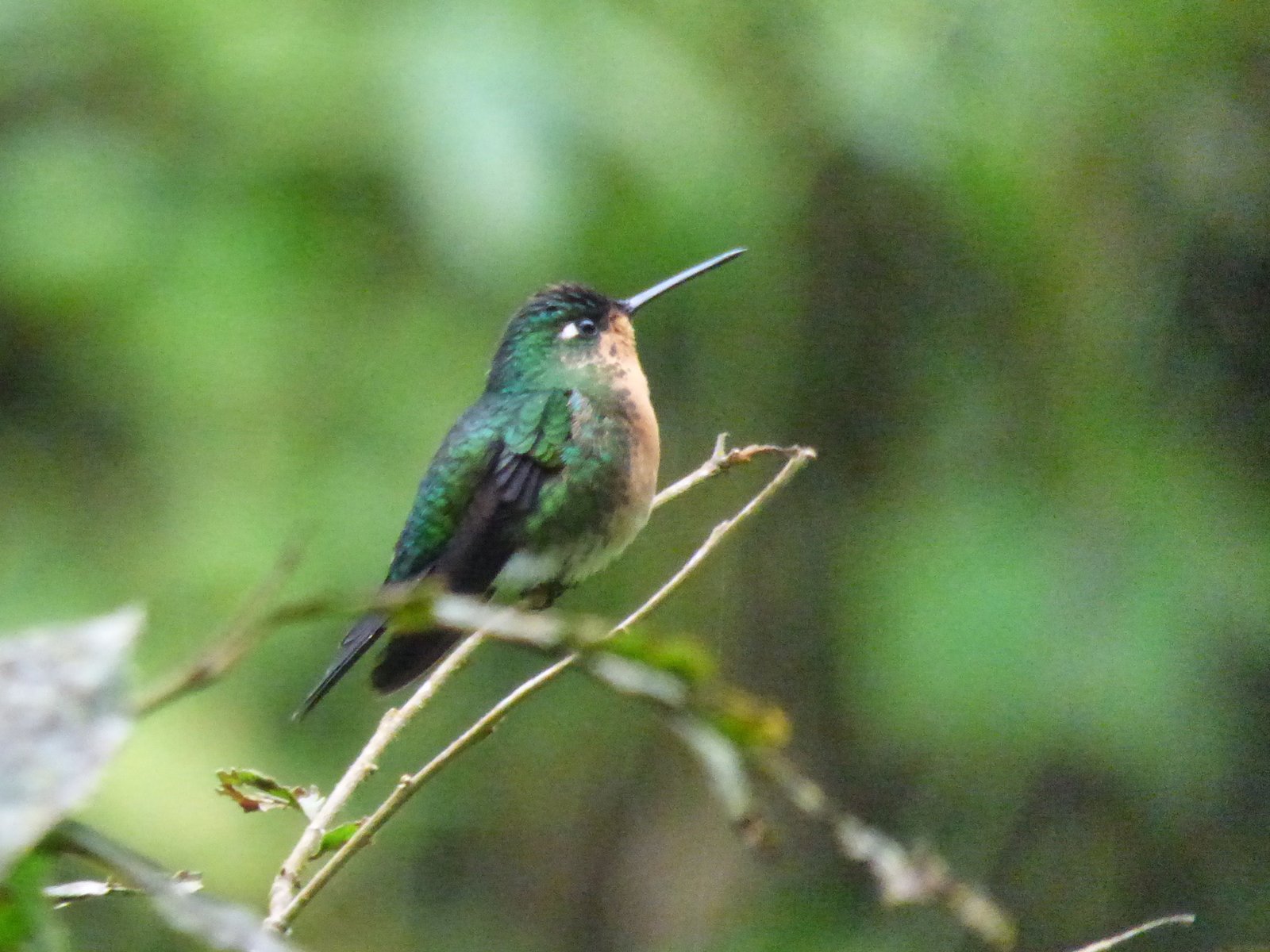
The Blue-capped Puffleg is the southernmost puffleg, a green hummingbird of the Yungas montane forest in Bolivia and north-western Argentina. The male has a shining blue crown, the female cinnamon underparts. Both sexes have white downy tufts around the legs.
Voice
A high, dry tsit and a rapid, thin twitter.
Recording: GABRIEL LEITE — CC BY-NC-SA 4.0 · xeno-canto
Identification
10–11 cm, with a short, straight black bill and a slightly forked, blue-black tail. The male is green above, with a shining blue forehead and crown, glittering green underparts, blue undertail coverts and white leg puffs. The female is green above and has a cinnamon to rufous throat and underparts, without a blue crown; the leg puffs are white. Juveniles resemble the female.
Confusion species
No other Eriocnemis puffleg occurs in the same area within the guide area. Rufous-booted Racket-tail Ocreatus addae has cinnamon leg puffs and, in the male, long tail feathers with rackets. Tyrian Metaltail Metallura tyrianthina is smaller, with a rufous or coppery tail and no conspicuous leg puffs.
Habitat
Humid montane forest and cloud forest of the Yungas, forest edges, alder woodland and scrub along streams, roughly between 1500 and 3000 m. It feeds at flowering shrubs and trees at forest edges and clearings, often low to mid-height. The nest is a cup of moss and plant down in a shrub.
Where the bird is most at home, classified by the vegetation units of the Andes and the west coast.


Range and movements
In Bolivia in the eastern Andes from La Paz and Cochabamba south to Chuquisaca and Tarija. Absent from Colombia, Ecuador, Peru and the Galápagos. Outside the guide area in north-western Argentina. Some birds move to lower valleys outside the breeding season.
- Resident
- dark = core range, pale = thinly spread
How and when to look
At flowering shrubs along forest edges and roads in the Yungas, for example in the montane forest of Cochabamba and Tarija. Males often sit on bare twigs at the forest edge.
Conservation status
Least Concern. The species also uses forest edges and secondary forest.
Scientific name
Eriocnemis glaucopoides | (d'Orbigny, ACVMD & de Lafresnaye, 1838)
D'Orbigny, ACVMD & de Lafresnaye described the species in 1838 as Ornismya glaucopoides; because it was later moved to another genus, the author and year stand in brackets. The genus Eriocnemis was introduced in 1849 by Reichenbach. The genus name combines Greek erion, 'wool', with knēmis, 'legging', after the downy feather tufts on the legs. The species name combines the specific name of Trochilus glaucopis (now Thalurania glaucopis) with Greek -oidēs, 'resembling'. The describers d'Orbigny and de Lafresnaye (1838) called the species closely related to it. The specimen the first description was based on came from Vallegrande, Santa Cruz, Bolivia.