All species › Tinamous › Tinamous › Brazilian Tinamou
Brazilian Tinamou | Crypturellus strigulosus
Braziliaanse tinamoe | Tinamú brasileño | Inhambu-relógio
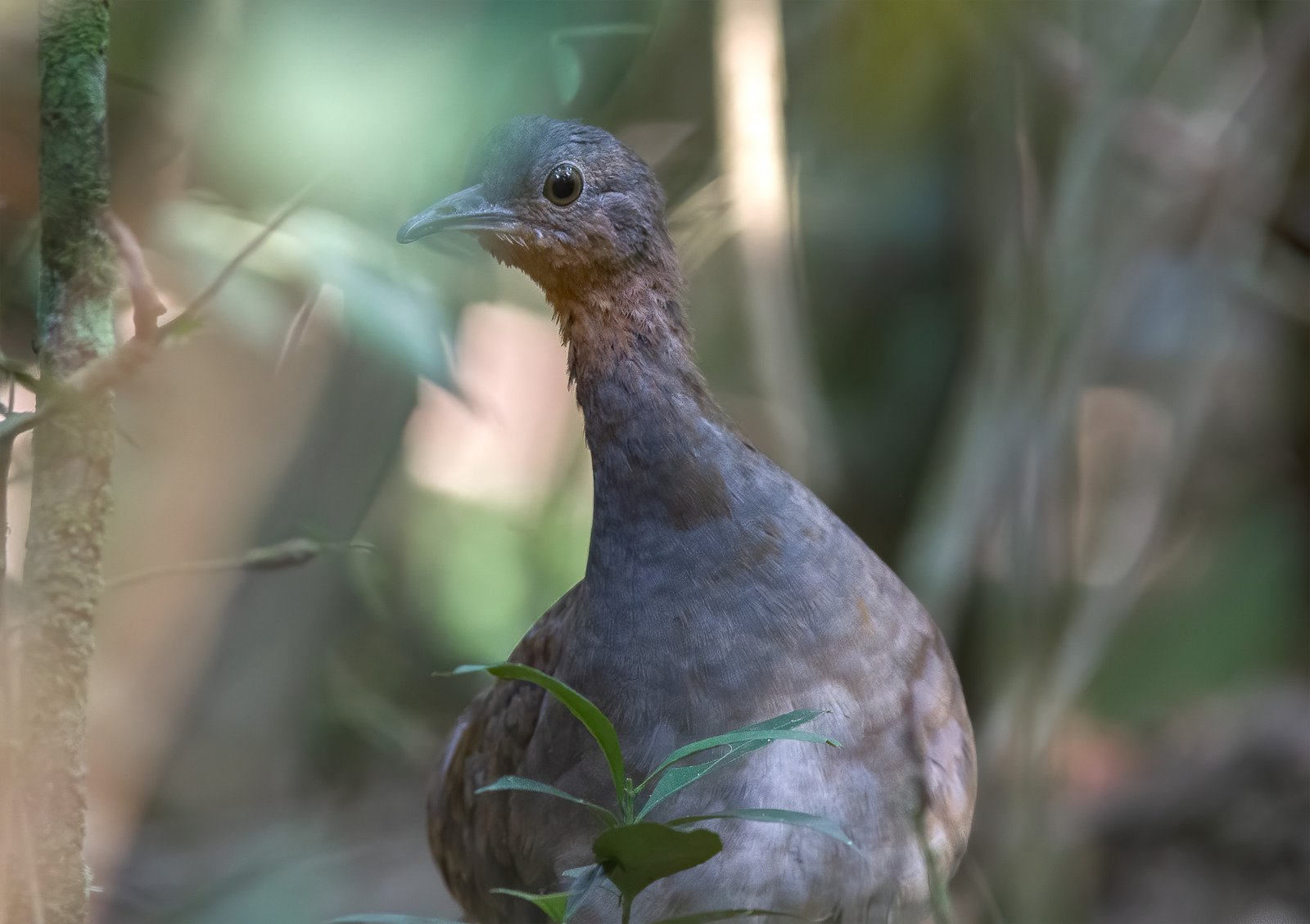
The Brazilian Tinamou is a medium-sized tinamou of the Amazonian rainforest south of the Amazon, occurring in the guide area only in south-eastern Peru and northern Bolivia. It lives hidden on the forest floor and is detected mainly by a long, plaintive whistle.
Voice
A long, pure whistle that slowly rises in pitch and falls slightly at the end, repeated at intervals, mainly in the early morning and at dusk.
Recording: Jacob Wijpkema — CC BY-NC-SA 4.0 · xeno-canto
Identification
26–28 cm, with a small head, a thin neck and almost no tail. The male is warm brown and almost unmarked above, with a rufous foreneck and sides of the throat, a greyish breast and a paler, buff belly. The female has fine black barring on the wings and lower back.
Confusion species
Undulated Tinamou Crypturellus undulatus is larger and greyer, with fine wavy lines all over, and lives mainly in flooded forest and forest edge. Little Tinamou Crypturellus soui is smaller, without the rufous neck. Black-capped Tinamou Crypturellus atrocapillus has a black cap and red legs. Variegated Tinamou Crypturellus variegatus has a black cap and a strongly barred back.
Habitat
The floor of humid terra firme forest in the lowlands, also older secondary forest, up to about 500 m. It walks over the forest floor searching for fallen fruit, seeds and invertebrates. The nest is on the ground; the male incubates the eggs.
Where the bird is most at home, classified by the vegetation units of the Andes and the west coast.


Range and movements
In Peru in the south-eastern Amazonian lowlands, mainly in Madre de Dios. In Bolivia in the northern lowlands. Absent from Colombia, Ecuador and the Galápagos. Outside the guide area in Brazilian Amazonia south of the Amazon.
- Resident
- dark = core range, pale = thinly spread
How and when to look
Listen in the early morning in terra firme forest in Madre de Dios for the long whistles. It is seen mainly on quiet forest trails, where it walks slowly over the forest floor.
Conservation status
Least Concern (LC). Locally affected by deforestation and hunting, but the range is large.
Scientific name
Crypturellus strigulosus | (Temminck, 1815)
Temminck described the species in 1815 as Tinamus strigulosus; because it was later moved to another genus, the author and year stand in brackets. The genus Crypturellus was introduced in 1914 by Brabourne, WWK-H & Chubb. The genus name comes from Greek kruptos, 'hidden', and oura, 'tail', with the Latin diminutive -ellus: 'little hidden tail'. The species name comes from Latin strigula, 'small streak', with the suffix -osus, 'full of': 'finely streaked'. The specimen the first description was based on came from Pará, Brazil.