All species › Tinamous › Tinamous › Pale-browed Tinamou
Pale-browed Tinamou | Crypturellus transfasciatus
Wenkbrauwtinamoe | Tinamú cejiblanco | Inhambu-de-sobrancelha-clara
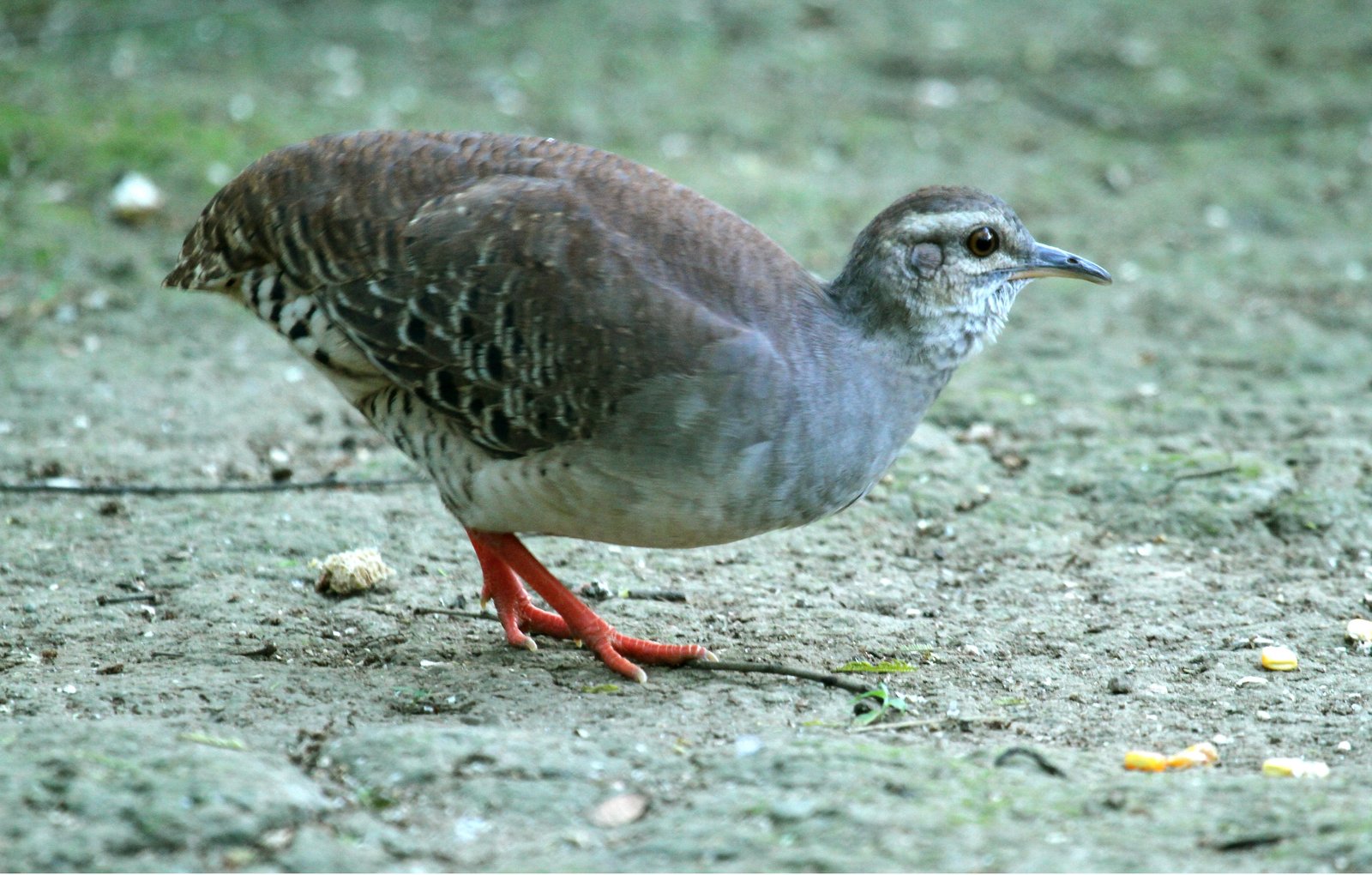
The Pale-browed Tinamou is a medium-sized tinamou of the dry Tumbesian region of south-western Ecuador and north-western Peru. The long, pale eyebrow gives it its name. It is tied to dry forest and scrub, a habitat rich in endemic species that is heavily fragmented.
Voice
A low, full, somewhat plaintive whistle, repeated at intervals, mainly in the early morning and at dusk.
Recording: Peter de Rouw — CC BY-NC-SA 4.0 · xeno-canto
Identification
25–28 cm, with a small head, a thin neck and almost no tail. The upperparts are grey-brown; the female has distinct black barring on the back and wings, which is weaker in the male. A long, whitish supercilium runs from the bill to the nape, above a darker eyestripe. The throat is white, the breast grey, the belly paler and the flanks barred.
Confusion species
Little Tinamou Crypturellus soui is smaller, lacks the pale supercilium and the barring, and lives in more humid forest. Great Tinamou Tinamus major is much larger and olive-brown and lives in humid lowland forest. Other Crypturellus tinamous barely occur in the dry forest of the south-west.
Habitat
Dry deciduous forest, semi-humid forest and dense thorn scrub in the Tumbesian region, from sea level to about 1600 m, also in older secondary forest with dense undergrowth. It walks on the ground searching for seeds, fruit and invertebrates. The nest is on the ground; as in other tinamous the male incubates the eggs.
Where the bird is most at home, classified by the vegetation units of the Andes and the west coast.


Range and movements
In Ecuador in the western lowlands and on the lower slopes, from Manabí and Guayas south to El Oro and Loja. In Peru in the north-west, in Tumbes, Piura and Lambayeque. Absent from Colombia, Bolivia and the Galápagos. Endemic to the guide area.
- Resident
- dark = core range, pale = thinly spread
How and when to look
In the rainy season, walk slowly along trails in dry forest in south-western Ecuador or Tumbes in the early morning and listen for the whistles. Birds often walk away over the forest floor before flushing.
Conservation status
Near Threatened (NT). Numbers are declining through the conversion of dry forest to farmland, grazing by goats and cattle, and hunting. The species occurs in a few protected areas, such as Cerros de Amotape in Peru.
Scientific name
Crypturellus transfasciatus | (Sclater & Salvin, 1878)
Sclater & Salvin described the species in 1878 as Crypturus transfasciatus; because it was later moved to another genus, the author and year stand in brackets. The genus Crypturellus was introduced in 1914 by Brabourne, WWK-H & Chubb. The genus name comes from Greek kruptos, 'hidden', and oura, 'tail', with the Latin diminutive -ellus: 'little hidden tail'. The species name comes from Latin trans, 'across', and fasciatus, 'banded', for the cross-bars. The specimen the first description was based on came from Santa Rosa, Manabí, Ecuador.