All species › Tinamous › Tinamous › Undulated Tinamou
Undulated Tinamou | Crypturellus undulatus
Marmertinamoe | Tinamú ondulado | Jaó
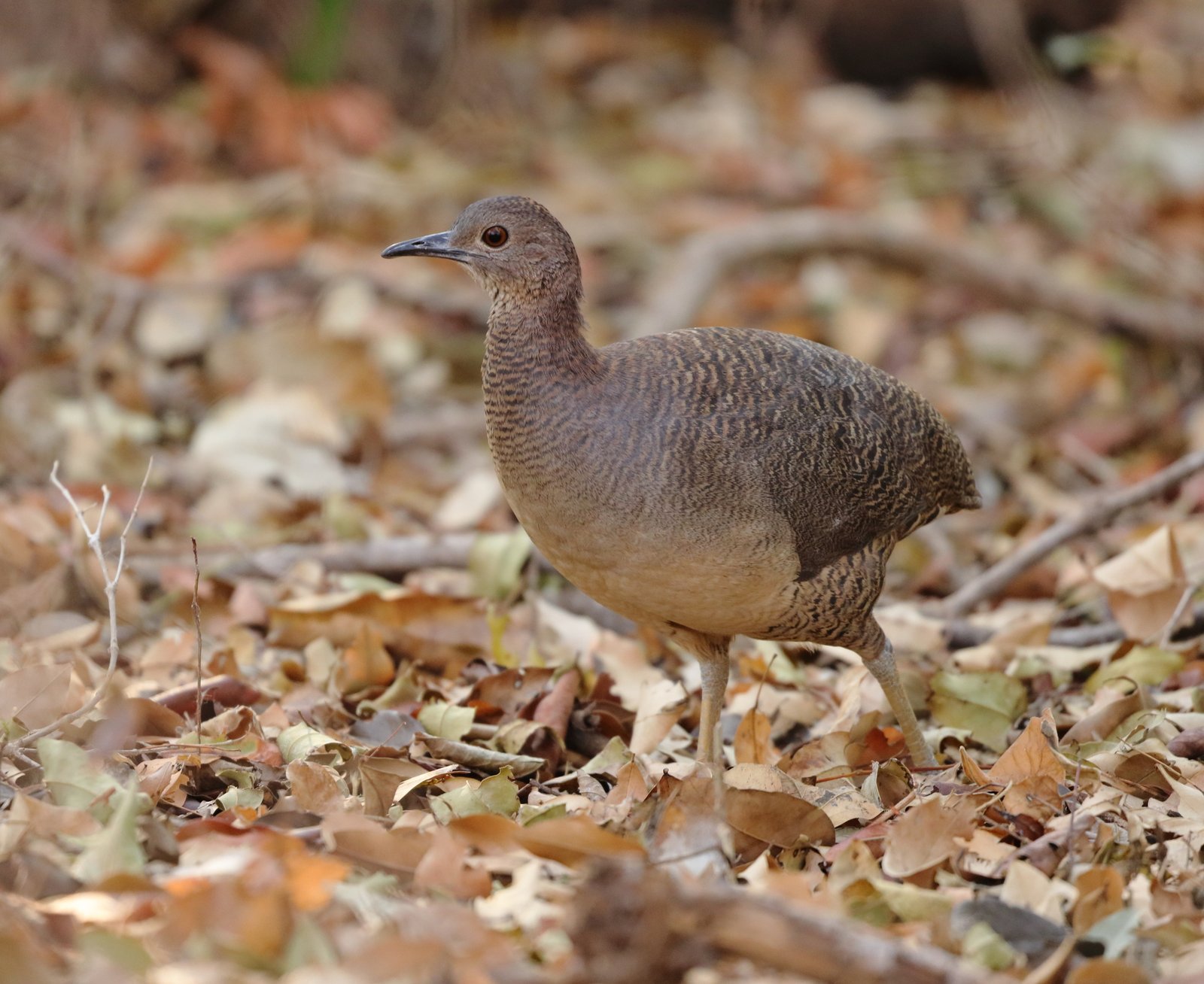
The Undulated Tinamou is a medium-sized, finely vermiculated Crypturellus of riverine forest and forest edge in the Amazonian lowlands. Its song of three or four whistles, the last rising like a question, is one of the most frequently heard sounds along the large rivers. It lives more often in young and flooded forest than in the interior of tall forest.
Voice
A series of three or four hollow whistles: a long first note, then shorter notes, the last rising like a question. Heard by day and at dusk, often repeated for long periods.
Recording: JAYRSON ARAUJO DE OLIVEIRA — CC BY-NC-SA 4.0 · xeno-canto
Identification
28–30 cm, with a small head and a rounded, almost tailless body. The upperparts are grey-brown to olive-brown, densely covered with fine, wavy black lines. The head is grey and the throat whitish. The breast is grey-brown, the belly paler buff to whitish, and the flanks and undertail coverts are barred dark. The legs are greyish green. The female is slightly more heavily vermiculated than the male.
Confusion species
Cinereous Tinamou Crypturellus cinereus is darker and plainer, without vermiculation and without a pale throat, and sings a single level whistle. Variegated Tinamou Crypturellus variegatus has a black crown, a rufous neck and a coarsely black-and-buff barred back. Bartlett's Tinamou Crypturellus bartletti is smaller, with a more rufous neck and more clearly barred upperparts. Small-billed Tinamou Crypturellus parvirostris is much smaller, with a red bill and red legs, and lives in open, grassy terrain. Brazilian Tinamou Crypturellus strigulosus has a rufous throat and lives in terra firme forest.
Habitat
Seasonally flooded forest (várzea), forest on river islands, riverine forest, secondary forest and forest edge, also swamp forest; in Bolivia also in drier forest and savanna woodland. Mostly below 500 m. It searches the ground for fruit, seeds and insects. The nest is on the ground in dense vegetation.
Where the bird is most at home, classified by the vegetation units of the Andes and the west coast.


Range and movements
In Colombia in the south-eastern lowlands. In Ecuador in the Amazonian lowlands, mainly along the large rivers. In Peru in the Amazonian lowlands throughout the east of the country. In Bolivia in the northern and eastern lowlands. Absent west of the Andes and from the Galápagos. Outside the guide area in Brazil, Guyana, Paraguay and northern Argentina.
- Resident
- dark = core range, pale = thinly spread
How and when to look
Listen along rivers and oxbow lakes for the three- or four-note song; birds also sing on hot afternoons. On river islands and in young riverine forest they sometimes walk across open patches or trails.
Conservation status
Least Concern. It is hunted, but tolerates secondary and disturbed forest and is common over large parts of the Amazonian lowlands.
Scientific name
Crypturellus undulatus | (Temminck, 1815)
Temminck described the species in 1815 as Tinamus undulatus; because it was later moved to another genus, the author and year stand in brackets. The genus Crypturellus was introduced in 1914 by Brabourne, WWK-H & Chubb. The genus name comes from Greek kruptos, 'hidden', and oura, 'tail', with the Latin diminutive -ellus: 'little hidden tail'. The species name comes from Latin undulatus, 'wavy', for the wavy barring. The specimen the first description was based on came from Paraguay.