All species › Swifts › Hummingbirds › Buff-bellied Hermit
Buff-bellied Hermit | Phaethornis subochraceus
Bruinbuikheremietkolibrie | Ermitaño ocráceo | Rabo-branco-de-barriga-fulva
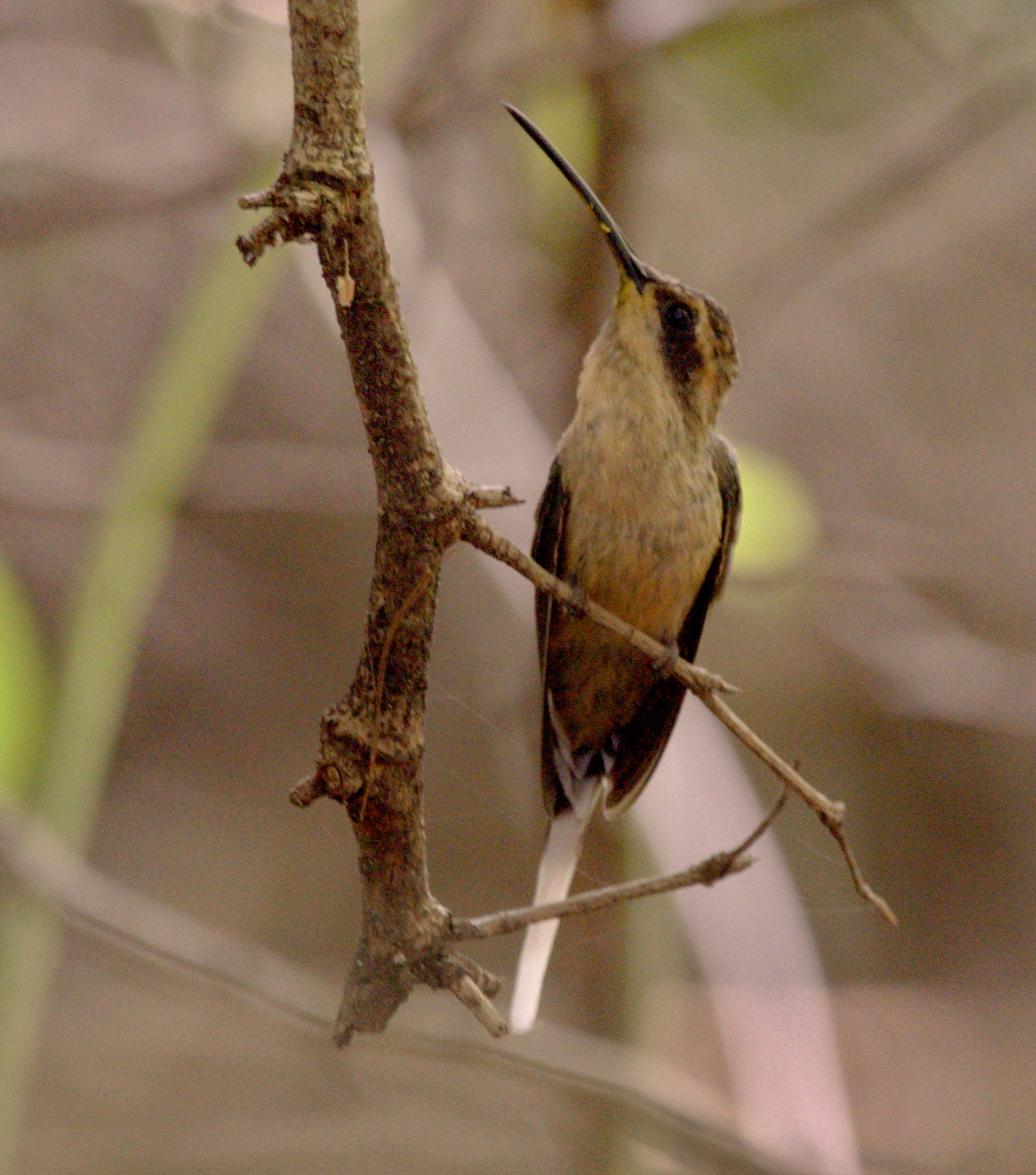
The Buff-bellied Hermit is a medium-sized hermit of the dry and semi-humid forests of eastern Bolivia and adjacent Brazil. It has long, white-tipped central tail feathers and rather plain buff underparts. Like other hermits it follows a fixed route along flowers in the understorey.
Voice
The song is a high, repeated, squeaky phrase. The call is a sharp tseep, also in flight.
Recording: Marco Cruz — CC BY-NC-SA 4.0 · xeno-canto
Identification
13 cm, with a long, decurved bill and a long, graduated tail whose central feathers project well beyond the rest, with white tips. The upperparts are bronzy green to brownish green. The head has a dark mask with a pale supercilium and malar stripe. The underparts are rather plain ochre-buff to pale brown. The outer tail feathers are dark with pale tips. The sexes are nearly alike.
Confusion species
Planalto Hermit Phaethornis pretrei is larger, with a bright rufous rump and warmer cinnamon underparts, and lives in more open, drier terrain. Cinnamon-throated Hermit Phaethornis nattereri is much smaller, with a shorter tail and a cinnamon throat. White-browed Hermit Phaethornis stuarti is much smaller, without long central tail feathers.
Habitat
Understorey of dry and semi-humid forest, gallery forest along rivers, forest edges and scrub in the lowlands, mostly below about 600 m. It visits understorey flowers along a fixed route and catches small arthropods. The nest hangs from the underside of a leaf.
Where the bird is most at home, classified by the vegetation units of the Andes and the west coast.


Range and movements
In Bolivia in the lowlands of the north and east, mainly in Beni and Santa Cruz. Absent from Colombia, Ecuador, Peru and the Galápagos. Outside the guide area in south-western Brazil.
- Resident
- dark = core range, pale = thinly spread
How and when to look
Search the Chiquitano dry forest and gallery forest of Santa Cruz in Bolivia, along shady trails with flowering understorey plants. The long white tail tips show well when the bird hovers.
Conservation status
Least Concern. Clearing for farming and ranching in eastern Bolivia affects its habitat locally.
Scientific name
Phaethornis subochraceus | Todd, 1915
Todd described the species in 1915 and placed it straight away in the genus where it still stands. The genus Phaethornis was introduced in 1827 by Swainson. The genus name combines Ancient Greek phaethōn, 'sun', with ornis, 'bird'. The species name combines Latin sub, 'somewhat', with ochraceus, 'ochre-coloured', after the buff belly. The specimen the first description was based on came from Santa Cruz de la Sierra, Bolivia.