All species › Passerines › Shrike-babblers, Erpornis and vireos › Buff-cheeked Greenlet
Buff-cheeked Greenlet | Pachysylvia muscicapina
Bruinwangvireo | Verdillo atrapamoscas | Vite-vite-camurça
The Buff-cheeked Greenlet is a small, green vireo of the canopy of lowland forest in north-eastern South America. In the guide area it occurs only in eastern Bolivia, at the edge of its range. It travels with mixed flocks of insect-eating birds high in the trees.
Voice
A fast, repeated series of clear, whistled notes, often sung at length from the canopy. Calls with short, nasal notes.
Recording: JAYRSON ARAUJO DE OLIVEIRA — CC BY-NC-SA 4.0 · xeno-canto
Identification
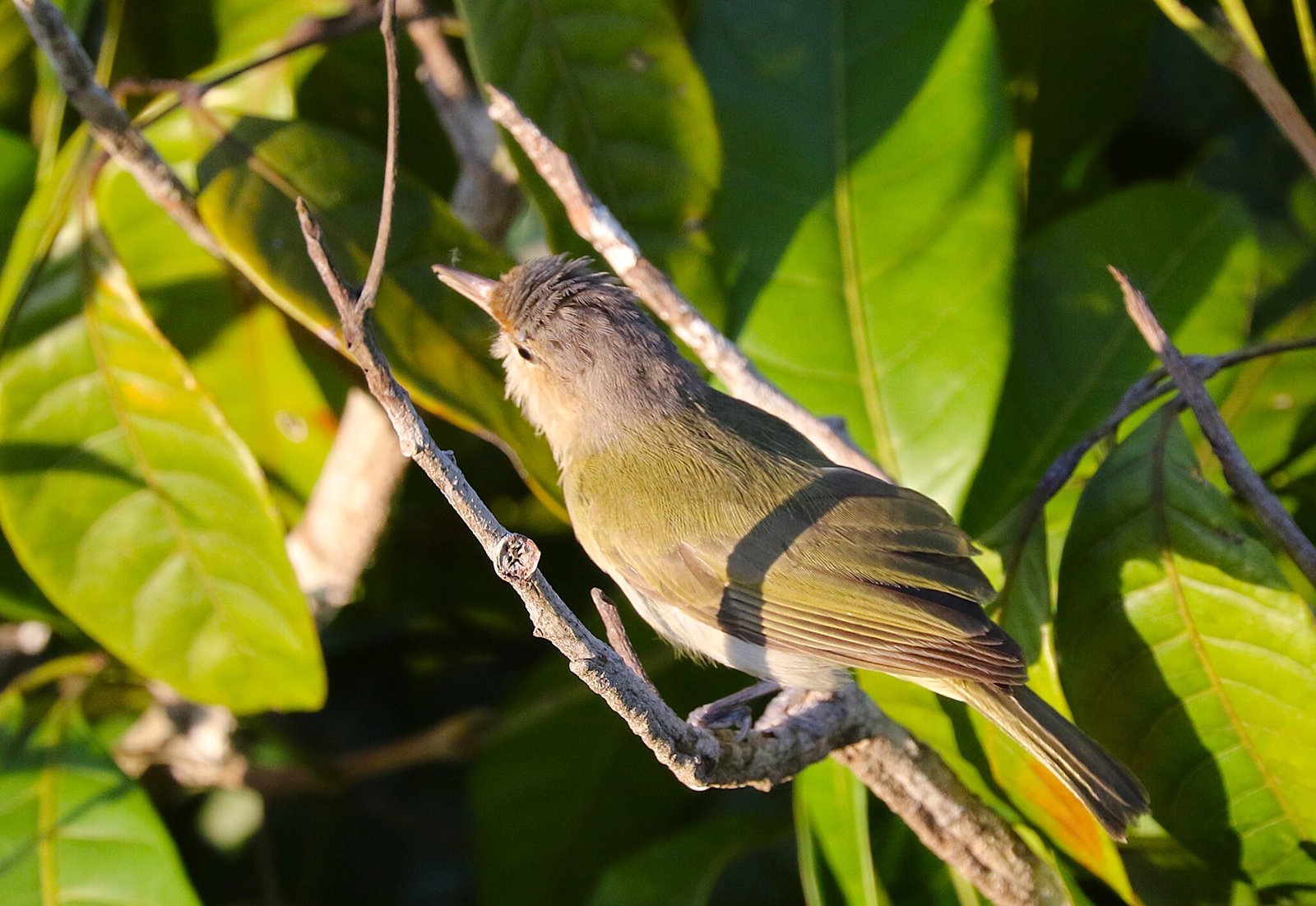
12 cm, with a short, pale bill, dark eyes and a fairly short tail. The crown and nape are grey, the forehead and lores paler greyish. The cheeks, throat and breast are warm buff, and the belly is whitish. The back, wings and tail are olive-green. The sexes are alike; young birds are duller.
Confusion species
Dusky-capped Greenlet Pachysylvia hypoxantha has a brown cap and yellow underparts and lives farther west in Amazonia. Ashy-headed Greenlet Hylophilus pectoralis has a grey head with a yellow breast and lives in scrub and forest edge in lower, more open country. Grey-eyed Greenlet Hylophilus amaurocephalus has pale eyes and a brownish crown and lives in drier forest. Greenlets of the genus Hylophilus also usually have a more pointed, paler bill.
Habitat
Canopy and edges of humid lowland forest and transitional forest towards drier woodland, up to about 600 m. It searches the outer twigs and foliage for insects and spiders, often in mixed flocks with tanagers and other greenlets. The nest is a small, hanging cup in the fork of a branch.
Where the bird is most at home, classified by the vegetation units of the Andes and the west coast.


Range and movements
Bolivia: in the east, in Beni and Santa Cruz. Absent from Colombia, Ecuador, Peru and the Galápagos. Outside the guide area in the Guianas, southern Venezuela and much of Brazilian Amazonia.
- Resident
- dark = core range, pale = thinly spread
How and when to look
Search eastern Santa Cruz, for example around Noel Kempff Mercado, for mixed flocks in the canopy at forest edges. Listen for the repeated, whistled song.
Conservation status
Least Concern. The species has a large range; deforestation in eastern Bolivia reduces its habitat locally.
Scientific name
Pachysylvia muscicapina | (Sclater & Salvin, 1873) (GBIF: Hylophilus muscicapinus)
Sclater & Salvin described the species in 1873 as Hylophilus muscicapinus; because it was later moved to another genus, the author and year stand in brackets. The genus Pachysylvia was introduced in 1850 by Bonaparte. The genus name comes from Greek pakhus, 'large, stout', and Sylvia, the warbler genus. The species name comes from Muscicapa, the flycatcher genus, with Latin -inus, 'resembling': 'flycatcher-like'. The specimen the first description was based on came from Saint-Louis d'Oyapock (Oyapock River), French Guiana.