All species › Pelicans, herons and ibises › Herons, egrets and bitterns › Capped Heron
Capped Heron | Pilherodius pileatus
Kapreiger | Garza capirotada | Garça-real
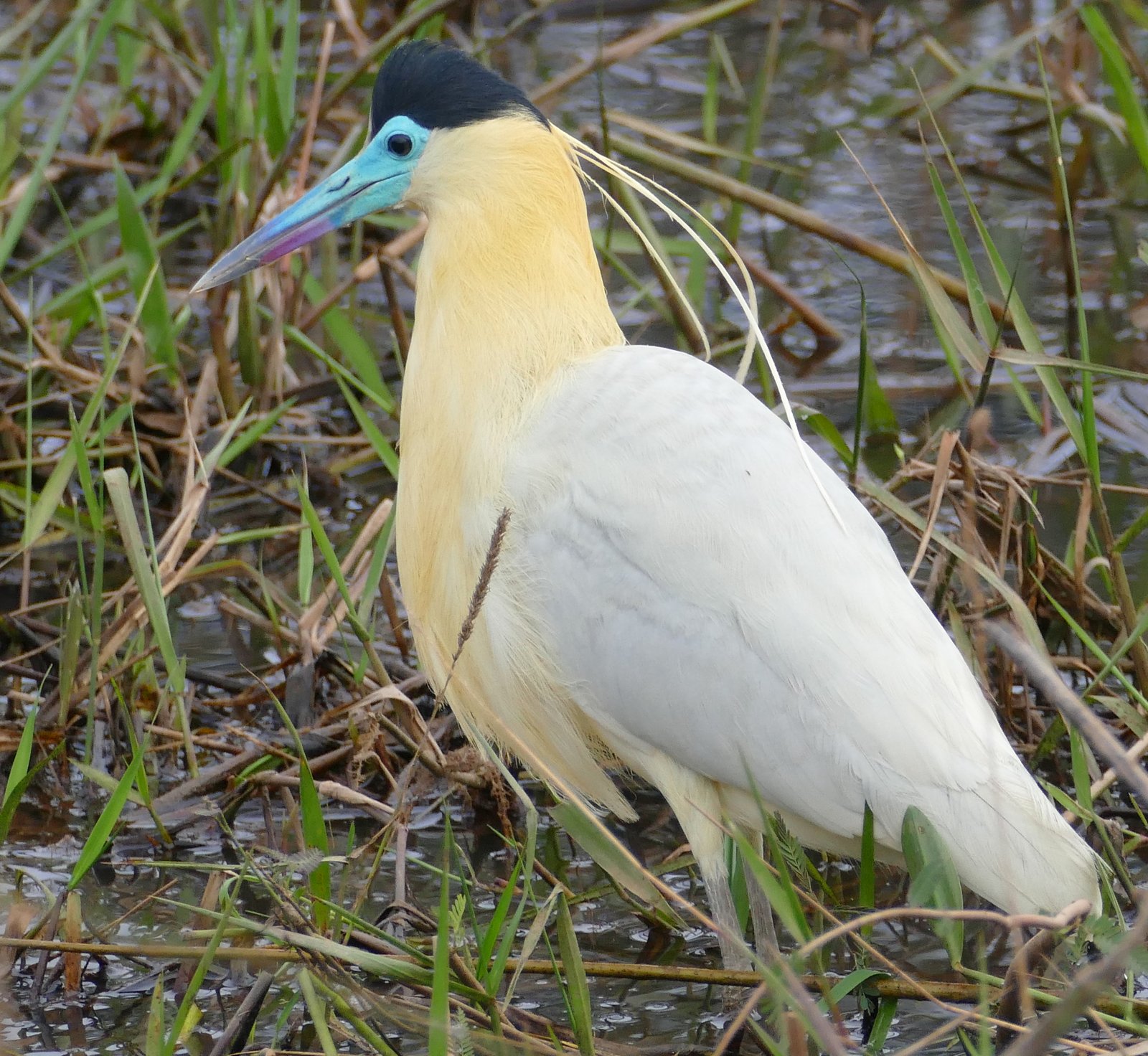
The Capped Heron is a medium-sized, mostly white heron with a black cap and a bright blue bill and facial skin. It is a bird of riverbanks and small lakes in Amazonia and the llanos, usually hunting alone or in pairs. It is the only species in its genus.
Voice
Usually silent. When disturbed and in flight a soft, short woop or a series of low, grunting notes.
Recording: Jerome Fischer — CC BY-NC-SA 4.0 · xeno-canto
Identification
51–59 cm, a rather stocky heron. The plumage is white, with a creamy yellow wash on the neck and breast that is stronger in fresh birds. The crown is black, with two or three long white plumes. The bare skin around the eye and the base of the bill are cobalt blue, and the bill tip is pink to red. The legs are bluish grey. The sexes are alike. Juveniles have a greyer cap with white streaks and a less intensely coloured bill.
Confusion species
Great Egret Ardea alba is much larger and longer-necked, with a yellow bill and black legs. Snowy Egret Egretta thula is slimmer, with a black bill, black legs and yellow feet, and has no black cap. Cattle Egret Ardea ibis is smaller, with a short yellow bill, and mainly keeps to cattle. The black cap and blue face are distinctive of Capped Heron.
Habitat
Edges of rivers and creeks, oxbow lakes, marshes and flooded grassland in the lowlands, also along forested waters; mostly below 500 m, locally to 900 m. It stands still or walks slowly in shallow water and takes mainly small fish, also tadpoles and aquatic insects. It nests solitarily, not in colonies; the nest is a stick platform in a tree over or near water.
Where the bird is most at home, classified by the vegetation units of the Andes and the west coast.


Range and movements
In Colombia east of the Andes in the llanos and Amazonia, and in the Caribbean lowlands and the Magdalena Valley. In Ecuador in the eastern lowlands. In Peru in the Amazonian lowlands. In Bolivia in the north and east, in Amazonia and the Beni savannas. Absent west of the Andes in Ecuador and Peru and from the Galápagos. Outside the guide area from Panama to Paraguay and southern Brazil.
- Resident
- dark = core range, pale = thinly spread
How and when to look
On boat trips along Amazonian rivers and oxbow lakes, watch banks with dead trunks and shallow edges; the species often sits alone and lets a boat approach quite closely.
Conservation status
Least Concern. The species occurs over a large range and is locally common; degradation of banks and pollution of waters are local threats.
Scientific name
Pilherodius pileatus | (Boddaert, 1783)
Boddaert described the species in 1783 as Ardea pileata; because it was later moved to another genus, the author and year stand in brackets. The genus Pilherodius was introduced in 1853 by Reichenbach. The genus name combines Greek pilos, 'cap', and erōdios, 'heron'. The species name is Latin pileatus, 'capped', after the black crown. The specimen the first description was based on came from Cayenne, French Guiana.