All species › Pelicans, herons and ibises › Herons, egrets and bitterns › Whistling Heron
Whistling Heron | Syrigma sibilatrix
Fluitreiger | Garza chiflona | Maria-faceira
The Whistling Heron is a heron of dry and wet grassland, less tied to open water than most herons. It stands out for its colourful face and its whistled call, from which it takes its name. In the guide area it is a bird of the savannas of the llanos and the Beni.
Voice
A high, clear, plaintive whistle, often in series, like pyeew-pyeew, mainly in flight and when pairs keep in contact. Also short, soft notes.
Recording: JAYRSON ARAUJO DE OLIVEIRA — CC BY-NC-SA 4.0 · xeno-canto
Identification
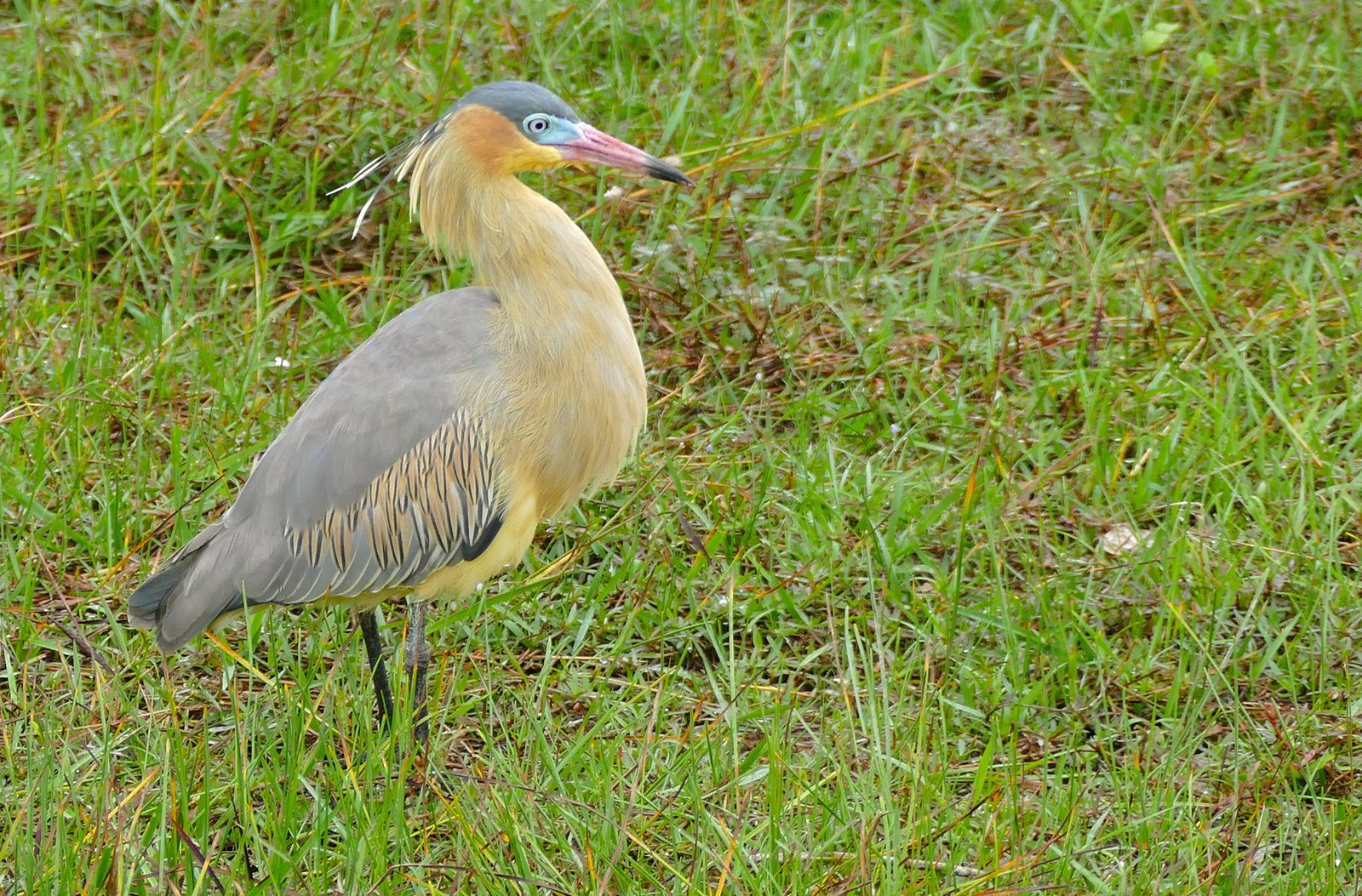
53–58 cm, a medium-sized, rather short-necked heron. The back and wings are bluish grey, with buff, finely black-streaked wing coverts. The crown and short crest plumes are black, and the face has blue bare skin around the eye. The neck and breast are cream to golden buff, and the belly and undertail coverts are white, as is the tail. The bill is pink with a black tip, and the legs are blackish. The sexes are alike; juveniles are duller, with a greyer neck.
Confusion species
Capped Heron Pilherodius pileatus also has a black cap and a blue face, but is mostly white, with a blue bill base, and usually keeps to water. Cocoi Heron Ardea cocoi is much larger, with a white neck, a black cap and a yellow bill. At a distance the grey and buff colouring sometimes recalls a juvenile night heron, but the long pink bill and feeding in dry grassland are distinctive.
Habitat
Open savanna, wet and dry grassland, pastures with scattered trees and edges of marshes and shallow pools, in the lowlands up to about 500 m. It walks slowly through the grass taking insects, especially grasshoppers and beetles, as well as frogs, lizards and small fish. The nest is a stick platform in a tree, usually solitary rather than in colonies.
Where the bird is most at home, classified by the vegetation units of the Andes and the west coast.


Range and movements
In Colombia in the llanos east of the Andes. In Bolivia in the savannas of the north and east, especially in the Beni and Santa Cruz. In Peru only very locally in the savannas of the Pampas del Heath in the south-east. Absent from Ecuador and the Galápagos. Outside the guide area in Venezuela and, in a separate southern population, from southern Brazil and Paraguay to northern Argentina.
- Resident
- dark = core range, pale = thinly spread
How and when to look
Drive along the pastures and savannas of the llanos of Colombia or the Beni in Bolivia and look for pairs walking in dry grass or perched on fence posts and isolated trees. The whistled call in flight often gives the species away.
Conservation status
Least Concern. The species benefits locally from extensively grazed grassland, but conversion of savanna to cropland can remove habitat.
Scientific name
Syrigma sibilatrix | (Temminck, 1824)
Temminck described the species in 1824 as Ardea sibilatrix; because it was later moved to another genus, the author and year stand in brackets. The genus Syrigma was introduced in 1878 by Ridgway. The genus name comes from Greek surigma, 'whistling', after the whistled call. The species name is Latin sibilatrix, 'whistler', after the whistled call. The specimen the first description was based on came from Brazil and Paraguay.