All species › Pelicans, herons and ibises › Herons, egrets and bitterns › Little Blue Heron
Little Blue Heron | Egretta caerulea
Kleine blauwe reiger | Garceta azul | Garça-azul
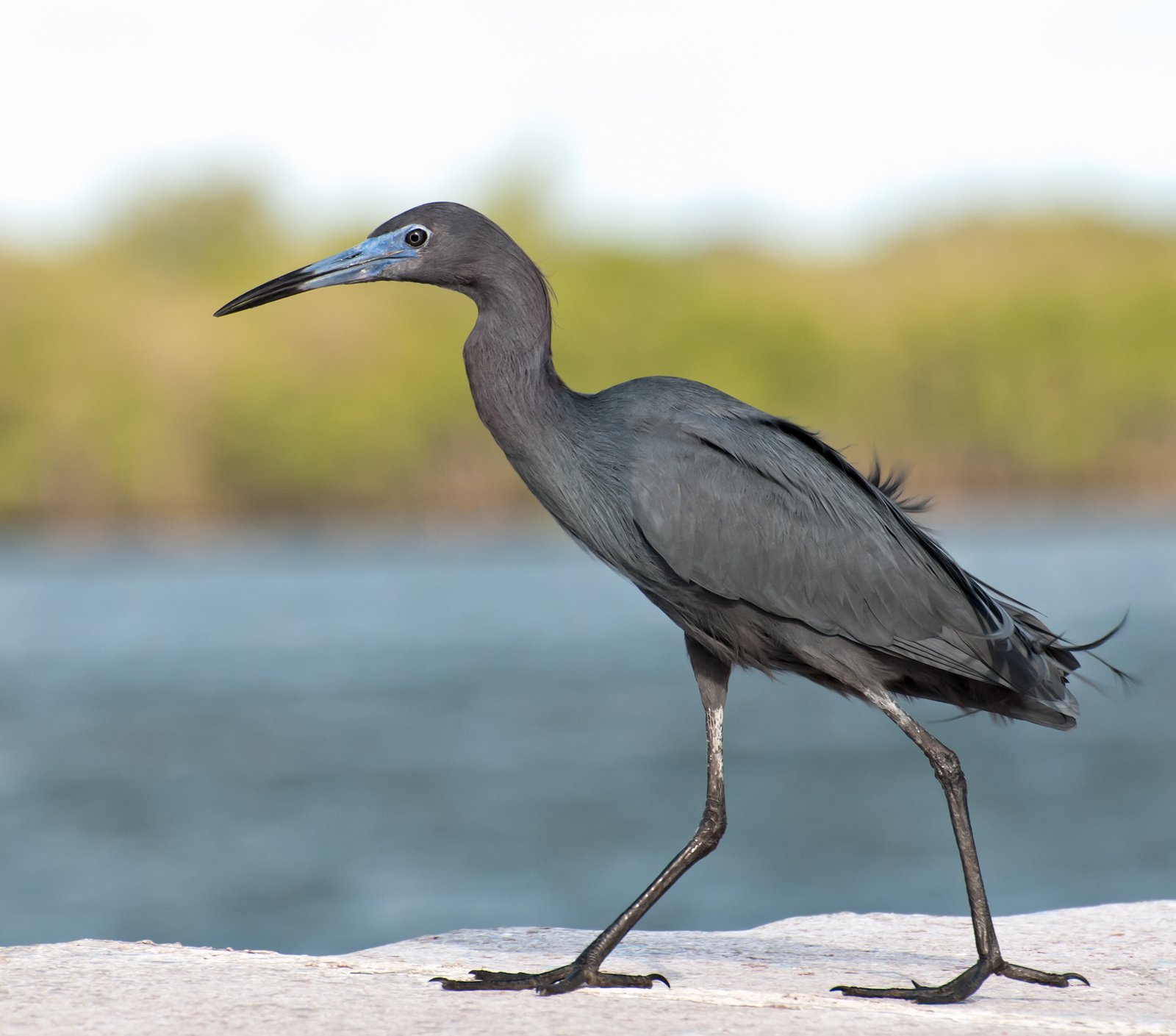
The Little Blue Heron is a slim, medium-sized heron whose adults are dark slate blue and whose juveniles are entirely white. In transitional plumage birds are white with blue-grey blotches. It hunts calmly and deliberately in shallow water, often in mangroves and along coasts.
Voice
Usually silent away from colonies. When disturbed and in colonies a hoarse, scratchy croaking.
Recording: Valerie Heemstra — CC BY-NC-SA 4.0 · xeno-canto
Identification
56–66 cm, with a rather thick, two-toned bill: blue-grey with a black tip. Adults are uniformly dark slate blue, with a purplish-brown head and neck; in the breeding season with long, filamentous plumes on the head, breast and back. The legs are greenish grey. Juveniles are white, often with dark wingtips, greenish-yellow legs and the same two-toned bill. In their second calendar year they are pied white and blue. The sexes are alike.
Confusion species
Snowy Egret Egretta thula closely resembles a juvenile Little Blue Heron, but has a thin, all-black bill, yellow lores and black legs with yellow feet, and feeds more actively. Tricolored Heron Egretta tricolor is dark above, but has a white belly and a longer, thinner bill. Dark-morph Reddish Egret Egretta rufescens is larger, with a rufous, shaggy neck and a pink bill with a black tip.
Habitat
Mangroves, tidal flats, lagoons, estuaries and coastal marshes, also freshwater marshes, rice fields and lake edges in the lowlands; locally also in Andean valleys up to about 2500 m. It walks slowly through shallow water taking fish, crabs, shrimps, frogs and aquatic insects. It breeds in mixed colonies with other herons, in mangroves or trees over water.
Where the bird is most at home, classified by the vegetation units of the Andes and the west coast.


Range and movements
In Colombia on the Caribbean and Pacific coasts and inland along the major rivers and marshes of the lowlands. In Ecuador mainly on the coast and in the western lowlands, scarce in the east. In Peru along the entire coast and in the Amazonian lowlands. In Bolivia scarce in the lowlands of the north and east. A rare vagrant to the Galápagos. Outside the guide area from the eastern United States and Mexico to northern Argentina and southern Brazil.
- Resident
- dark = core range, pale = thinly spread
How and when to look
Check the mangroves and mudflats around the Gulf of Guayaquil in Ecuador or along the coast of Tumbes in Peru; both white juveniles and dark adults often mix with other herons. White birds can be recognised by the two-toned bill.
Conservation status
Least Concern. Threats are local loss of mangroves and wetlands and disturbance of breeding colonies.
Scientific name
Egretta caerulea | (Linnaeus, 1758)
Linnaeus described the species in 1758 as Ardea caerulea; because it was later moved to another genus, the author and year stand in brackets. The genus Egretta was introduced in 1817 by Forster. The genus name comes from Provençal French aigrette, 'little egret', a diminutive of aigron, 'heron'. The species name is Latin caeruleus, 'blue'. The specimen the first description was based on came from South Carolina, United States.