All species › Pelicans, herons and ibises › Herons, egrets and bitterns › Tricolored Heron
Tricolored Heron | Egretta tricolor
Witbuikreiger | Garceta tricolor | Garça-tricolor
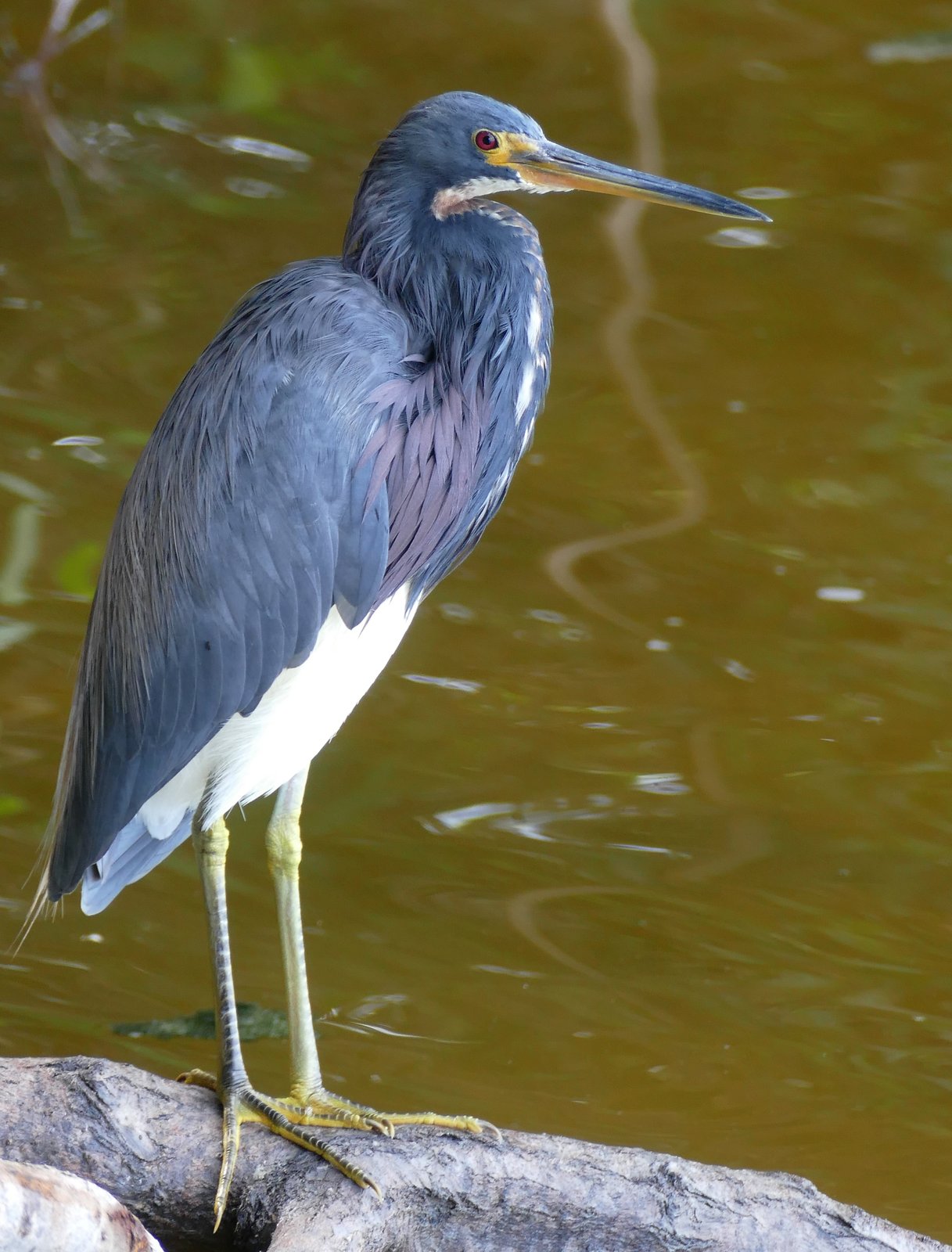
The Tricolored Heron is a slender, long-billed heron of coasts and mangroves. It is recognisable by its white belly, which contrasts sharply with the dark upperparts. When hunting it often dashes through shallow water with half-spread wings.
Voice
Usually silent. When disturbed and in colonies a hoarse, nasal croaking.
Recording: GABRIEL LEITE — CC BY-NC-SA 4.0 · xeno-canto
Identification
60–70 cm, with a long, thin neck and a long, pointed bill. The upperparts, head and neck are dark bluish grey, with a white stripe down the front of the neck; the belly, underwing and rump are white. In the breeding season it has long, creamy to brown plumes on the back, a white crest and a blue bill base. Otherwise the bill is yellowish with a dark upper mandible, and the legs are yellow to greenish grey. The sexes are alike. Juveniles have a rufous neck and wing coverts.
Confusion species
Adult Little Blue Heron Egretta caerulea is uniformly dark, without a white belly, and has a thicker, two-toned bill. Reddish Egret Egretta rufescens is larger and has a rufous, shaggy neck and a pink bill with a black tip. Striated Heron Butorides striata is much smaller and stockier, with short legs.
Habitat
Mangroves, tidal flats, lagoons, estuaries, salt marshes and salt pans on the coast; locally also freshwater marshes near the coast. It hunts actively in shallow water, often with sudden dashes and spread wings, for small fish, shrimps and other aquatic animals. It breeds in mixed colonies in mangroves.
Where the bird is most at home, classified by the vegetation units of the Andes and the west coast.


Range and movements
In Colombia along the Caribbean coast and scarce on the Pacific coast. In Ecuador along the coast, especially around the Gulf of Guayaquil. In Peru on the coast of the far north-west, in Tumbes, with scattered records further south. Absent from Bolivia and the Galápagos (recorded there only as a vagrant). Outside the guide area from the east coast of the United States and Mexico to northern Brazil.
- Resident
- dark = core range, pale = thinly spread
How and when to look
At low tide check the mudflats and mangrove channels around the Gulf of Guayaquil or the mangroves of Tumbes; the species often feeds alongside other herons.
Conservation status
Least Concern. Loss of mangroves to shrimp farms and coastal development is a local threat.
Scientific name
Egretta tricolor | (Müller, 1776)
Müller described the species in 1776 as Ardea tricolor; because it was later moved to another genus, the author and year stand in brackets. The genus Egretta was introduced in 1817 by Forster. The genus name comes from Provençal French aigrette, 'little egret', a diminutive of aigron, 'heron'. The species name is Latin tricolor, 'three-coloured'. The specimen the first description was based on came from Cayenne, French Guiana.