All species › Pelicans, herons and ibises › Herons, egrets and bitterns › Reddish Egret
Reddish Egret | Egretta rufescens
Roodhalsreiger | Garceta rojiza | Garça-vermelha
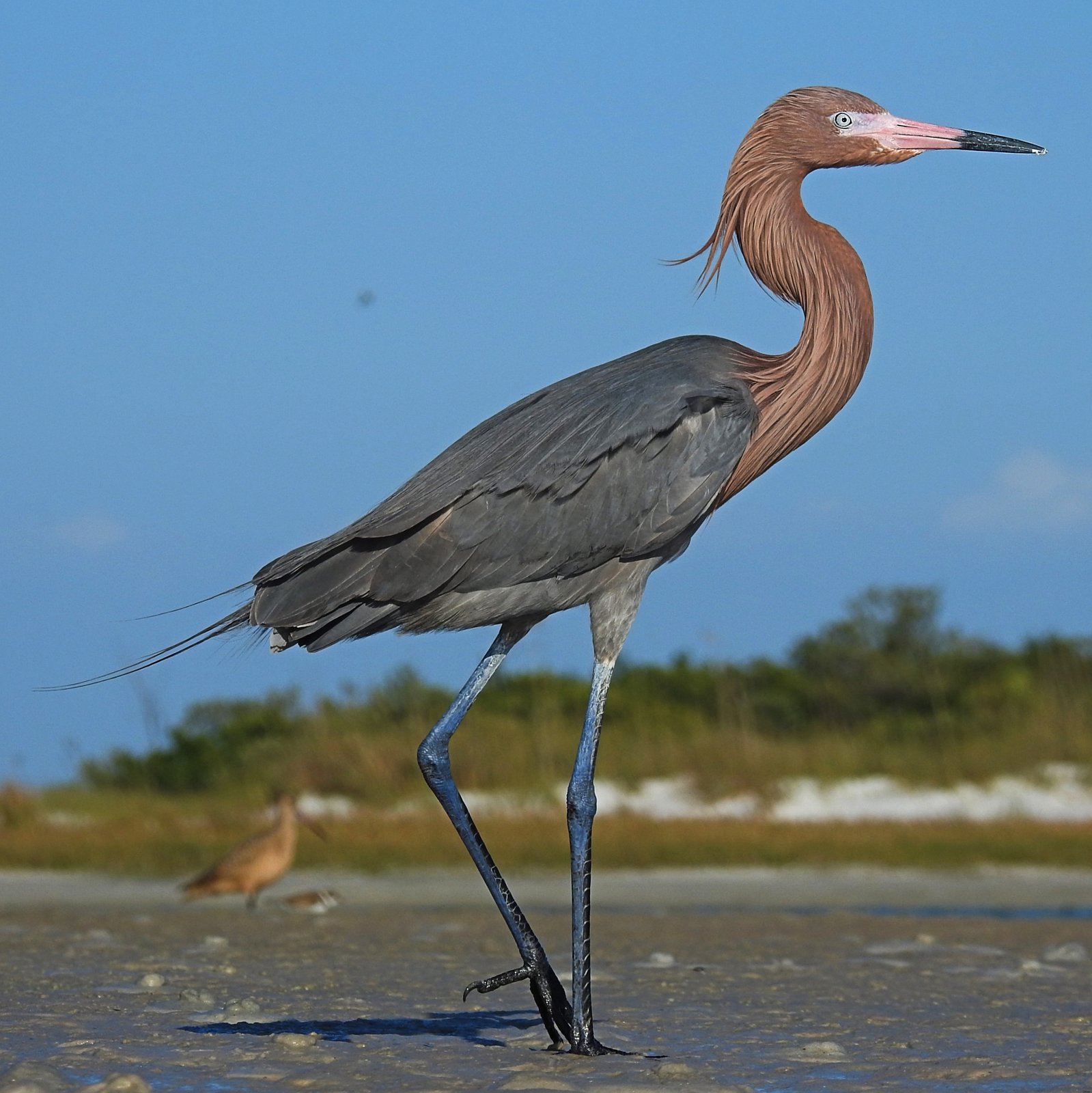
The Reddish Egret is a large, shaggy heron of shallow saline lagoons and salt pans. It has a distinctive way of hunting: with staggering leaps, sudden turns and half-spread wings that cast shade on the water. There is a dark and a white morph. In the guide area it is confined to the Caribbean coast of Colombia.
Voice
Usually silent. When disturbed a low, hoarse croak or grunt.
Recording: Isain Contreras Rodríguez — CC BY-NC-SA 4.0 · xeno-canto
Identification
68–82 cm, with a long, thick bill and long legs. The dark morph is slate grey, with a rufous-brown, shaggy head and neck; the white morph is entirely white. Adults have a pink bill with a sharply defined black tip and bluish-grey legs; in the breeding season the head and neck plumes are long and ragged. The sexes are alike. Juveniles are a duller greyish brown or white, with an all-dark bill.
Confusion species
Little Blue Heron Egretta caerulea is smaller, with a purplish-brown, not shaggy neck and a blue-grey bill with a black tip. Tricolored Heron Egretta tricolor has a white belly and a thinner bill. The white morph resembles Great Egret Ardea alba, which is larger and has a yellow bill, and Snowy Egret Egretta thula, which is smaller, with a black bill and yellow feet.
Habitat
Shallow, open saline and brackish water: lagoons, tidal flats, salt pans and salt marshes, often near mangroves. It hunts small fish in very shallow water with fast, erratic movements. It breeds in colonies on islets in lagoons, on the ground or low in shrubs and mangroves.
Where the bird is most at home, classified by the vegetation units of the Andes and the west coast.


Range and movements
In Colombia scarce and local on the Caribbean coast, mainly on the Guajira Peninsula and around the Ciénaga Grande de Santa Marta. Elsewhere in the guide area at most a rare vagrant; not a regular species in Ecuador, Peru, Bolivia or the Galápagos. Outside the guide area on the coasts of the Gulf of Mexico, Central America, the Caribbean and northern Venezuela.
- Resident
- dark = core range, pale = thinly spread
How and when to look
Search the shallow lagoons and salt pans of La Guajira, for example around Camarones, where the species feeds among flamingos and other herons. The staggering hunting action can be seen from far away.
Conservation status
Near Threatened. The world population is small and scattered; disturbance of breeding colonies, loss of coastal wetlands and salt extraction threaten the species locally.
Scientific name
Egretta rufescens | (Gmelin, 1789)
Gmelin described the species in 1789 as Ardea rufescens; because it was later moved to another genus, the author and year stand in brackets. The genus Egretta was introduced in 1817 by Forster. The genus name comes from Provençal French aigrette, 'little egret', a diminutive of aigron, 'heron'. The species name is Latin rufescens, 'reddish'. The specimen the first description was based on came from Louisiana, United States.