All species › Pelicans, herons and ibises › Herons, egrets and bitterns › Snowy Egret
Snowy Egret | Egretta thula
Amerikaanse kleine zilverreiger | Garceta nívea | Garça-branca-pequena
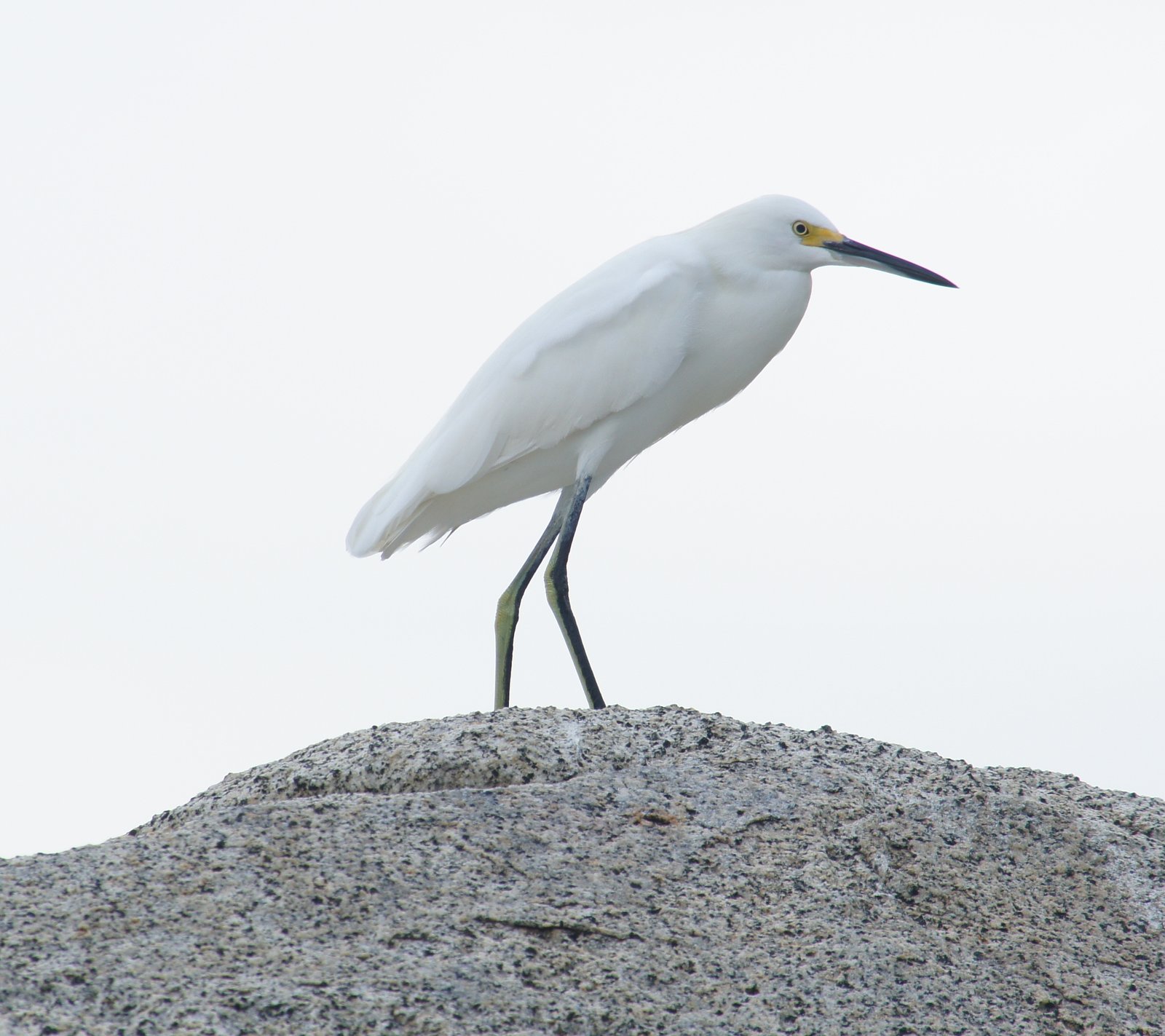
The Snowy Egret is a small, slender white heron, recognisable by its black legs with bright yellow feet. It hunts actively, walking quickly and shuffling its feet in the water to flush prey. It occurs from the coast high into the Andes, up to the altiplano.
Voice
In colonies and when disturbed a hoarse, rasping aarr or a nasal croak.
Recording: Paul Driver — CC BY-NC-SA 4.0 · xeno-canto
Identification
55–65 cm, slender, with a thin, all-black bill, yellow lores and black legs with yellow feet. The plumage is entirely white. In the breeding season it has long, strongly curled plumes on the back and a shaggy crest on the head and breast, and the lores and feet turn orange-red. The sexes are alike. Juveniles have a yellow stripe up the back of the legs and a paler bill base.
Confusion species
Great Egret Ardea alba is much larger, with a yellow bill and all-black legs. Juvenile Little Blue Herons Egretta caerulea are also white, but have a thicker, blue-grey bill with a black tip and greenish-yellow legs. Cattle Egret Ardea ibis is stockier, with a short yellow bill and dark to yellow legs, and feeds in dry grassland. The white morph of Reddish Egret Egretta rufescens is larger, with a pink bill with a black tip.
Habitat
Lagoons, tidal flats, mangroves, fresh and brackish marshes, rice fields, riverbanks and lakes, from sea level to over 4000 m in the Andes, including Lake Titicaca. It hunts actively in shallow water for small fish, crustaceans and insects, often stirring the bottom with one foot. It breeds in mixed colonies with other herons in trees, shrubs or reeds.
Where the bird is most at home, classified by the vegetation units of the Andes and the west coast.


Range and movements
In Colombia widespread in the lowlands and in Andean valleys, also on the high plateaus. In Ecuador on the coast and in the western lowlands, locally in the Andes and in the east. In Peru along the entire coast, on the altiplano and in the Amazonian lowlands. In Bolivia on the altiplano, around Lake Titicaca, and in the lowlands. A rare visitor to the Galápagos. Outside the guide area from the United States to Chile and Argentina.
- Resident
- dark = core range, pale = thinly spread
How and when to look
Watch riverbanks and lagoons on the Peruvian coast, for example near Lima or at the Mejía lagoons, or at Lake Titicaca; the species is often numerous and hunts with quick, jerky movements in shallow water.
Conservation status
Least Concern. After a steep decline due to the plume trade around 1900 the species has recovered; loss of wetlands and pollution are local threats.
Scientific name
Egretta thula | (Molina, 1782)
Molina described the species in 1782 as Ardea Thula; because it was later moved to another genus, the author and year stand in brackets. The genus Egretta was introduced in 1817 by Forster. The genus name comes from Provençal French aigrette, 'little egret', a diminutive of aigron, 'heron'. The species name is the Mapudungun word for the Black-necked Swan; Molina applied it to this heron in error in 1782. The specimen the first description was based on came from Chile.