All species › Pelicans, herons and ibises › Herons, egrets and bitterns › Yellow-crowned Night Heron
Yellow-crowned Night Heron | Nyctanassa violacea
Geelkruinkwak | Martinete coronado | Savacu-de-coroa
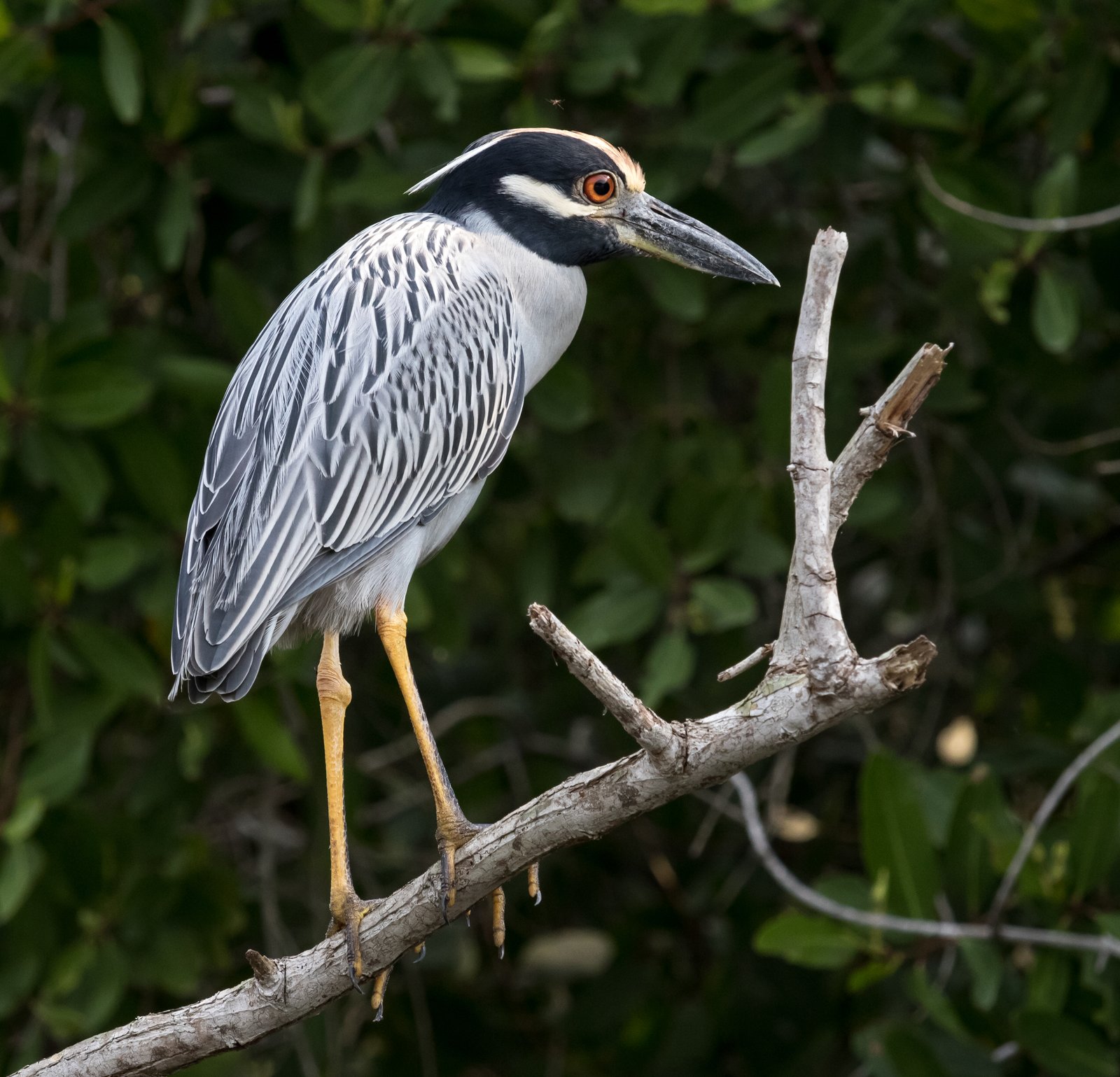
The Yellow-crowned Night Heron is a stocky night heron of mangroves and rocky coasts that specialises in catching crabs. It is active both at night and by day, depending mainly on the tide. On the Galápagos a distinct subspecies lives, which is fairly common there and shows little fear.
Voice
A short, high, sharp kwok or quak, higher than the call of Black-crowned Night Heron, mainly in flight and at night.
Recording: José María Loaiza B. — CC BY-NC-SA 4.0 · xeno-canto
Identification
55–65 cm, with a thick, black bill, a rather short neck, large red eyes and long, yellow legs. Adults are grey, with dark centres to the feathers of the back and wings. The head is black, with a white cheek patch, a creamy white to yellowish crown and long white nape plumes. The sexes are alike. Juveniles are greyish brown with fine white spots above and streaks below; they take two to three years to reach adult plumage.
Confusion species
Adult Black-crowned Night Heron Nycticorax nycticorax has a black back and crown and grey wings, without a white cheek patch. Juvenile Black-crowned closely resembles juvenile Yellow-crowned, but has a thinner bill with a yellow base, larger white spots on the wings, shorter legs, and in flight the feet project less far beyond the tail. Boat-billed Heron Cochlearius cochlearius has a very broad, boat-shaped bill.
Habitat
Mangroves, tidal channels, rocky shores, lagoons and estuaries, locally also freshwater marshes and riverbanks in the lowlands; on the Galápagos also lava shores. It feeds mainly on crabs, which it breaks with its thick bill, as well as other crustaceans, fish and, on the Galápagos, lizards and young birds. It nests singly or in small groups, with a stick nest in mangroves, shrubs or among rocks.
Where the bird is most at home, classified by the vegetation units of the Andes and the west coast.


Range and movements
In Colombia on the Caribbean and Pacific coasts, locally inland along rivers. In Ecuador along the entire coast, especially in mangroves. In Peru along the northern coast, scarcer to the south. On the Galápagos on all larger islands. Absent from Bolivia. Outside the guide area from the eastern United States and Mexico to northern Brazil.
- Resident
- dark = core range, pale = thinly spread
How and when to look
On the Galápagos, watch lava shores and mangroves near landing sites; birds often sit in the open on rocks at low tide. On the mainland, search the mangroves around the Gulf of Guayaquil, preferably at dusk.
Conservation status
Least Concern. Loss of mangroves is a local threat; on the Galápagos the population is stable.
Scientific name
Nyctanassa violacea | (Linnaeus, 1758)
Linnaeus described the species in 1758 as Ardea violacea; because it was later moved to another genus, the author and year stand in brackets. The genus Nyctanassa was introduced in 1887 by Stejneger. The genus name combines Greek nux (genitive nuktos), 'night', and anassa, 'queen, lady'. The species name is Latin violaceus, 'violet-coloured'. The specimen the first description was based on came from the Carolinas, United States.