All species › Pelicans, herons and ibises › Herons, egrets and bitterns › Black-crowned Night-Heron
Black-crowned Night-Heron | Nycticorax nycticorax
Kwak | Martinete común | Savacu
The Black-crowned Night-Heron is a stocky heron that feeds mainly at dusk and at night and roosts by day in groups in trees and reeds. In the guide area it occurs from coastal mangroves to the lakes of the altiplano above 4000 m. The species breeds on every continent except Australia and Antarctica.
Voice
A hoarse, short quok or wok, mainly in flight at dusk; croaking and clattering sounds at colonies.
Recording: Timeo CONSTANT — CC BY-NC-SA 4.0 · xeno-canto
Identification
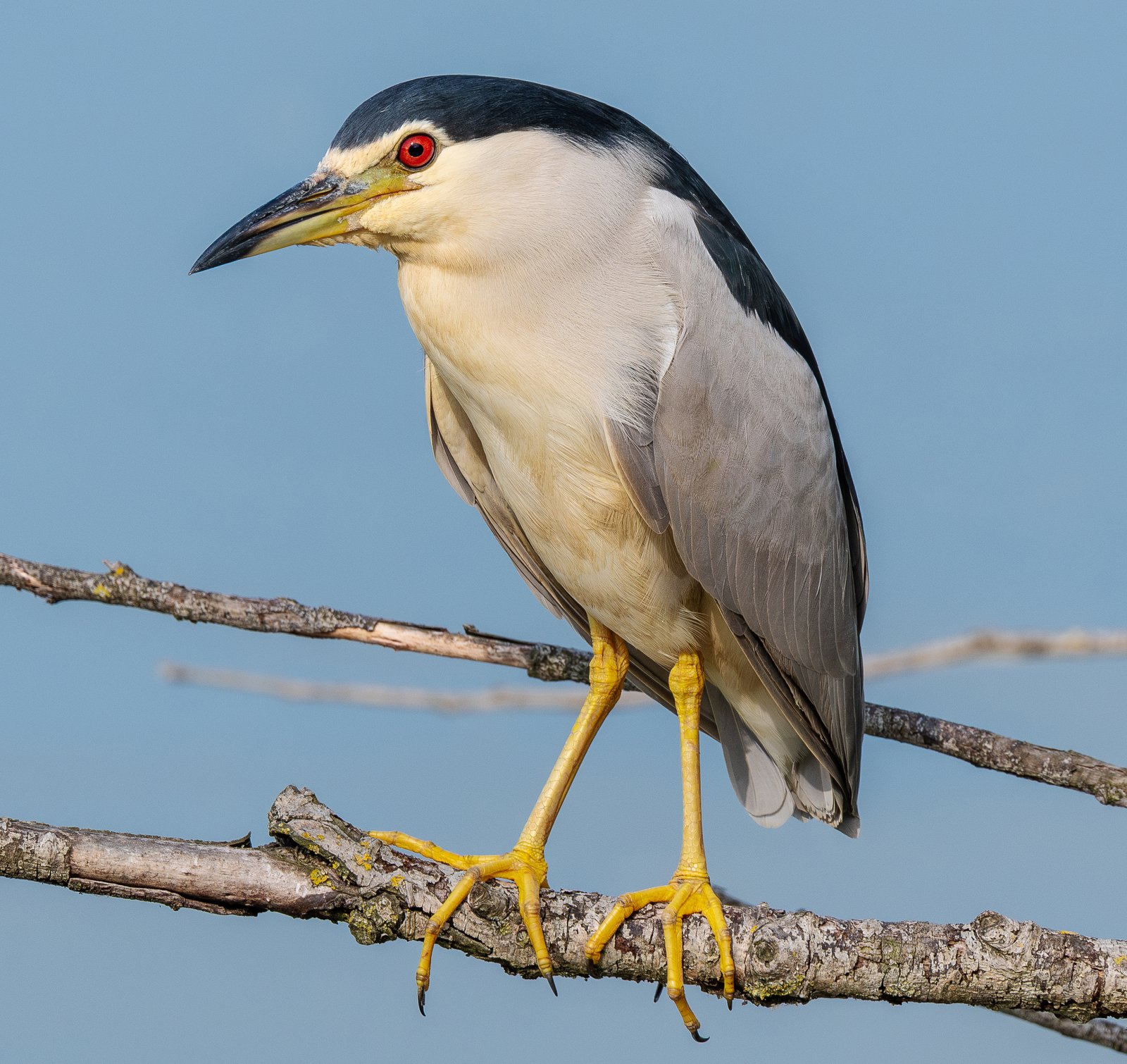
56–65 cm. Stocky, with a short neck, a thick black bill and fairly short yellow legs. Adults have a black crown and back, grey wings and white to pale grey underparts; in the breeding season two or three long white nape plumes. The eye is red. In the Andes dark birds occur with more grey on the neck and breast; the dark subspecies obscurus occurs in southern Peru and Bolivia. The sexes are alike. Juveniles are brown with white teardrop spots on the upperparts and streaked underparts, with an orange eye.
Confusion species
Yellow-crowned Night Heron Nyctanassa violacea has a grey body, a black-and-white head with a pale crown and longer legs; juvenile Yellow-crowned Night Herons are greyer brown, more finely spotted and have a thicker, all-dark bill. Boat-billed Heron Cochlearius cochlearius has a broad, boat-shaped bill and large black eyes. Juvenile Black-crowned Night-Herons resemble bitterns such as Pinnated Bittern Botaurus pinnatus, which is larger and finely barred.
Habitat
Marshes, reedbeds, lakes, riverbanks, mangroves and coastal lagoons, also rice fields and fishponds, from sea level to above 4000 m on the altiplano. It eats fish, frogs, crustaceans, insects and sometimes nestling birds. It breeds in colonies in trees, shrubs or reeds, on Lake Titicaca in the totora reeds; the nest is a platform of twigs or stems.
Where the bird is most at home, classified by the vegetation units of the Andes and the west coast.


Range and movements
In Colombia locally in the lowlands and the Andes, including the Bogotá plateau. In Ecuador along the coast and in the Andes, scarce in the Amazonian lowlands. In Peru along the whole coast and in the highlands, including Lake Titicaca. In Bolivia on the altiplano and locally in the lowlands. Absent from the Galápagos. Outside the guide area across much of the Americas, Europe, Africa and Asia.
- Resident
- dark = core range, pale = thinly spread
How and when to look
At Lake Titicaca and in the lagoons of the Peruvian coast, such as Pantanos de Villa near Lima, groups sit in the reeds or in trees by day; at sunset they fly out to their feeding areas.
Conservation status
Least Concern. Locally the species suffers from the loss and pollution of wetlands and from disturbance of colonies.
Scientific name
Nycticorax nycticorax | (Linnaeus, 1758)
Linnaeus described the species in 1758 as Ardea Nycticorax; because it was later moved to another genus, the author and year stand in brackets. The genus Nycticorax was introduced in 1817 by Forster. The genus name comes from Greek nux, 'night', and korax, 'raven': a 'night raven', after the nocturnal habits and croaking call. The species name repeats the genus name: Greek nux, 'night', and korax, 'raven'. The specimen the first description was based on came from Southern Europe.