All species › Pelicans, herons and ibises › Herons, egrets and bitterns › Striated Heron
Striated Heron | Butorides striata
Mangrovereiger | Garcita estriada | Socozinho
The Striated Heron is a small, stocky heron that waits motionless on a branch or root just above the water for fish. It occurs in tropical and subtropical regions of the Americas, Africa, Asia and Australia. In the guide area it lives both in coastal mangroves and along rivers and lakes in the lowlands.
Voice
A sharp, explosive kyow or kyek when flushed; also a repeated, soft kek-kek-kek.
Recording: David Darrell-Lambert — CC BY-NC-SA 4.0 · xeno-canto
Identification
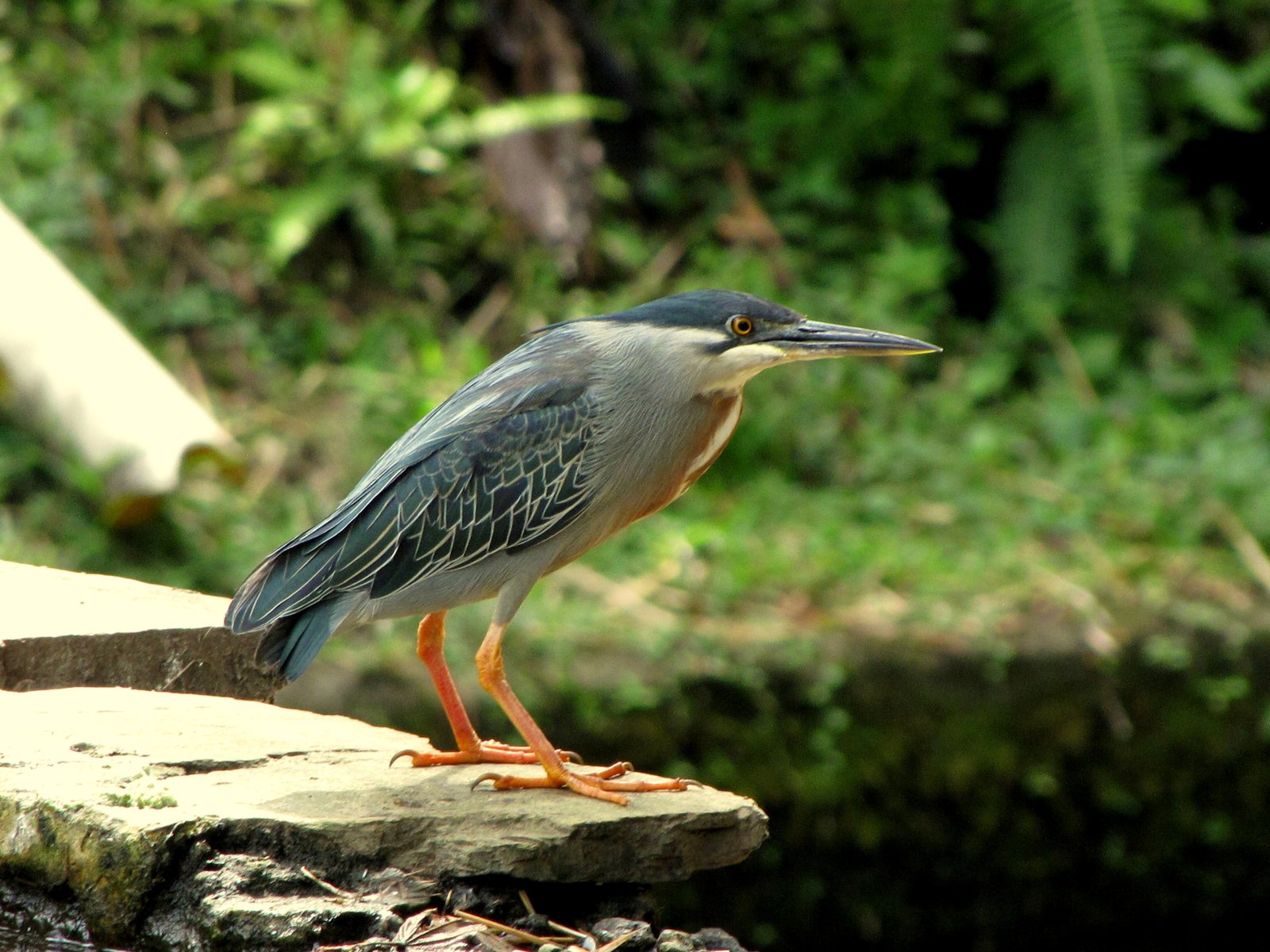
40–48 cm. Small and stocky, with short legs and a fairly long, pointed dark bill. Adults have a black crown with a short crest, grey neck and flanks, a pale throat with a white stripe down the foreneck and breast, and grey-green back and wings with pale edges to the coverts. The legs are yellow to orange. The sexes are alike. Juveniles are brown, with a heavily streaked neck and underparts and pale spots on the wing coverts.
Confusion species
Green Heron Butorides virescens has a chestnut neck and flanks instead of grey ones; intermediates occur. Lava Heron Butorides sundevalli is entirely slate-grey, without a stripe on the throat. Least Bittern Botaurus exilis is smaller, with a pale wing patch and a black back. Stripe-backed Bittern Botaurus involucris is pale brown streaked with black.
Habitat
Mangroves, coastal lagoons and estuaries, and inland the banks of rivers, lakes and oxbow lakes with overhanging vegetation, mostly below 1000 m. It waits still on a branch, root or stone and seizes small fish, frogs, crabs and insects; it sometimes uses a feather or insect as bait. It breeds solitarily or in loose groups; the nest is a platform of twigs in a shrub or tree near water.
Where the bird is most at home, classified by the vegetation units of the Andes and the west coast.


Range and movements
In Colombia widespread in the lowlands, on both coasts and in the east. In Ecuador on the coast and in the Amazonian lowlands. In Peru along the coast, mainly in the north, and in the Amazonian lowlands. In Bolivia in the lowlands of the north and east. On the Galápagos paler, grey birds occur alongside Lava Heron. Outside the guide area from Panama to Argentina and in Africa, Asia and Australia.
- Resident
- dark = core range, pale = thinly spread
How and when to look
In the Amazonian lowlands it sits on branches along the banks of rivers and lakes; from a canoe or boat it can be approached closely. On the coast of Ecuador it feeds at low tide among the mangrove roots.
Conservation status
Not Evaluated in the current circumscription of the species; as a whole widespread and numerous. Locally the species suffers from the loss of mangroves.
Scientific name
Butorides striata | (Linnaeus, 1758)
Linnaeus described the species in 1758 as Ardea striata; because it was later moved to another genus, the author and year stand in brackets. The genus Butorides was introduced in 1852 by Blyth. The genus name comes from Middle English butor, 'bittern', with the Greek suffix -oides, 'resembling'. The species name is Latin striatus, 'striped'. The specimen the first description was based on came from Suriname.