All species › Pelicans, herons and ibises › Herons, egrets and bitterns › Lava Heron
Lava Heron | Butorides sundevalli
Galápagosreiger | Garcilla de Galápagos | Socó-de-galápagos
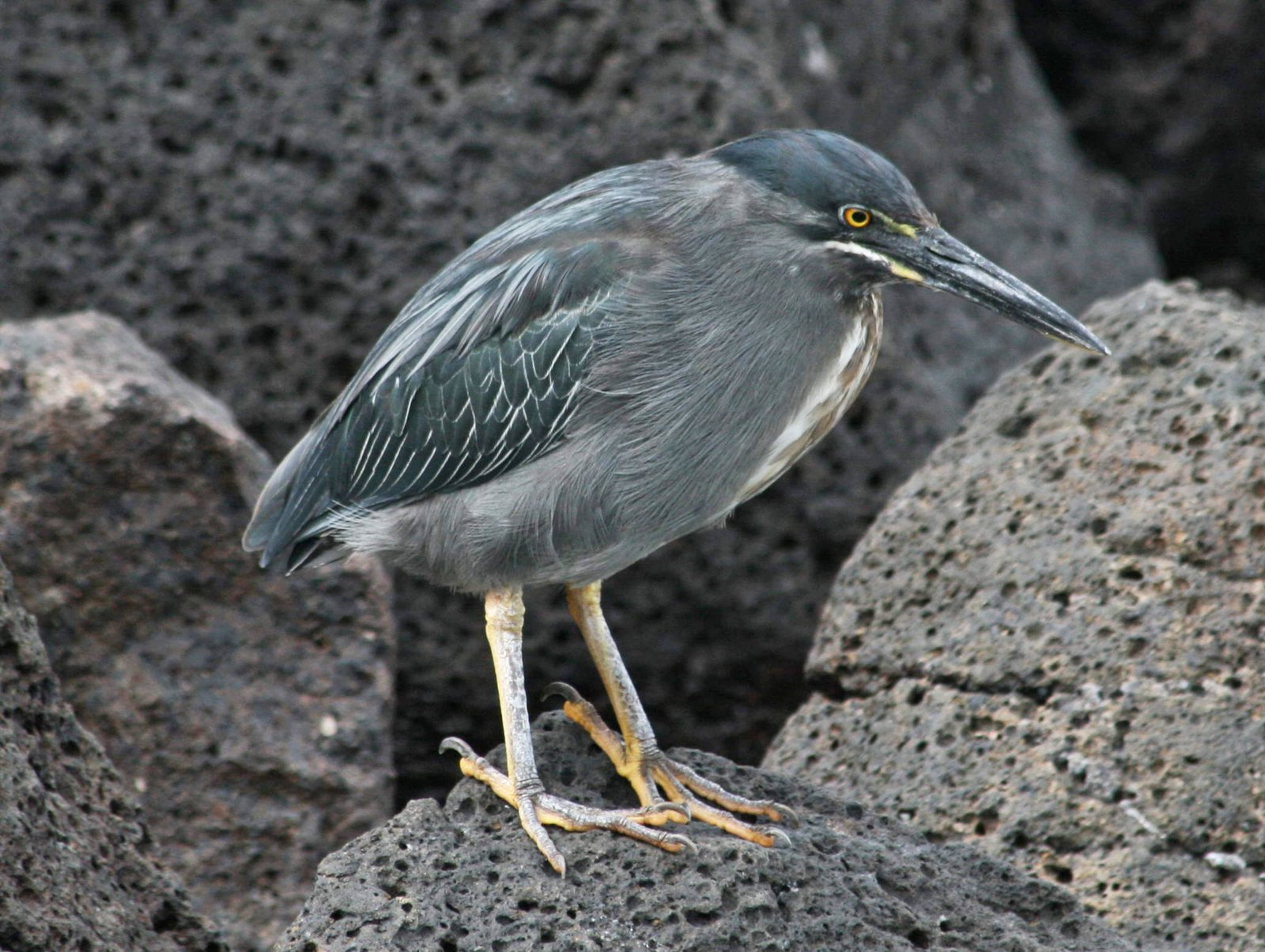
The Lava Heron is a small, dark heron found only on the Galápagos. It hunts crabs and small fish along the lava shore and defends a territory there throughout the year. Some authors treat it as a dark form or subspecies of Striated Heron.
Voice
A sharp, explosive kyow when flushed; otherwise mostly silent.
No recording with a suitable Creative Commons licence is available for this species yet.
Identification
35–41 cm. Small and stocky, with short legs and a fairly long, pointed bill. Adults are uniform slate-grey, with a short crest and silvery grey edges to the back and wing feathers. The bill is black; the legs and bare skin between eye and bill are yellowish grey and turn orange in the breeding season. The sexes are alike. Juveniles are brownish grey, with pale, dark-streaked underparts and pale spots on the wings.
Confusion species
Paler birds resembling Striated Heron Butorides striata, with a pale throat and grey flanks, also occur on the Galápagos; intermediates are known. Yellow-crowned Night Heron Nyctanassa violacea is larger and grey, with a black-and-white head and longer legs; juvenile Yellow-crowned Night Herons are browner, white-speckled and have a thicker bill.
Habitat
Lava shores, rocky intertidal zones, mangroves and coastal lagoons, almost exclusively in the coastal strip. It waits still on the lava or on a mangrove branch and seizes crabs, especially young Sally Lightfoot crabs, small fish, lizards and insects. It breeds solitarily; the nest is a platform of twigs in a mangrove or in a crevice in the lava. It breeds in almost every month.
Where the bird is most at home, classified by the vegetation units of the Andes and the west coast.


Range and movements
Only on the Galápagos (Ecuador), where it occurs along the shores of most islands. Absent from Colombia, Peru and Bolivia.
- Resident
How and when to look
Along the lava shore and at the landing sites of Santa Cruz, San Cristóbal, Isabela and Fernandina it often sits on the rocks close to the water, where it allows people to within a few metres.
Conservation status
Not Evaluated; treated by some authorities as a subspecies of Striated Heron. The population is small but appears stable; introduced predators such as cats and rats may threaten nests.
Scientific name
Butorides sundevalli | (Reichenow, 1877)
Reichenow described the species in 1877 as Ardea Sundevalli; because it was later moved to another genus, the author and year stand in brackets. The genus Butorides was introduced in 1852 by Blyth. The genus name comes from Middle English butor, 'bittern', with the Greek suffix -oides, 'resembling'. The species name honours Carl Jakob Sundevall (1801–1875), Swedish zoologist and ornithologist at the Swedish Museum of Natural History in Stockholm. The specimen the first description was based on came from Galápagos Islands.