All species › Pelicans, herons and ibises › Herons, egrets and bitterns › Green Heron
Green Heron | Butorides virescens
Groene reiger | Garcita verdosa | Socozinho-verde
The Green Heron is the northern counterpart of Striated Heron. It breeds from North America to Panama and the Caribbean and partly winters farther south. In the guide area it is a scarce winter visitor, mainly in northern Colombia.
Voice
A sharp, explosive kyow or skeow when flushed; also a soft kuk-kuk-kuk.
Recording: Zsombor Károlyi — CC BY-NC-SA 4.0 · xeno-canto
Identification
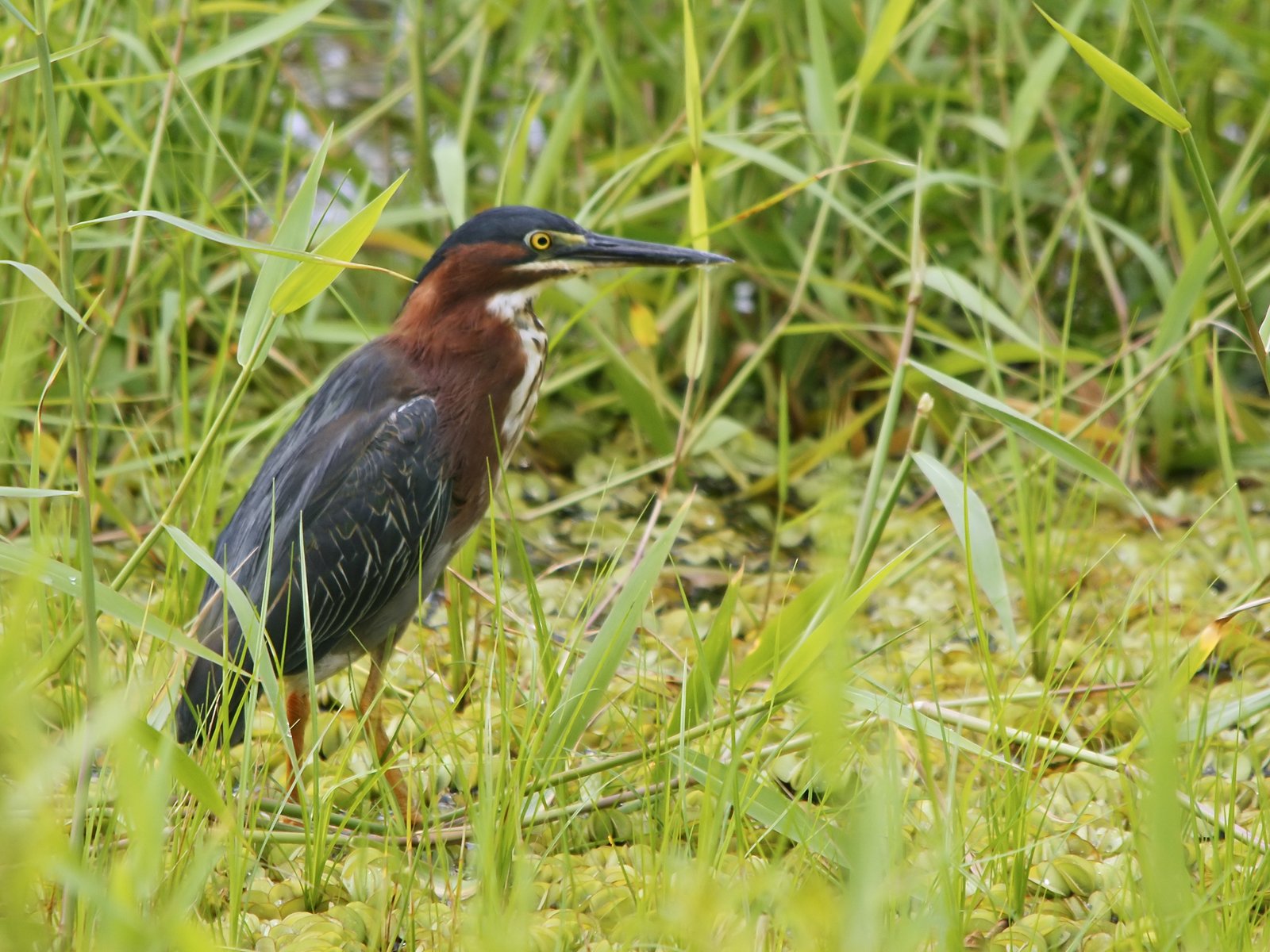
40–46 cm. Small and stocky, with short legs and a fairly long, pointed dark bill. Adults have a black crown with a short crest, a chestnut neck and sides of the head, a white stripe down the throat and foreneck, and dark, green-glossed back and wings with pale edges to the coverts. The legs are yellow, orange in the breeding season. The sexes are alike; the female is duller. Juveniles are brown, with a heavily streaked neck and underparts.
Confusion species
Striated Heron Butorides striata has a grey rather than chestnut neck; intermediates occur in Panama and northern Colombia, and juveniles often cannot be identified in the field. Least Bittern Botaurus exilis is smaller, with a pale wing patch and a black back.
Habitat
Mangroves, coastal lagoons, marshes and the banks of lakes and rivers with dense vegetation, in the lowlands. It waits still just above the water and seizes small fish, frogs, crustaceans and insects. It does not breed in the guide area.
Where the bird is most at home, classified by the vegetation units of the Andes and the west coast.


Range and movements
In Colombia a scarce winter visitor, mainly on the Caribbean coast and in the north-west; rarer farther inland. In Ecuador very rare, with a few records. Hardly or not known from Peru and Bolivia, and not from the Galápagos. Outside the guide area it breeds from southern Canada through the United States and Central America to Panama and in the Caribbean, and winters south to northern South America.
- Resident
- dark = core range, pale = thinly spread
How and when to look
Look for it between October and April in the mangroves and lagoons along the Caribbean coast of Colombia, for example around Santa Marta and Cartagena; check the neck colour of every Butorides.
Conservation status
Not Evaluated in the current circumscription of the species; widespread and numerous in its breeding range. Locally it suffers from the loss of wetlands and mangroves.
Scientific name
Butorides virescens | (Linnaeus, 1758)
Linnaeus described the species in 1758 as Ardea virescens; because it was later moved to another genus, the author and year stand in brackets. The genus Butorides was introduced in 1852 by Blyth. The genus name comes from Middle English butor, 'bittern', with the Greek suffix -oides, 'resembling'. The species name is Latin virescens, 'greenish, becoming green'. The specimen the first description was based on came from coast of South Carolina, United States.