All species › Pelicans, herons and ibises › Herons, egrets and bitterns › Great Egret
Great Egret | Ardea alba
Grote zilverreiger | Garceta grande | Garça-branca-grande
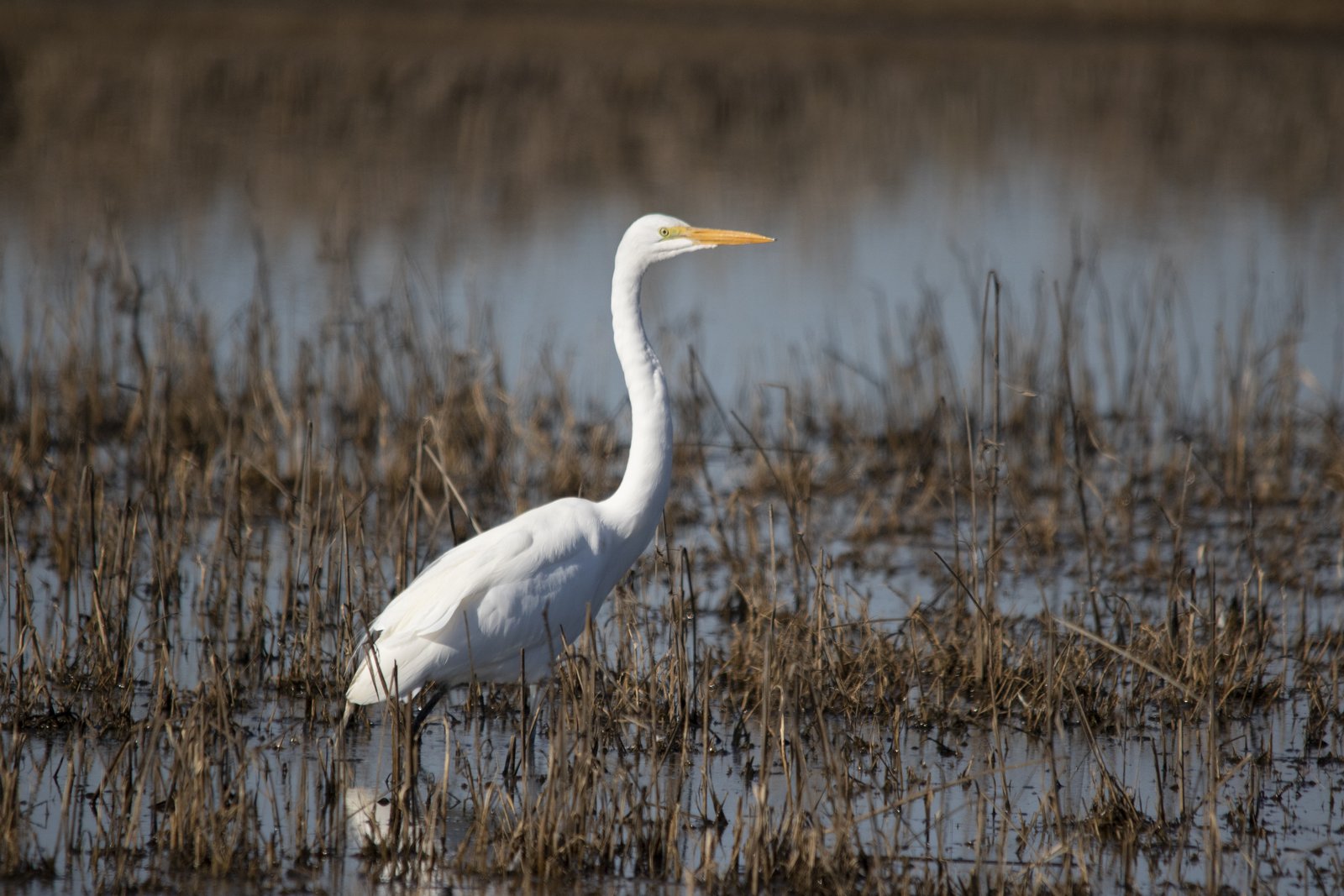
The Great Egret is the largest white heron of the guide area and occurs almost worldwide. It hunts by slow wading or by standing motionless in shallow water. In the guide area it lives in wetlands from the coast and the lowlands to the lakes of the Andes.
Voice
A low, croaking kraak or grok, mainly when disturbed and at colonies.
Recording: Xavier Riera — CC BY-NC-SA 4.0 · xeno-canto
Identification
85–100 cm. Large and slender, all white, with a long, S-shaped kinked neck. The bill is yellow, in the breeding season sometimes with a blackish tip; legs and toes are black. In the breeding season it carries long plumes on the back and the bare skin between eye and bill turns green. The gape line extends behind the eye. The sexes are alike. Juveniles resemble adults without plumes.
Confusion species
Snowy Egret Egretta thula is much smaller, with a black bill and yellow toes. Cattle Egret Ardea ibis is smaller and stockier, with a short yellow bill and a short neck. Juvenile Little Blue Herons Egretta caerulea are white, with a grey-blue, dark-tipped bill and greenish legs. Ibises and Wood Stork Mycteria americana fly with the neck extended; Great Egret retracts its neck.
Habitat
Marshes, lakes, riverbanks, wet grasslands, rice fields, mangroves, lagoons and mudflats, from sea level to about 3000 m, occasionally higher. It eats fish, frogs, crustaceans, insects and small mammals. It breeds in colonies, often together with other herons, in trees, shrubs or reeds over water; the nest is a platform of sticks.
Where the bird is most at home, classified by the vegetation units of the Andes and the west coast.


Range and movements
In Colombia widespread in the lowlands and locally in the Andes. In Ecuador on the coast, in the Amazonian lowlands and locally in the Andes. In Peru along the coast, in the Amazonian lowlands and locally in the highlands. In Bolivia in the lowlands and occasionally on the altiplano. On the Galápagos a scarce resident. Outside the guide area across much of the Americas, Europe, Africa, Asia and Australia.
- Resident
- dark = core range, pale = thinly spread
How and when to look
In the lagoons of the Peruvian coast, in the rice fields of the Ecuadorian coast and in the llanos and lowland wetlands it often stands in groups in shallow water together with other herons.
Conservation status
Least Concern. After persecution for its plumes around 1900 the species has recovered strongly; locally it suffers from the loss and pollution of wetlands.
Scientific name
Ardea alba | Linnaeus, 1758
Linnaeus described the species in 1758 and placed it straight away in the genus where it still stands. He introduced the genus Ardea in that same work. The genus name is Latin ardea, 'heron'. The species name is Latin albus, 'white'. The specimen the first description was based on came from Europe.