All species › Pelicans, herons and ibises › Herons, egrets and bitterns › Cattle Egret
Cattle Egret | Ardea ibis
Koereiger | Garcilla bueyera | Garça-vaqueira
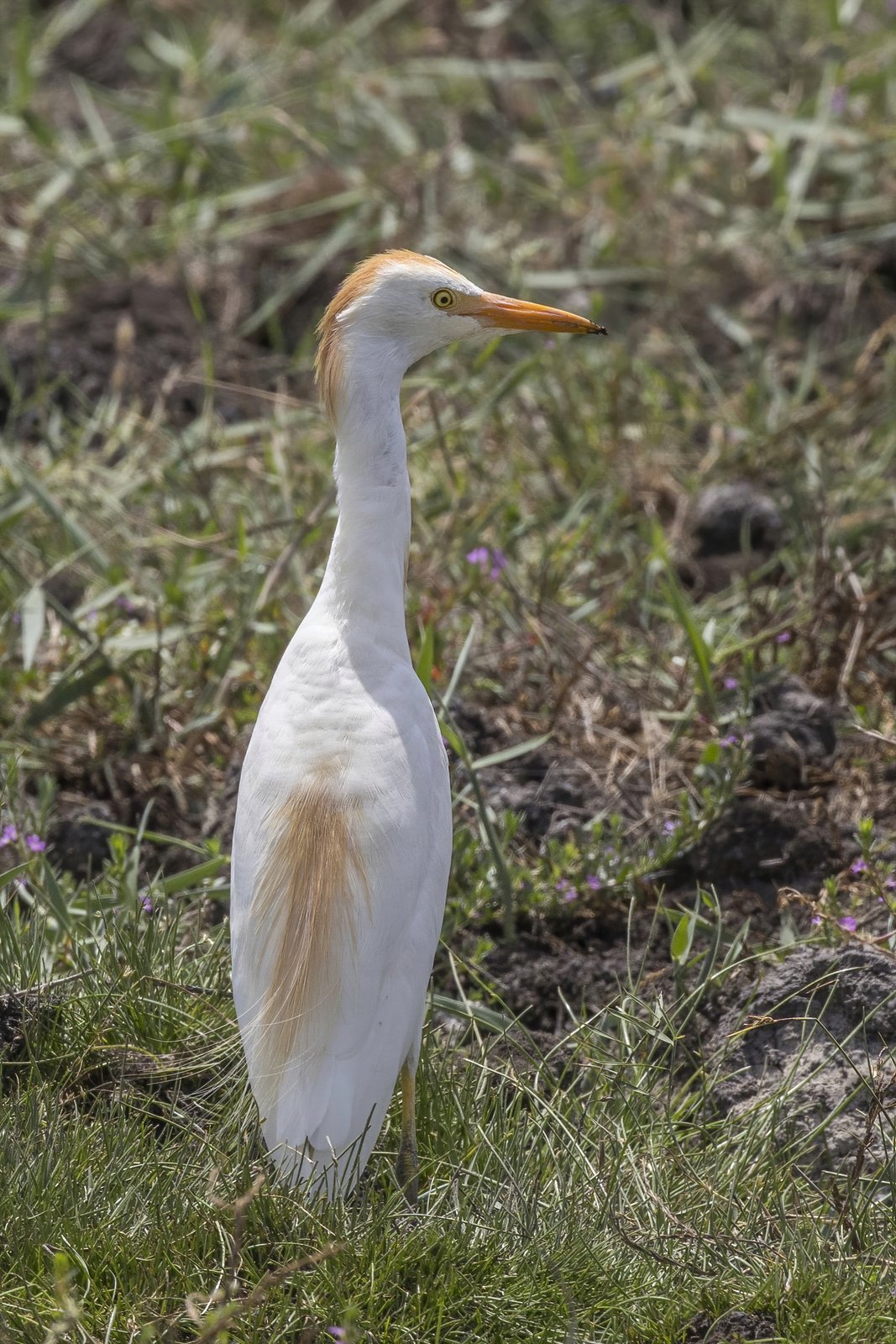
The Cattle Egret is a small, stocky white heron that feeds mainly on dry land, often among grazing livestock. It was originally found in Africa and southern Europe and reached north-eastern South America on its own around 1900. Since then it has spread over almost the entire guide area, high into the Andes and to the Galápagos.
Voice
Mostly silent away from colonies; at colonies a hoarse rick-rack and croaking sounds.
No recording with a suitable Creative Commons licence is available for this species yet.
Identification
46–53 cm. Small and stocky, with a short, thick neck, a short, strong yellow bill and a feathered jowl below the bill. Outside the breeding season all white, with dark legs. In the breeding season the crown, breast and back are buff to orange-brown, and the bill and legs turn orange-red for a short time. The sexes are alike. Juveniles are white, with a blackish bill that later turns yellow.
Confusion species
Great Egret Ardea alba is much larger and more slender, with a long neck. Snowy Egret Egretta thula is more slender, with a long, thin black bill and yellow toes. Juvenile Little Blue Herons Egretta caerulea are white, with a longer, grey-blue bill and a more slender neck.
Habitat
Pastures, ranchland, fields, rice fields, wet grasslands and roadsides, from sea level to about 3500 m, locally higher. It eats mainly grasshoppers and other insects flushed by livestock or farm machinery, also frogs, lizards and ticks. It breeds in large colonies, often with other herons, in trees and shrubs near or over water; at night it roosts in large groups.
Where the bird is most at home, classified by the vegetation units of the Andes and the west coast.


Range and movements
In Colombia widespread in the lowlands and in the Andes up to the Bogotá plateau. In Ecuador on the coast, in the Andean valleys and in the Amazonian lowlands. In Peru along the coast, in the Andean valleys and in the Amazonian lowlands. In Bolivia in the lowlands and in the Andean valleys. On the Galápagos established since the 1960s, mainly in the highlands of the large islands. Outside the guide area across much of the Americas, Africa, southern Europe and western Asia.
- Resident
- dark = core range, pale = thinly spread
How and when to look
On pastures with livestock in almost the whole guide area it walks in groups among the animals; towards evening flocks fly in lines to communal roosts in trees.
Conservation status
Not Evaluated in the current circumscription of the species, which treats Eastern Cattle Egret as a separate species; as a whole widespread and numerous. It benefits from the conversion of forest into pasture.
Scientific name
Ardea ibis | Linnaeus, 1758 (GBIF: Bubulcus ibis)
Linnaeus described the species in 1758 and placed it straight away in the genus where it still stands. He introduced the genus Ardea in that same work. The genus name is Latin ardea, 'heron'. The species name is Greek and Latin ibis, the name of the sacred bird of ancient Egypt; Linnaeus applied it to this Egyptian heron. The specimen the first description was based on came from Egypt.