All species › Passerines › Tyrant flycatchers and allies › Caribbean Elaenia
Caribbean Elaenia | Elaenia martinica
Witbuikelenia | Elenia caribeña | Guaracava-do-caribe
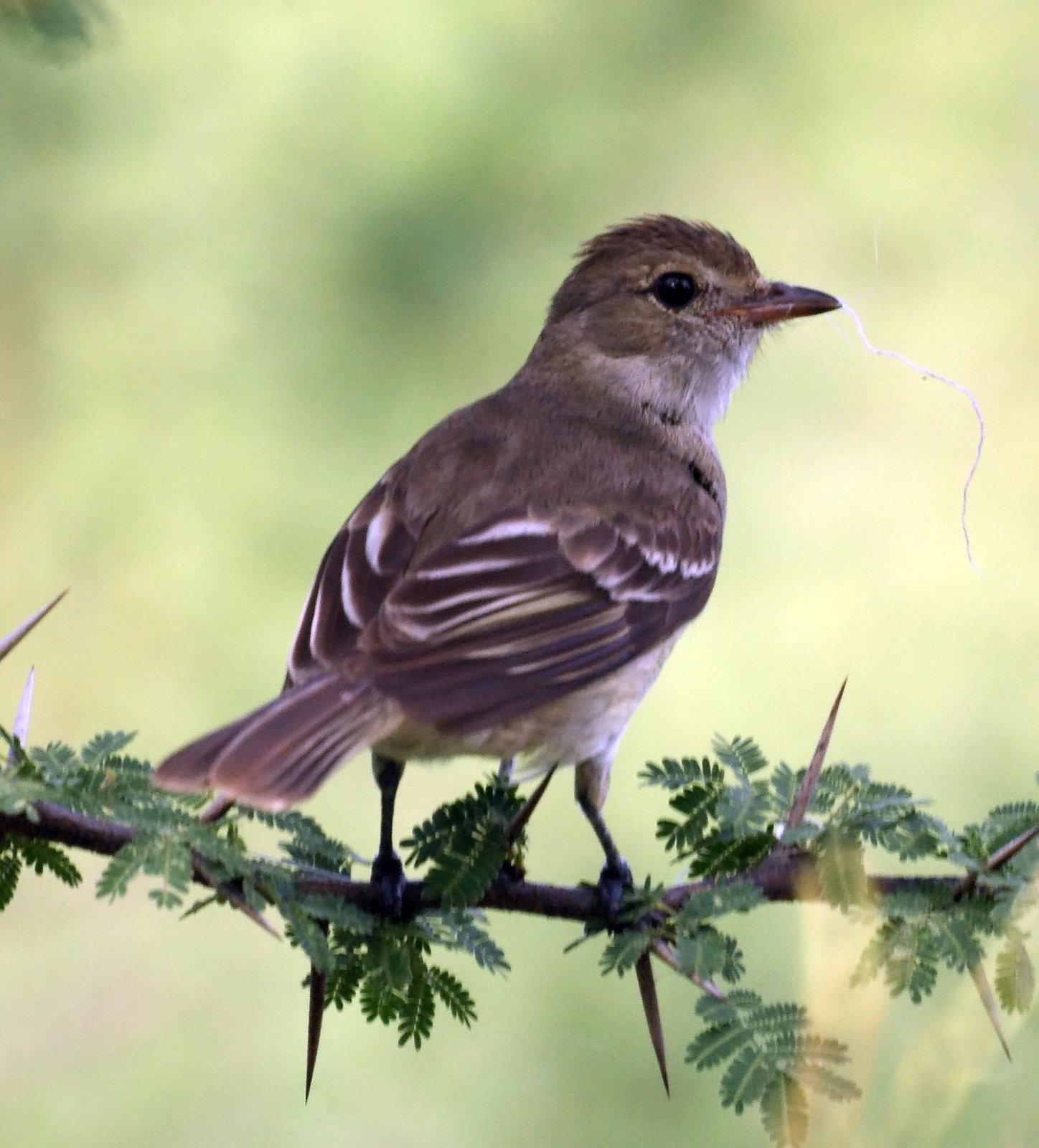
The Caribbean Elaenia is an elaenia of the islands of the Caribbean. In the guide area it lives only on San Andrés and Providencia, the Colombian islands off the coast of Nicaragua. There it is the only elaenia, and it is common in scrub and gardens.
Voice
A husky, somewhat rattling wee-jee-jeew and a husky call like byeer. It sings mainly in the early morning from a perch in a tree.
Recording: Étienne Leroy — CC BY-NC-SA 4.0 · xeno-canto
Identification
16 cm, with a small crest with a partly concealed white patch and a fairly stout bill with a pink to pale base to the lower mandible. The upperparts are greyish olive to brownish olive, the wings dark with two whitish wing bars and pale edges to the tertials. There is an indistinct pale eye-ring. The throat and breast are grey, and the belly is whitish with a faint yellow wash, especially on the undertail coverts. The sexes are alike.
Confusion species
No other elaenias occur on San Andrés and Providencia. San Andres Vireo Vireo caribaeus is smaller, without a crest, with yellow lores and a thicker, slightly hooked bill. Black-whiskered Vireo Vireo altiloquus has a dark eye-stripe, a narrow black whisker and a red eye. The mainland Yellow-bellied Elaenia Elaenia flavogaster is yellower below and has a more obvious, split crest.
Habitat
Dry scrub, secondary woodland, forest edges, mangrove edges, gardens and yards, on the islands from sea level to the hills. It eats insects and many small fruits. The nest is a small, open cup of plant fibres in a tree or shrub.
Where the bird is most at home, classified by the vegetation units of the Andes and the west coast.


Range and movements
Colombia: only on the islands of San Andrés and Providencia (with Santa Catalina) in the Caribbean Sea. Absent from mainland Colombia, Ecuador, Peru, Bolivia and the Galápagos. Outside the guide area on many islands in the Caribbean, from Puerto Rico and the Lesser Antilles to the Cayman Islands, Aruba, Curaçao and Bonaire and islands off the Yucatán coast.
- Resident
- dark = core range, pale = thinly spread
How and when to look
Search gardens and scrub along the roads of San Andrés or Providencia; birds often perch on an open branch and call regularly.
Conservation status
Least Concern. On the small islands the population is limited, but the species tolerates human-modified landscapes.
Scientific name
Elaenia martinica | (Linnaeus, 1766)
Linnaeus described the species in 1766 as [Muscicapa] martinica; because it was later moved to another genus, the author and year stand in brackets. The genus Elaenia was introduced in 1836 by Sundevall. The genus name comes from Ancient Greek elaineos, 'of olive oil' or 'oleaginous'. Refers to the island of Martinique, not necessarily the only place where the species occurs. The specimen the first description was based on came from Martinique.