All species › Passerines › Tyrant flycatchers and allies › Mountain Elaenia
Mountain Elaenia | Elaenia frantzii
Bergelenia | Elenia montañera | Guaracava-montanhesa
The Mountain Elaenia is an olive-brown elaenia with a rounded, uncrested head, found at forest edges, in pastures with trees and in coffee plantations in the mountains. Its range extends from Guatemala to northern South America; in the guide area it occurs only in Colombia. It eats much fruit and partly moves up and down the slopes in search of it.
Voice
A flat, slightly falling whistle peeuw, often repeated. The dawn song is a husky, two-part chee-burr, repeated endlessly at twilight.
Recording: Marcela Morales sánchez — CC BY-NC-SA 4.0 · xeno-canto
Identification
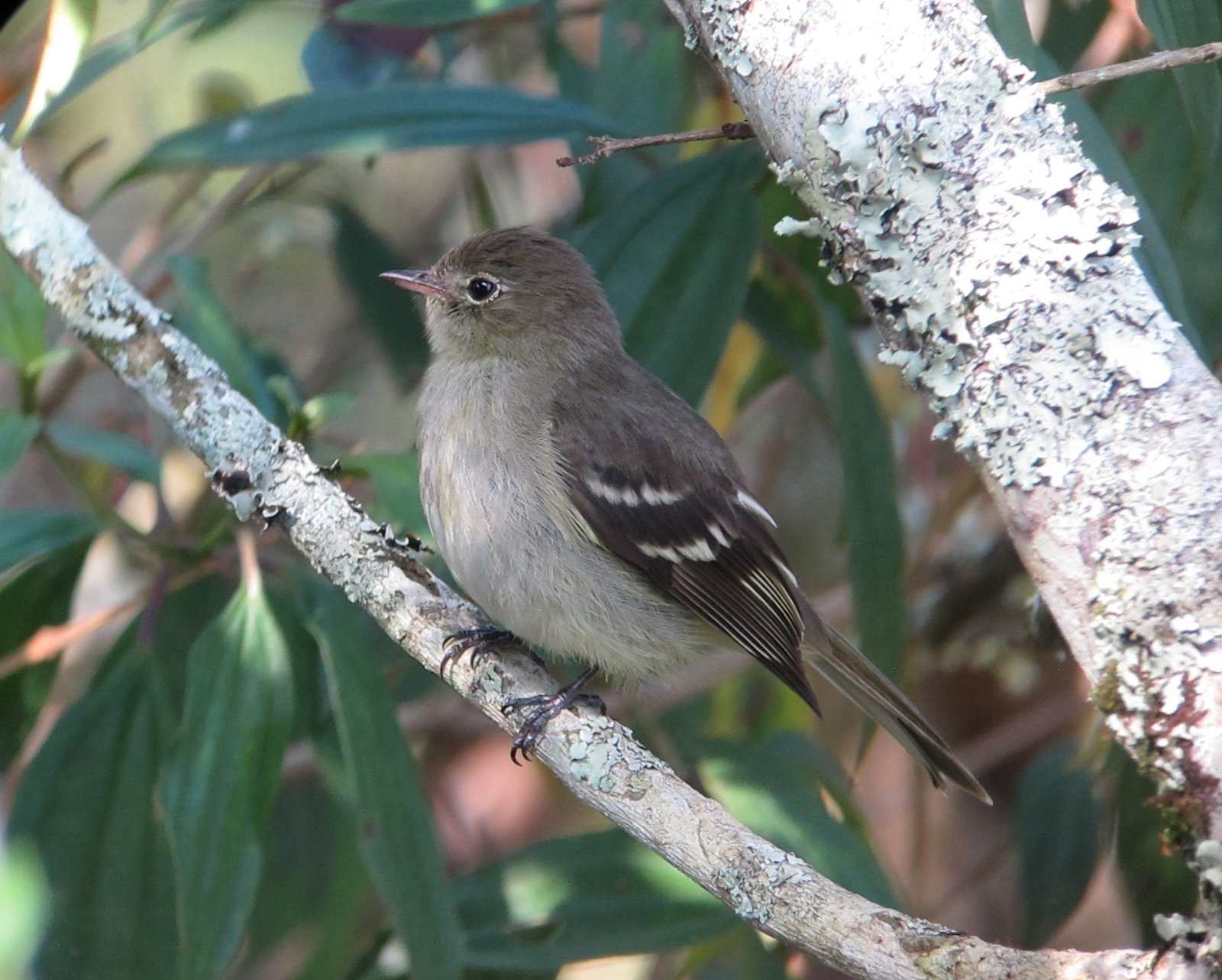
14.5 cm, with a rounded head without a crest and usually without visible white in the crown, and a small, narrow bill with a pale base to the lower mandible. The upperparts are olive-brown, the face greyish with a pale eye-ring. The wings are dark, with two pale, somewhat yellowish wing bars and pale edges to the tertials. The throat and breast are greyish olive, and the belly is pale yellow. The sexes are alike.
Confusion species
Sierran Elaenia Elaenia pallatangae has a short crest with white and a yellower belly, and is greener above. White-crested Elaenia Elaenia albiceps has a white crown stripe and a whitish belly. Yellow-bellied Elaenia Elaenia flavogaster has an obvious, split crest and usually lives lower. Greenish Elaenia Myiopagis viridicata lacks distinct wing bars, has a yellow crown patch and lives inside forest.
Habitat
Forest edges, clearings in cloud forest, pastures with scattered trees, hedgerows, coffee plantations and gardens, in Colombia roughly between 1500 and 3200 m. It eats mainly small fruits, also insects. The nest is an open cup of moss and plant fibres in a tree or shrub.
Where the bird is most at home, classified by the vegetation units of the Andes and the west coast.


Range and movements
Colombia: in the Andes, the Sierra Nevada de Santa Marta and the Serranía de Perijá. Absent from Ecuador, Peru, Bolivia and the Galápagos. Outside the guide area in the mountains of Venezuela and from Guatemala to Panama.
- Resident
- dark = core range, pale = thinly spread
How and when to look
Search pastures with scattered trees and forest edges in the mountains, especially near fruiting shrubs. In the early morning it gives itself away by its repeated dawn song.
Conservation status
Least Concern. The species is common in semi-open mountain country and in shade coffee.
Scientific name
Elaenia frantzii | Lawrence, 1865
Lawrence described the species in 1865 and placed it straight away in the genus where it still stands. The genus Elaenia was introduced in 1836 by Sundevall. The genus name comes from Ancient Greek elaineos, 'of olive oil' or 'oleaginous'. Honours Alexander von Frantzius (1821–1877), a German physician and naturalist who worked in Costa Rica for about fifteen years and collected the type specimen. The specimen the first description was based on came from San José, Costa Rica.