All species › Passerines › Tyrant flycatchers and allies › Sierran Elaenia
Sierran Elaenia | Elaenia pallatangae
Andeselenia | Fiofío serrano | Guaracava-serrana
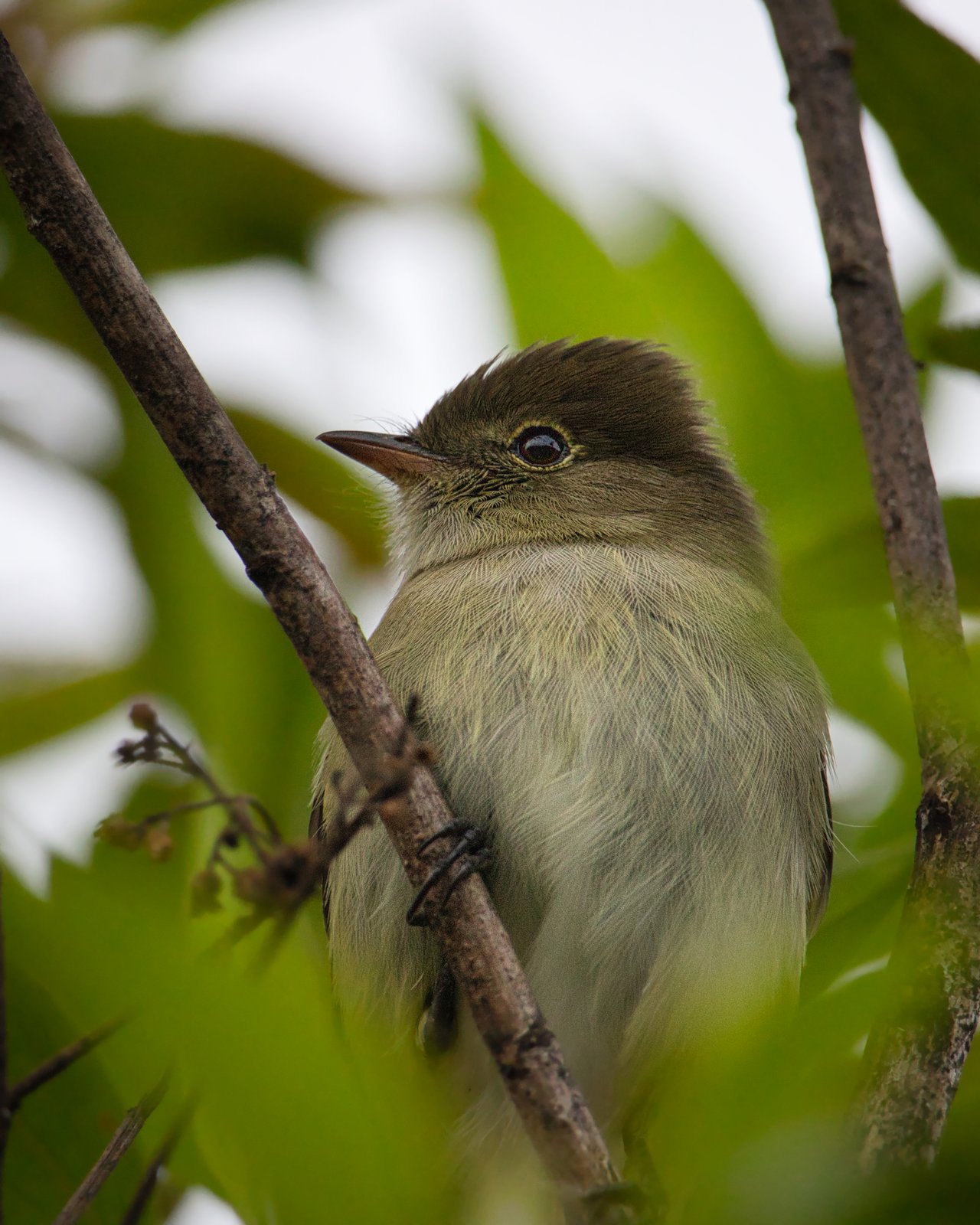
The Sierran Elaenia is an olive elaenia with a yellow belly, found at shrubby forest edges and clearings in montane forest in the Andes, from Colombia to Bolivia. At middle elevations it is one of the most numerous elaenias, but it closely resembles other montane species. It eats much fruit and often sits among berry-bearing shrubs.
Voice
Husky, somewhat squeaky calls such as jeew and wheew, and a short, dry rattle. The dawn song is a repeated series of husky notes, often in the twilight before sunrise.
Recording: José María Loaiza B. — CC BY-NC-SA 4.0 · xeno-canto
Identification
15 cm, with a short, rounded crest with a partly concealed white patch and a narrow bill with a pale base to the lower mandible. The upperparts are olive, the wings dark with two pale wing bars and pale edges to the tertials. There is a whitish eye-ring. The throat and breast are greyish olive, and the belly is clearly pale yellow. The sexes are alike.
Confusion species
White-crested Elaenia Elaenia albiceps is smaller and greyer, with a white crown stripe and a whitish belly. Mountain Elaenia Elaenia frantzii has a rounder head without a crest or white in the crown, and is browner above. Highland Elaenia Elaenia obscura is larger and darker olive, with a broader bill and no white in the crown. Coopmans's Elaenia Elaenia brachyptera is smaller, with a greyer breast, and usually lives lower.
Habitat
Forest edges, shrubby clearings, young woodland, hedgerows and scrub between pastures and fields in the Andes, roughly between 1500 and 3200 m, locally higher. It eats many small fruits, including those of Miconia, and insects, often in mixed flocks. The nest is a small open cup in a shrub or low tree.
Where the bird is most at home, classified by the vegetation units of the Andes and the west coast.


Range and movements
Colombia: in the Andes, mainly in the Central and Western Cordilleras, locally in the Eastern. Ecuador: on both slopes of the Andes and in the inter-Andean valleys. Peru: on the eastern slope of the Andes throughout, in the north also on the western slope. Bolivia: on the eastern slope of the Andes in La Paz, Cochabamba and Santa Cruz. Absent from the Galápagos. The species barely occurs outside the guide area.
- Resident
- dark = core range, pale = thinly spread
How and when to look
Search along roads with shrubby verges through montane forest, especially where berry-bearing shrubs grow. Birds often perch in the open on the outside of a bush and call regularly.
Conservation status
Least Concern. The species is common in semi-open and partly deforested mountain landscapes.
Scientific name
Elaenia pallatangae | Sclater, 1862
Sclater described the species in 1862 and placed it straight away in the genus where it still stands. The genus Elaenia was introduced in 1836 by Sundevall. The genus name comes from Ancient Greek elaineos, 'of olive oil' or 'oleaginous'. Refers to Pallatanga in Chimborazo province, Ecuador. The specimen the first description was based on came from Pallatanga, Chimborazo, Ecuador.