All species › Passerines › Tyrant flycatchers and allies › White-crested Elaenia
White-crested Elaenia | Elaenia albiceps
Witkuifelenia | Fiofío crestiblanco | Guaracava-de-crista-branca
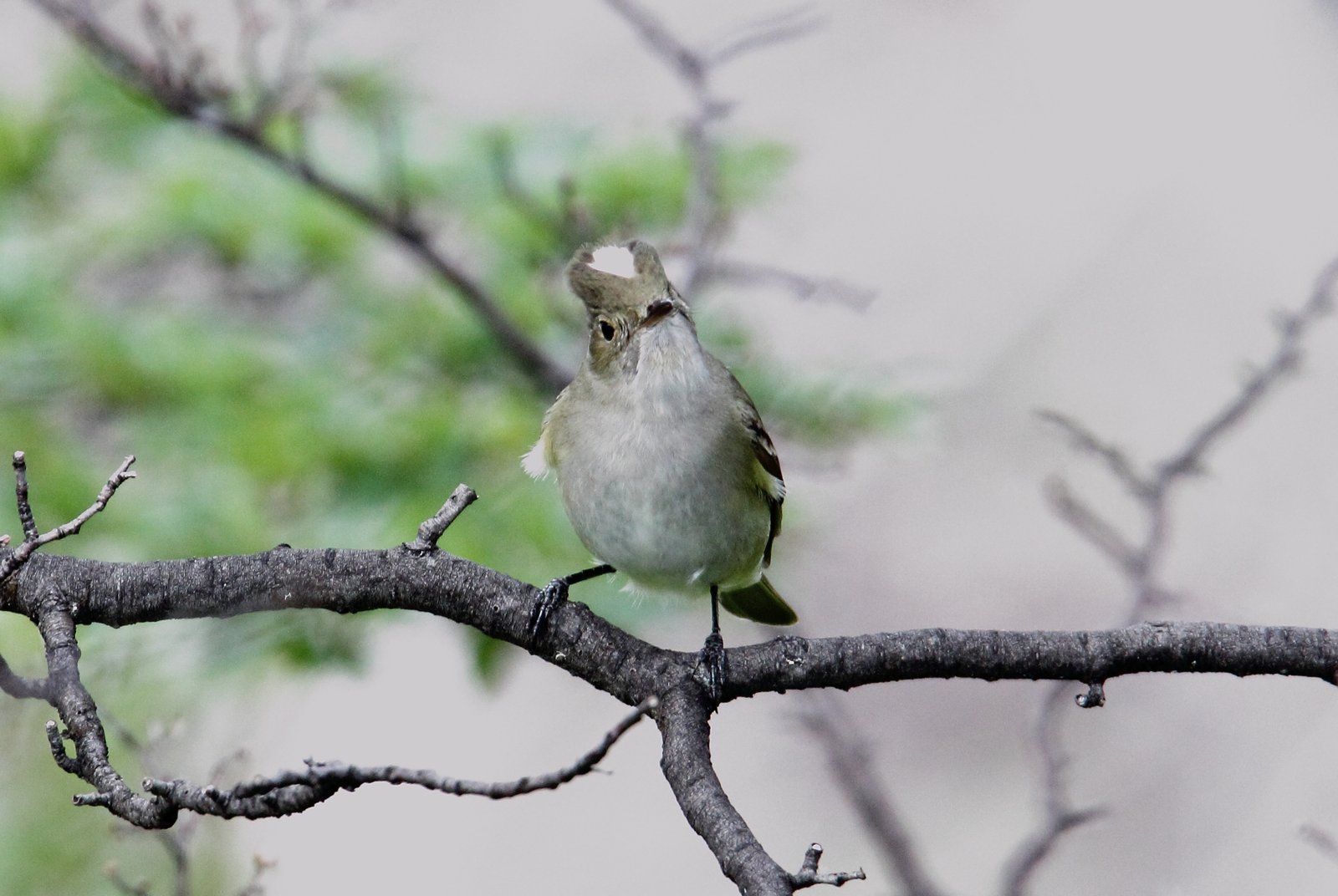
The White-crested Elaenia is a greyish-olive elaenia with a white stripe in the crown, which lives in the Andes from Colombia to Bolivia and breeds far into the south of the continent. Birds from Chile and Argentina move north in the austral winter and winter, among other places, in the lowlands east of the Andes. As a result the species occurs in the guide area both as a resident and as a winter visitor.
Voice
A clear, whistled feew and a soft, husky wee-jew. The song is a short series of husky, rolling notes, mainly in the early morning.
Recording: Juan Freile — CC BY-NC-SA 4.0 · xeno-canto
Identification
14–15 cm, with a small, narrow bill and a short crest with a white central stripe that is often visible. The upperparts are greyish olive, the wings dark with two white wing bars and whitish edges to the tertials. There is a narrow, pale eye-ring. The throat and breast are grey, and the belly is whitish with at most a faint yellow wash. The sexes are alike; young birds are browner above with little white in the crown.
Confusion species
Sierran Elaenia Elaenia pallatangae is larger and clearly yellower below, with less white in the crown. Mountain Elaenia Elaenia frantzii has a rounded head without a white crown stripe and a yellower belly. Small-billed Elaenia Elaenia parvirostris also winters in the Amazonian lowlands, but has a shorter bill, a more distinct eye-ring and often three wing bars. Highland Elaenia Elaenia obscura is larger and darker olive, without white in the crown.
Habitat
Scrub and forest edges in the Andes, light montane woodland, Polylepis groves, hedgerows, riparian scrub and gardens, in the north mainly between about 2000 and 3500 m, in the south also in dry valleys. Winter visitors live in forest edges, scrub and riverside vegetation in the lowlands. It eats insects and many small fruits and berries. The nest is an open cup of moss and plant fibres in a shrub.
Where the bird is most at home, classified by the vegetation units of the Andes and the west coast.


Range and movements
Colombia: in the Andes of the south. Ecuador: in the Andes, mainly in the inter-Andean valleys and on the higher slopes. Peru: in the Andes throughout, on both slopes. Bolivia: in the Andes and the dry valleys of the eastern slope. Austral migrants in the lowlands east of the Andes in Peru and Bolivia, with scattered records farther north. Absent from the Galápagos. Outside the guide area in Chile and Argentina to Tierra del Fuego; southern birds move in winter as far as Brazil.
- Resident
- dark = core range, pale = thinly spread
How and when to look
Search hedgerows and scrub around fields and villages in the Andes; birds often perch on the outside of bushes and pick berries. Winter visitors can be found from May to September in forest edges in the lowlands.
Conservation status
Least Concern. The species tolerates shrubby farmland well.
Scientific name
Elaenia albiceps | (d'Orbigny, ACVMD & de Lafresnaye, 1837)
D'Orbigny, ACVMD & de Lafresnaye described the species in 1837 as M[uscipeta] albiceps; because it was later moved to another genus, the author and year stand in brackets. The genus Elaenia was introduced in 1836 by Sundevall. The genus name comes from Ancient Greek elaineos, 'of olive oil' or 'oleaginous'. From Latin albus, 'white', and -ceps, 'headed': 'white-headed', after the white crown patch. The specimen the first description was based on came from Yungas, Bolivia.