All species › Passerines › Tyrant flycatchers and allies › Coopmans's Elaenia
Coopmans's Elaenia | Elaenia brachyptera
Coopmans' elenia | Fiofío de Coopmans | Chibum-de-coopmans
Coopmans's Elaenia was long treated as a subspecies of Lesser Elaenia; on the basis of differences in song and calls it is now treated as a separate species. It lives in two separate areas: on the western slope in south-western Colombia and northern Ecuador, and on the eastern slope of the Andes in Ecuador. The name honours the ornithologist Paul Coopmans, who worked extensively in Ecuador.
Voice
The dawn song differs slightly between the two populations: in the west a tsee… tsee… chee-wee, in the east a wit… wit… weedeew. By day a burry series such as bweer, wheeb, wher-r-r-r. In addition a rattle lasting up to about a second, with up to fifteen notes.
Recording: LUIS SALAGAJE — CC BY-NC-SA 4.0 · xeno-canto
Identification
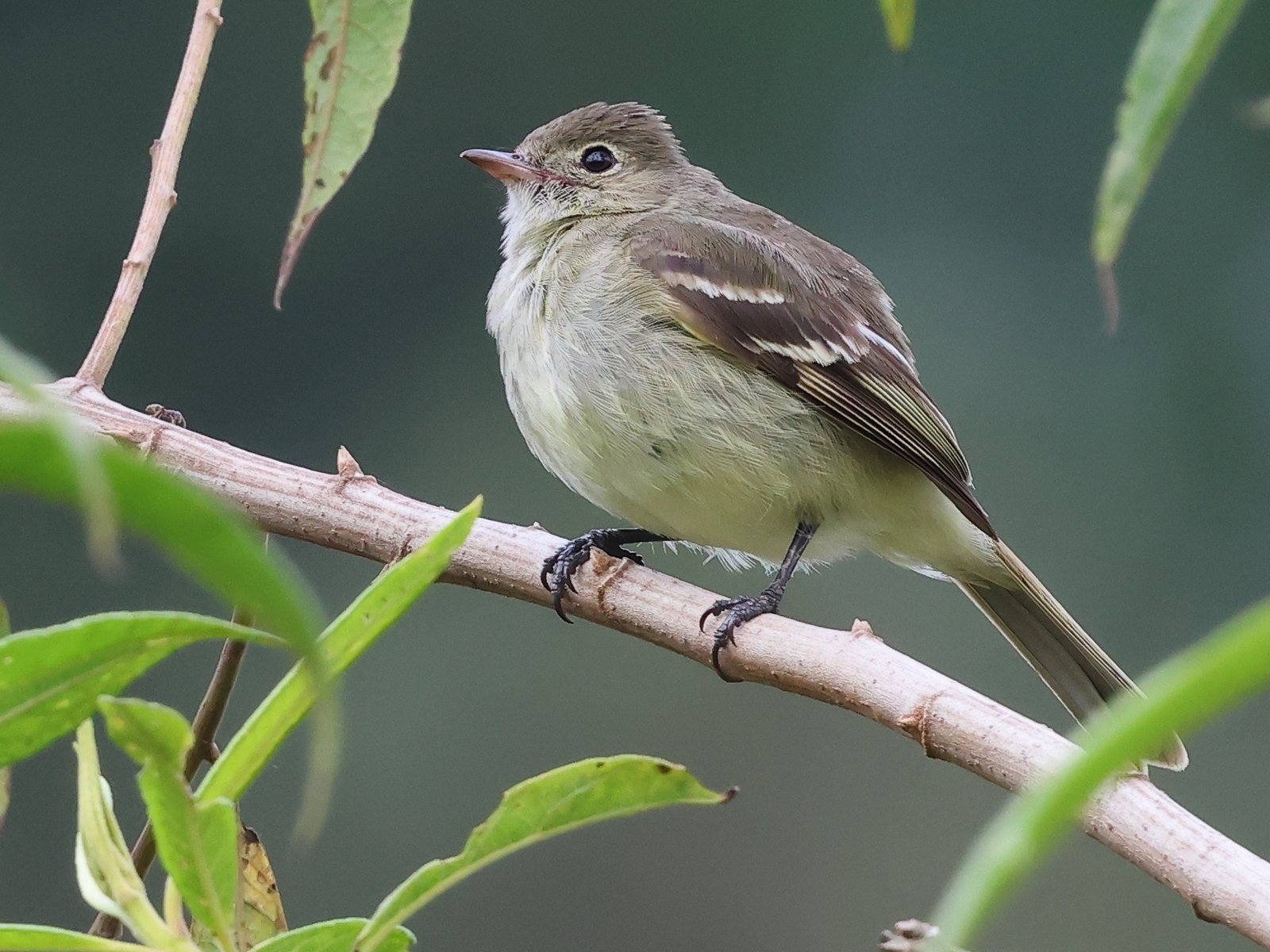
13.5 cm, with a small, somewhat squarish crest and a small bill, black with a pink base to the lower mandible. The head and upperparts are brownish olive, with paler cheeks, a narrow whitish eye-ring and a mostly concealed white crown patch. The wings are dark, with two broad white wing bars and whitish feather edges. The throat is grey, the breast greyish olive, and the belly and undertail coverts pale yellow. The legs are black. The sexes are alike.
Confusion species
Lesser Elaenia Elaenia chiriquensis is almost identical in plumage; Coopmans's Elaenia differs mainly in its song and in a rattling call not known from Lesser Elaenia. Sierran Elaenia Elaenia pallatangae is larger, with a yellower belly, and usually lives higher. White-crested Elaenia Elaenia albiceps has a white central crown stripe that is more often visible and a whiter belly. Yellow-bellied Elaenia Elaenia flavogaster is larger, with a prominent crest and a loud, harsh voice.
Habitat
Semi-open country: light woodland, clearings, forest edges and scrub along roads and pastures. In the west roughly between 700 and 2800 m, in the east between about 900 and 1900 m. It eats insects and small fruits. Little is known about the nest.
Where the bird is most at home, classified by the vegetation units of the Andes and the west coast.


Range and movements
Colombia: in the south-west, in Nariño, on the western slope of the Andes. Ecuador: on the western slope south to northern Pichincha, and separately on the eastern slope in Napo and Morona-Santiago. Peru: possibly in the north-east, but unconfirmed. Absent from Bolivia and the Galápagos. The species does not occur outside the guide area.
- Resident
- dark = core range, pale = thinly spread
How and when to look
Listen in the early morning in semi-open country and along forest edges at the right elevation for the dawn song and the rattle. A recording of the voice is often needed to separate it from Lesser Elaenia.
Conservation status
Least Concern. The species is poorly known; its distribution and numbers are uncertain because it was long not separated from Lesser Elaenia.
Scientific name
Elaenia brachyptera | Berlepsch, 1907
Berlepsch described the species in 1907 and placed it straight away in the genus where it still stands. The genus Elaenia was introduced in 1836 by Sundevall. The genus name comes from Ancient Greek elaineos, 'of olive oil' or 'oleaginous'. From Ancient Greek brachys, 'short', and pteron, 'wing': 'short-winged'. The specimen the first description was based on came from San Pablo, Nariño, Colombia.