All species › Passerines › Tyrant flycatchers and allies › Lesser Elaenia
Lesser Elaenia | Elaenia chiriquensis
Kleine elenia | Elenia menor | Chibum
The Lesser Elaenia is a small, greyish-olive elaenia of savanna, shrubby pastures and other semi-open country in the lowlands and on the lower slopes. It closely resembles several other elaenias and in the field is identified mainly by voice. In the guide area it is most numerous in Colombia and in the savannas of Bolivia.
Voice
A short, husky, somewhat burry call, rendered as jwebu or chewp, often repeated. The dawn song is a rapid repetition of such notes, mixed with short whistles.
Recording: JAYRSON ARAUJO DE OLIVEIRA — CC BY-NC-SA 4.0 · xeno-canto
Identification
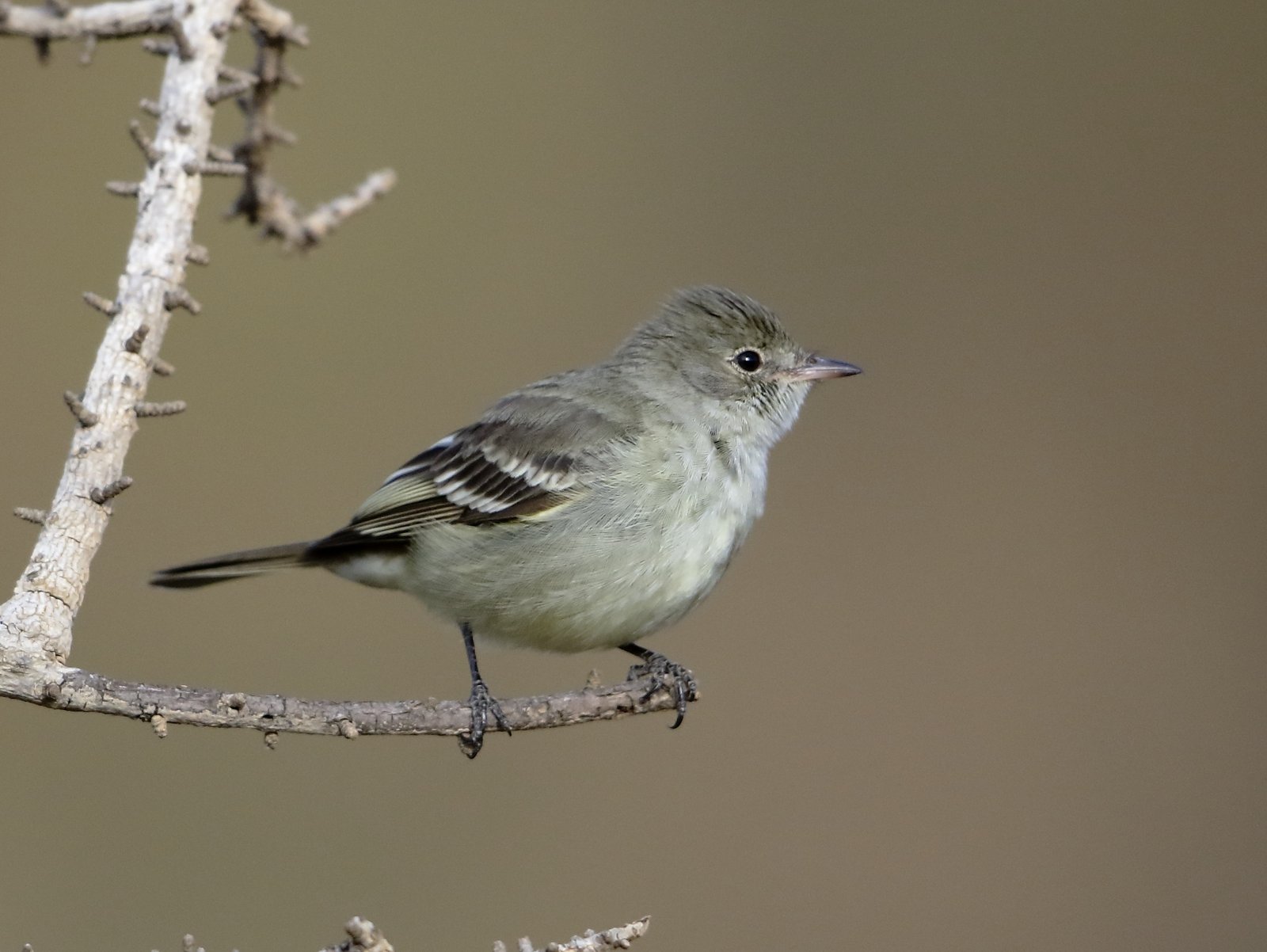
13.5 cm, with a rounded head without an obvious crest and a small, narrow bill with a pale base to the lower mandible. The upperparts are brownish olive, the wings dark with two whitish wing bars and pale edges to the tertials. There is a narrow, indistinct white eye-ring. The crown has a white patch that usually stays concealed. The throat and breast are pale grey with an olive wash, and the belly is pale yellow to whitish. The sexes are alike; young birds lack the white crown patch.
Confusion species
Yellow-bellied Elaenia Elaenia flavogaster is larger, with an obvious, often split crest, a yellower belly and a harsh, loud voice. Small-billed Elaenia Elaenia parvirostris is whiter below, with a more distinct eye-ring and often three wing bars. Coopmans's Elaenia Elaenia brachyptera is almost identical in plumage and is separated mainly by voice, including a short rattle. Plain-crested Elaenia Elaenia cristata is darker, with a bushy crest lacking white, and lives in open savanna.
Habitat
Savanna with scattered shrubs and trees, shrubby pastures, forest edges, open country with hedgerows and gardens, mainly in the lowlands and up to about 1800 m, locally higher. It eats insects and small fruits, taken from a perch in shrubs and low trees. The nest is a small, open cup of plant fibres and moss in a shrub or tree fork.
Where the bird is most at home, classified by the vegetation units of the Andes and the west coast.


Range and movements
Colombia: widespread in the Caribbean lowlands, the Llanos, the inter-Andean valleys and on the lower slopes. Ecuador: local and poorly known; older records from the west partly refer to Coopmans's Elaenia. Peru: local in open country and savanna east of the Andes. Bolivia: in the savannas and cerrado of Beni and Santa Cruz and in semi-open country at the foot of the Andes. Absent from the Galápagos. Outside the guide area from Costa Rica to Venezuela and the Guianas and in Brazil, Paraguay and north-eastern Argentina.
- Resident
- dark = core range, pale = thinly spread
How and when to look
Search shrubby pastures and savannas in the early morning, when birds sing from an open branch. Concentrate on the voice; without sound, identification among small elaenias often remains uncertain.
Conservation status
Least Concern. The species is common in semi-open, human-modified landscapes.
Scientific name
Elaenia chiriquensis | Lawrence, 1865
Lawrence described the species in 1865 and placed it straight away in the genus where it still stands. The genus Elaenia was introduced in 1836 by Sundevall. The genus name comes from Ancient Greek elaineos, 'of olive oil' or 'oleaginous'. Refers to Chiriquí in western Panama, where the first specimens came from. The specimen the first description was based on came from David, Chiriquí, Panama.