All species › Passerines › Tyrant flycatchers and allies › Large Elaenia
Large Elaenia | Elaenia spectabilis
Grote elenia | Fiofío grande | Guaracava-grande
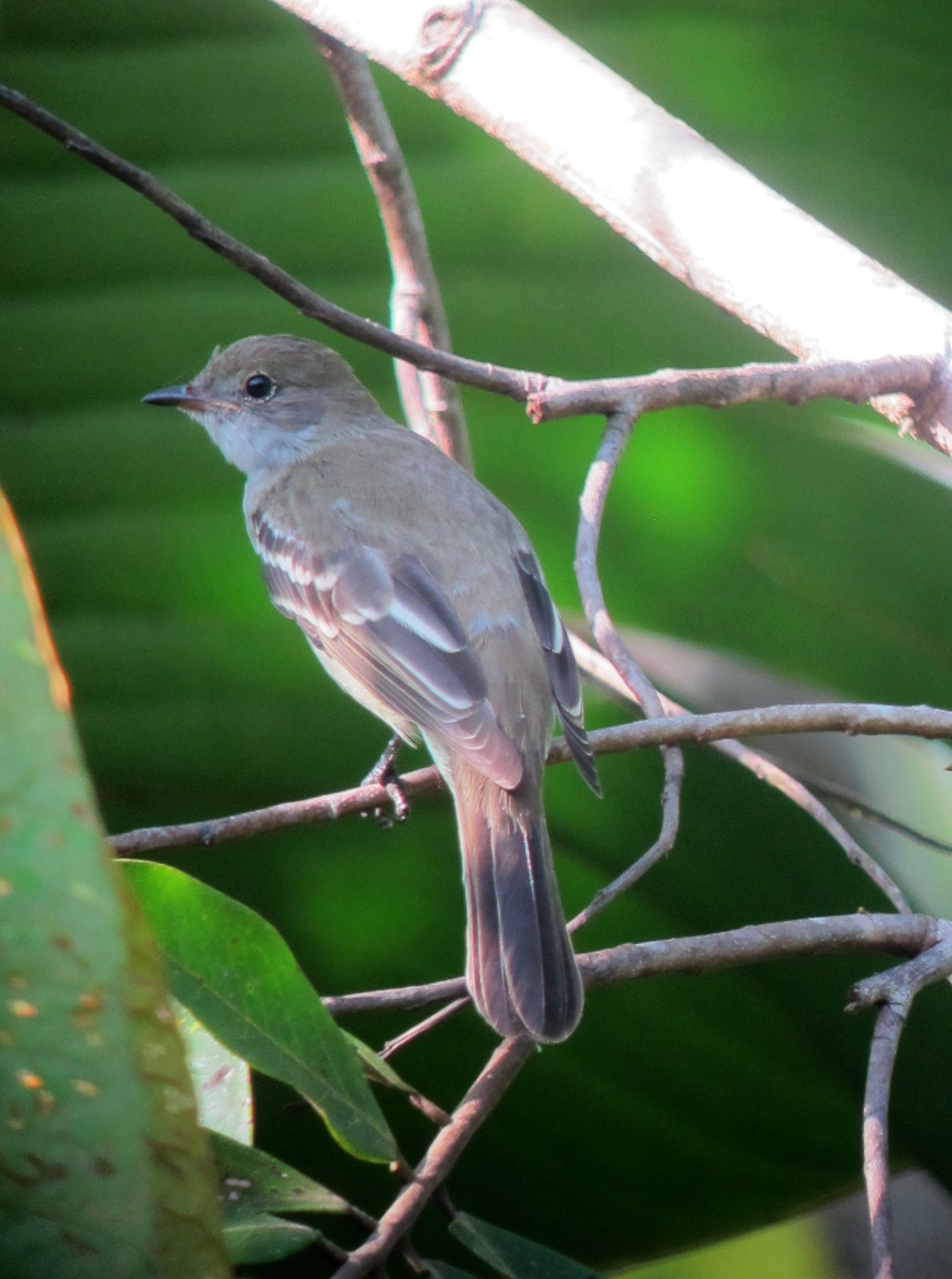
The Large Elaenia is a large, crestless elaenia with a dark grey breast and a yellow belly. Part of the population breeds in the southern Amazon Basin and the Chaco region and moves to western Amazonia in the austral winter. In the guide area it is then scattered through the eastern lowlands.
Voice
A soft cleeur or wheeo and short wheer calls; the dawn song is a shrill, repeated twee-wee-tweet.
Recording: Marcos E. Sosa — CC BY-NC-SA 4.0 · xeno-canto
Identification
17–18 cm, with an olive-brown head with a small crest and little or no white in the crown. The upperparts are dark greyish olive. The wings are dark with white tips to the coverts that form three wing bars. The throat is grey, the breast dark olive-grey, the belly and undertail coverts yellow. The bill is black with a pale pinkish base to the lower mandible. The sexes are alike.
Confusion species
Yellow-bellied Elaenia Elaenia flavogaster has a shaggy, often raised crest with a distinct white crown patch and two wing bars. Small-billed Elaenia Elaenia parvirostris is smaller, with a whitish belly and a distinct white eye-ring. Lesser Elaenia Elaenia chiriquensis is smaller and paler. Brownish Elaenia Elaenia pelzelni is brown with a whitish belly.
Habitat
Edges and openings in lowland forest, secondary forest and young riparian woodland; in winter mainly along rivers, on river islands and at fruiting trees, also in the lower foothills. It eats fruit and insects.
Where the bird is most at home, classified by the vegetation units of the Andes and the west coast.


Range and movements
Bolivia: year-round in the south-east, breeding in the austral summer; in the north mainly a winter visitor. Peru, Ecuador and Colombia: winter visitor in the eastern lowlands. Absent from the Galápagos. Outside the guide area it breeds in southern and central Brazil, Paraguay, Uruguay and northern Argentina; winter visitor in western Amazonian Brazil.
- Resident
- Summer visitor (c. Apr–Sep)
- Winter visitor (c. Oct–Mar)
- Passage (Mar–Apr, Oct–Nov)
- dark = core range, pale = thinly spread
How and when to look
In the austral winter search forest edges along Amazonian rivers and on river islands, for example near Iquitos or along the Napo; look for a large, crestless elaenia with a dark breast and yellow belly.
Conservation status
Least Concern. Tolerates forest edges and secondary forest.
Scientific name
Elaenia spectabilis | Pelzeln, 1868
Pelzeln described the species in 1868 and placed it straight away in the genus where it still stands. The genus Elaenia was introduced in 1836 by Sundevall. The genus name comes from Ancient Greek elaineos, 'of olive oil' or 'oleaginous'. Latin spectabilis, 'notable' or 'remarkable'. The specimen the first description was based on came from Goiás, Brazil.