All species › Passerines › Tyrant flycatchers and allies › Brownish Elaenia
Brownish Elaenia | Elaenia pelzelni
Bruine elenia | Fiofío pardo | Guaracava-parda
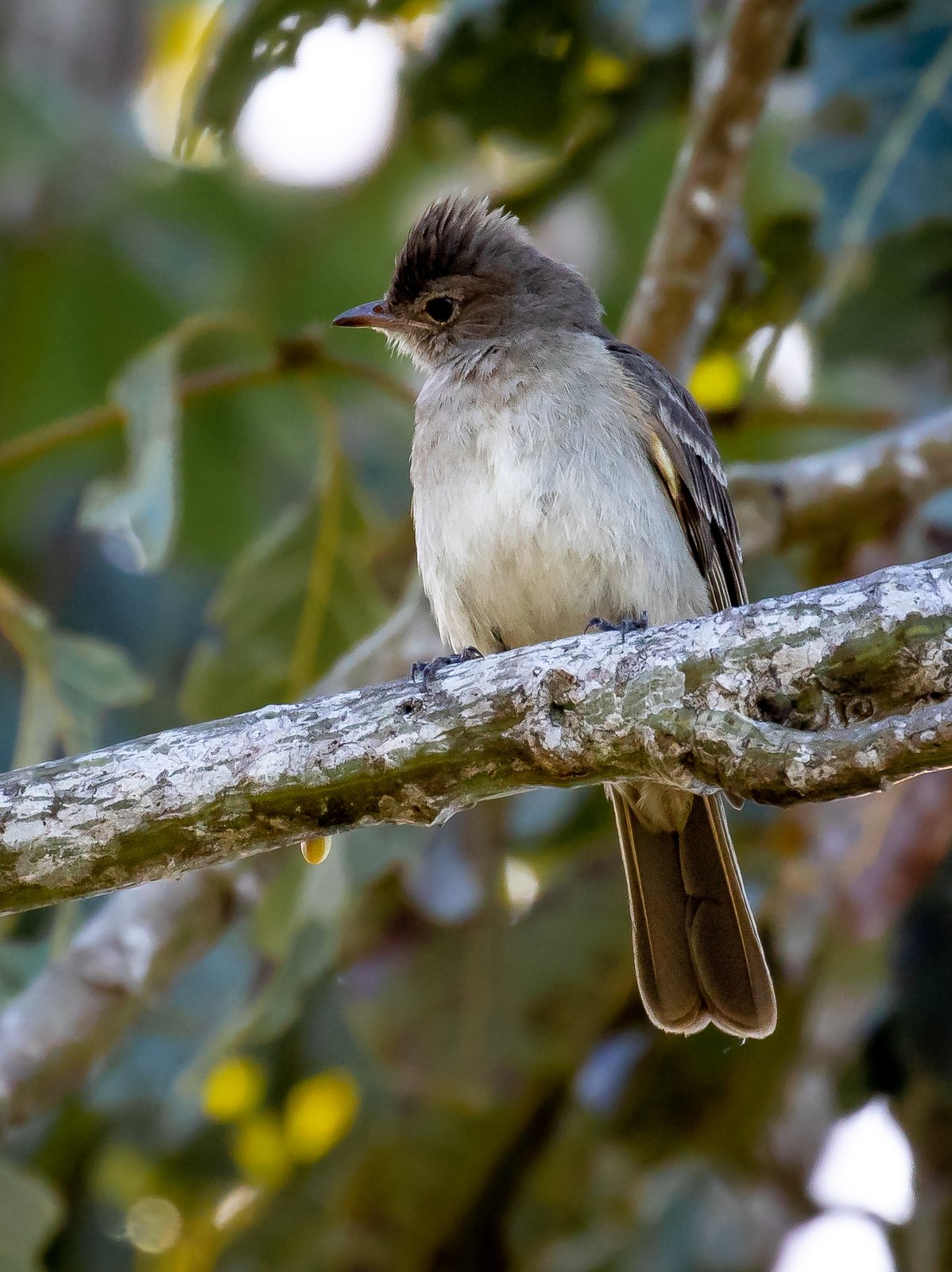
The Brownish Elaenia is a large, plain brown elaenia without a crest that lives almost exclusively on vegetated river islands along the Amazon and its large tributaries. Its lack of olive and yellow tones sets it apart from the other elaenias. In the guide area it is restricted to north-eastern Peru and northern Bolivia.
Voice
A deep, gruff dji-drt or dji-drt-drt and a fuller, rising call.
Recording: Jacob Wijpkema — CC BY-NC-SA 4.0 · xeno-canto
Identification
18 cm, with a round, crestless head and a black bill with a pale pinkish base to the lower mandible. The head and upperparts are dull brown, with paler cheeks, a faint whitish eye-ring and whitish lores. The male has a partly hidden white crown patch, the female does not. The wings are dark brown with three brownish-white wing bars. The throat is white, the breast and flanks whitish with a dingy brown wash.
Confusion species
Large Elaenia Elaenia spectabilis and Yellow-bellied Elaenia Elaenia flavogaster have a yellow belly and olive upperparts. Amazonian Scrub Flycatcher Sublegatus obscurior is smaller, with a short, stubby bill. Small-billed Elaenia Elaenia parvirostris, which also occurs on river islands in winter, is smaller and greyer, with a distinct white eye-ring.
Habitat
Young river-island forest with much Cecropia, also scrub and young secondary forest along riverbanks, in the lowlands up to about 200 m. It eats fruit and insects in the middle levels and the canopy.
Where the bird is most at home, classified by the vegetation units of the Andes and the west coast.


Range and movements
Peru: in the north-east along the Amazon and its tributaries, including the Napo, possibly also the Ucayali. Bolivia: in the far north, along the Beni and the Madre de Dios. Colombia: possibly in the extreme south-east along the Amazon, but without documented records. Absent from Ecuador and the Galápagos. Outside the guide area along the Amazon and its tributaries in Brazil.
- Resident
- dark = core range, pale = thinly spread
How and when to look
Visit the vegetated river islands in the Amazon near Iquitos by boat and search young Cecropia forest; the gruff call gives the bird away.
Conservation status
Least Concern. River islands are a dynamic habitat that constantly forms anew, but they are locally cleared for farming.
Scientific name
Elaenia pelzelni | Berlepsch, 1907
Berlepsch described the species in 1907 and placed it straight away in the genus where it still stands. The genus Elaenia was introduced in 1836 by Sundevall. The genus name comes from Ancient Greek elaineos, 'of olive oil' or 'oleaginous'. Honours August von Pelzeln (1825–1891), an Austrian ornithologist and curator of the bird collection in Vienna who studied Natterer's Brazilian birds. The specimen the first description was based on came from Lamalonga, Rio Negro, Brazil.