All species › Passerines › Cardinals and allies › Carmiol's Tanager
Carmiol's Tanager | Chlorothraupis carmioli
Carmiols tangare | Tangara de Carmiol | Tiê-de-carmiol
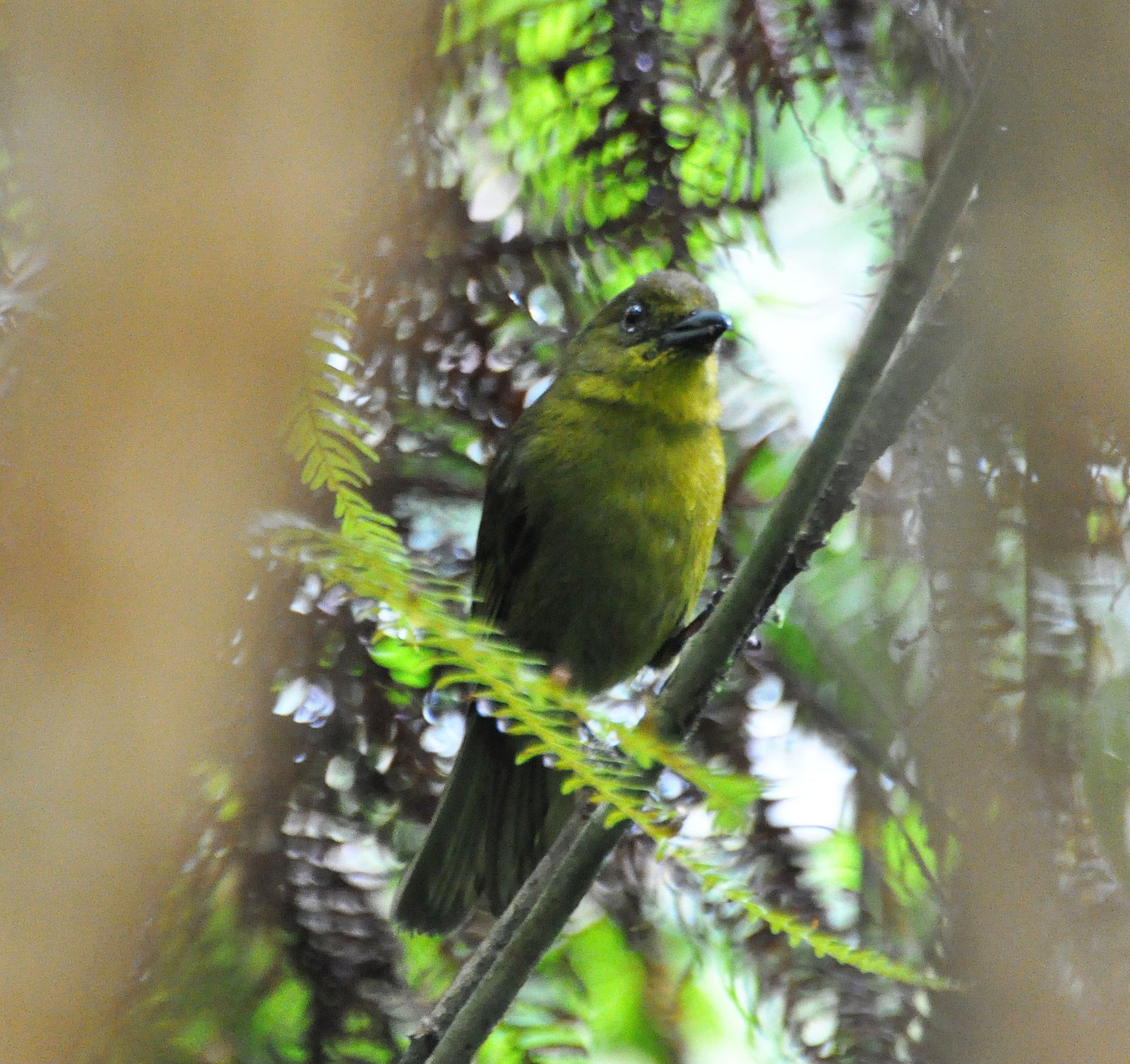
Carmiol's Tanager is a stocky, plain olive-green cardinal of humid forest in Central America, which in the guide area reaches only the extreme north-west of Colombia. Noisy groups often form the core of mixed understory flocks. The South American birds of the eastern slope of the Andes are now treated separately as Yellow-lored Tanager.
Voice
Very noisy. Groups give a repeated, harsh zhwek-zhwek-zhwek and other chatter; at dawn the male sings a fast series of clear, varied phrases.
Recording: Okamoto Keita Sin — CC BY-NC-SA 4.0 · xeno-canto
Identification
17 cm, stocky, with a stout, dark bill. Almost uniformly dull olive-green, slightly paler and yellower below. In the male the throat is slightly yellower and finely streaked; the female has a plain pale yellow throat and a yellowish patch in front of the eye. Young birds are duller.
Confusion species
Lemon-spectacled Tanager Chlorothraupis olivacea has conspicuous yellow spectacles and lores and a yellower throat, and lives in the Chocó lowlands. Ochre-breasted Tanager Chlorothraupis stolzmanni has an ochre breast and a greyer head and lives further south. Females of other tanagers and grosbeaks are usually smaller or have a paler bill.
Habitat
Undergrowth and mid-levels of humid forest in hills and on lower mountain slopes, also at forest edges and in older secondary forest. It lives in noisy groups that travel with mixed flocks. It eats insects and fruit. The nest is a cup low in the vegetation.
Where the bird is most at home, classified by the vegetation units of the Andes and the west coast.


Range and movements
In Colombia only in the extreme north-west, in the hills of the Chocó near the border with Panama. Absent from Ecuador, Peru, Bolivia and the Galápagos. Outside the guide area from Nicaragua to Panama.
- Resident
- dark = core range, pale = thinly spread
How and when to look
In forest in the hills near the border with Panama, listen for the harsh, repeated chatter of a group moving through the undergrowth.
Conservation status
Least Concern. The species depends on forest and disappears where the forest is cleared.
Scientific name
Chlorothraupis carmioli | (Lawrence, 1868)
Lawrence described the species in 1868 as Phoenicothraupis carmioli; because it was later moved to another genus, the author and year stand in brackets. The genus Chlorothraupis was introduced in 1883 by Salvin & Godman. The genus name comes from Greek khlōros, 'green', and thraupis, an unidentified small bird mentioned by Aristotle, used for tanagers. The species name honours Franz Carmiol, son of a German immigrant in Central America, who collected the type specimen in Costa Rica for the Smithsonian Institution. The specimen the first description was based on came from Angostura, Costa Rica.