All species › Passerines › Cardinals and allies › Red-crowned Ant Tanager
Red-crowned Ant Tanager | Habia rubica
Rode miertangare | Tángara hormiguera corona roja | Tiê-de-bando
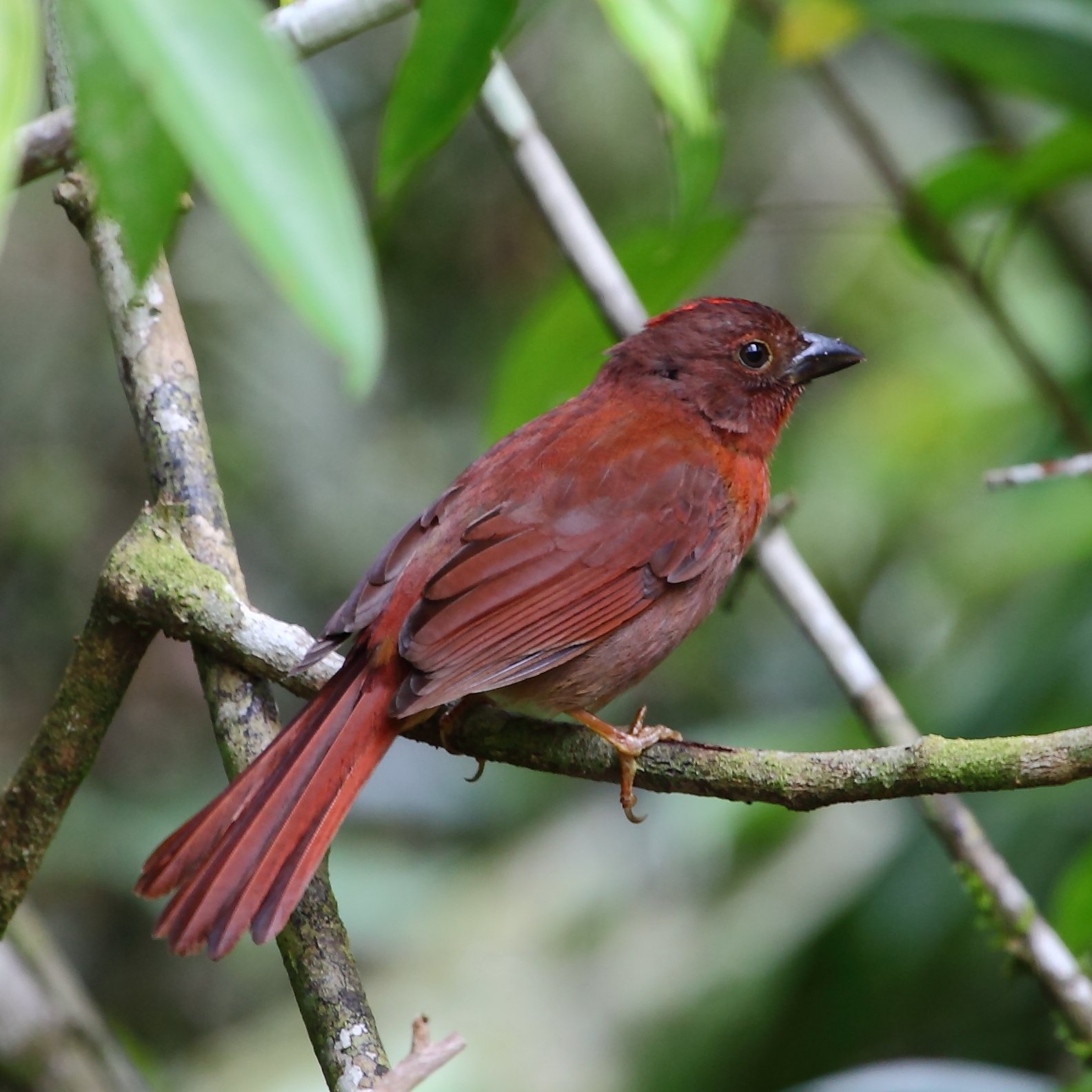
The Red-crowned Ant Tanager is a fairly large, dull red cardinal of the undergrowth of humid lowland forest, from Mexico to northern Argentina. Small groups move noisily through the lower levels of the forest and often form the core of mixed understory flocks. Despite the name it follows army-ant swarms only occasionally.
Voice
Groups give a constant, harsh chet or a rattling chatter. The song is a series of clear, whistled phrases, often repeated, mainly at dawn.
Recording: Marcos E. Sosa — CC BY-NC-SA 4.0 · xeno-canto
Identification
17–19 cm, with a fairly long tail and a stout, dark bill. The male is dull reddish brown, with a brighter, rosy-red throat and a narrow, scarlet crown stripe bordered black on both sides. The female is olive-brown, with an ochre-yellow throat and a narrow, ochre-yellow to orange-yellow crown stripe, also bordered black. In the field the crown stripe is often visible only when the feathers are raised.
Confusion species
Red-throated Ant Tanager Driophlox fuscicauda lacks the black-bordered crown stripe, has a more sharply defined red throat and lives west of the Andes. Crested Ant Tanager Driophlox cristata is a brighter red, with an erectile crest, and lives higher in the Andes of Colombia. Summer Tanager Piranga rubra is a more uniform red, with a pale bill, and lives higher in the trees. Females resemble Fulvous Shrike-Tanager Lanio fulvus, which has a hook-tipped bill and an ochre-yellow belly.
Habitat
Undergrowth and mid-levels of humid terra firme lowland forest, older secondary forest, bamboo forest and humid foothill forest, up to about 1200 m; in Bolivia also in semi-deciduous dry forest. It lives in pairs or family groups that travel with mixed flocks. It eats mainly insects and other invertebrates, as well as fruit. The nest is a shallow cup low in a shrub or sapling.
Where the bird is most at home, classified by the vegetation units of the Andes and the west coast.


Range and movements
In Colombia east of the Andes in the lowlands of the Orinoco and Amazon regions and in the foothills, locally also in the north and in the Magdalena valley. In Ecuador and Peru in the eastern lowlands and the foothills of the Andes. In Bolivia in the northern and eastern lowlands and in the foothills of the Yungas. Absent from the Galápagos and from west of the Andes in Ecuador and Peru. Outside the guide area from Mexico to Panama, in Venezuela, Trinidad, the Guianas, Brazil, Paraguay and north-eastern Argentina.
- Resident
- dark = core range, pale = thinly spread
How and when to look
Listen in the undergrowth of humid forest for the harsh chatter of a group; follow a mixed flock in the lower levels, where the ant tanagers often lead the way.
Conservation status
Least Concern. The species is widespread, but depends on closed forest and disappears with large-scale deforestation.
Scientific name
Habia rubica | (Vieillot, 1817)
Vieillot described the species in 1817 as Staltator rubicus; because it was later moved to another genus, the author and year stand in brackets. The genus Habia was introduced in 1840 by Blyth. The genus name is a Guarani word from Paraguay used for various finches and tanagers. The species name comes from Medieval Latin rubicus, 'reddish'. The specimen the first description was based on came from Paraguay.