All species › Passerines › Cardinals and allies › Indigo Bunting
Indigo Bunting | Passerina cyanea
Indigogors | Azulillo índigo | Azulinho-do-norte
The Indigo Bunting is a small North American cardinal that winters in Central America and the Caribbean. Northern Colombia lies at the southern edge of the wintering range. The birds migrate at night and orient themselves partly by the stars.
Voice
The call is a sharp, dry spit; in flight a buzzy bzzt. The song consists of short, high phrases, often repeated in pairs; in the wintering area you hear it mainly in March and April.
Recording: Rory Nefdt — CC BY-NC-SA 4.0 · xeno-canto
Identification
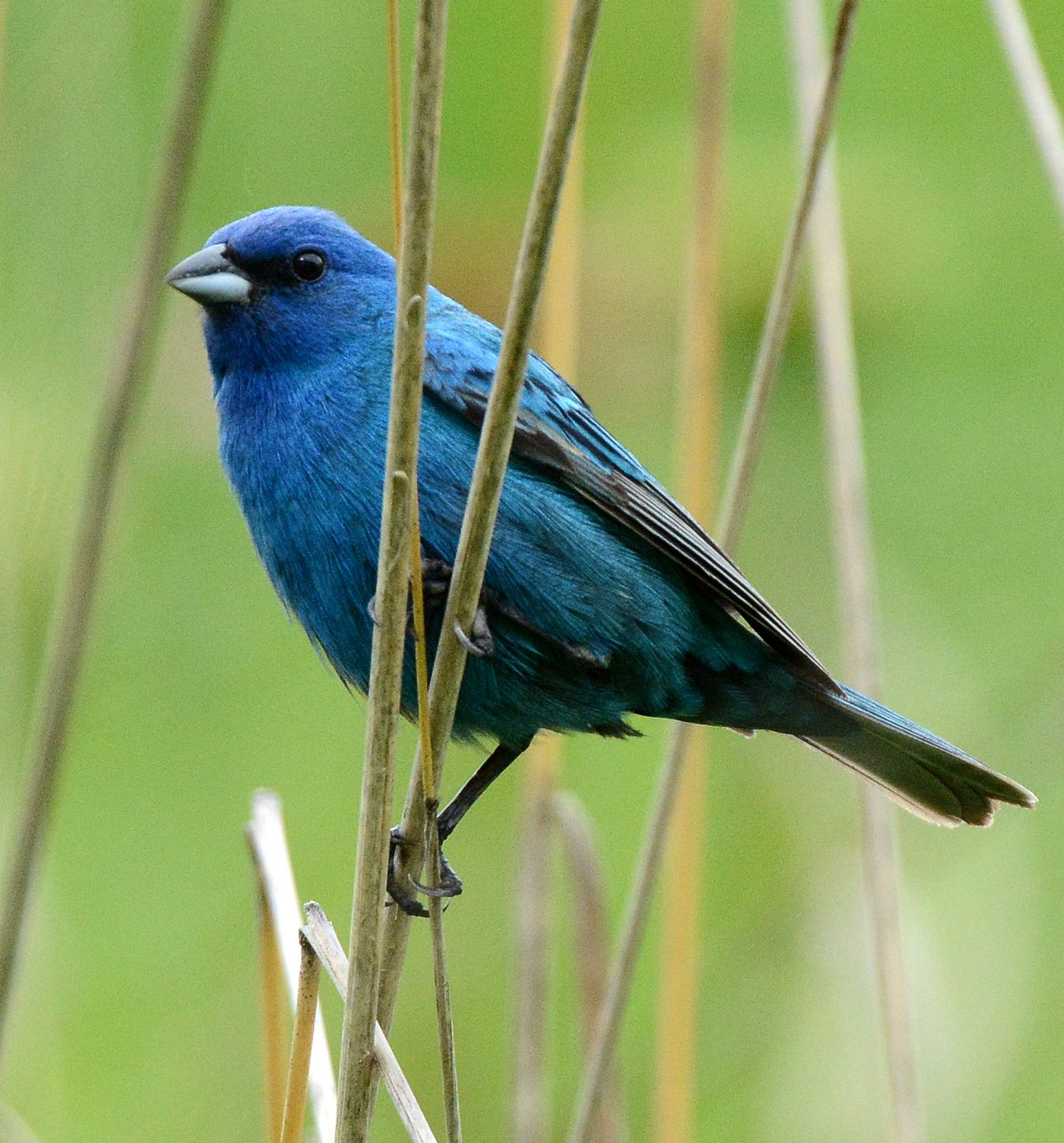
12–13 cm, with a short, conical bill. In winter most birds are brown: the male warm brown with blue feathers scattered over the body, wings and tail; from February it gradually becomes entirely deep indigo-blue, with blackish wings. The female is plain brown, slightly paler below, with faint streaks on the breast, two faint wing bars and often a tinge of blue on the rump, wing and tail.
Confusion species
Blue Grosbeak Passerina caerulea is larger, with a heavy bill and rufous wing bars. Blue-black Grassquit Volatinia jacarina has a more pointed bill; the male is glossy blue-black and the female has a clearly streaked breast. Females of Sporophila seedeaters have a shorter, more rounded bill and an unstreaked breast. Blue Seedeater Amaurospiza concolor is a darker blue and lives in bamboo.
Habitat
In winter in open and semi-open country with tall grass and weeds: rough pastures, field edges, rice fields, roadsides, forest edges and gardens, mainly in the lowlands. It feeds in small groups on the seeds of grasses and herbs, sometimes with seedeaters. It does not breed in the guide area.
Where the bird is most at home, classified by the vegetation units of the Andes and the west coast.


Range and movements
Colombia: scarce winter visitor in the north, mainly in the Caribbean lowlands and around the Sierra Nevada de Santa Marta; regular on the islands of San Andrés and Providencia. In Ecuador only a few records as a vagrant. Absent from Peru, Bolivia and the Galápagos. Outside the guide area the species breeds in eastern and central North America and winters from Mexico to Panama, in the Caribbean and in northern Venezuela.
- Winter visitor (c. Oct–Mar)
- dark = core range, pale = thinly spread
How and when to look
Look between November and March in rough grassland and along field edges in northern Colombia and on San Andrés, in small groups of seed-eaters.
Conservation status
Least Concern. The species is numerous in North America and benefits from rough, semi-open land.
Scientific name
Passerina cyanea | (Linnaeus, 1766)
Linnaeus described the species in 1766 as Tanagra cyanea; because it was later moved to another genus, the author and year stand in brackets. The genus Passerina was introduced in 1816 by Vieillot. The genus name comes from Latin passerinus, 'sparrow-like'. The species name is Latin cyaneus, 'dark blue', from Greek kuanos. The specimen the first description was based on came from South Carolina, United States.