All species › Passerines › Cardinals and allies › Ecuadorian Seedeater
Ecuadorian Seedeater | Amaurospiza aequatorialis
Ecuadordikbekje | Semillero ecuatoriano | Negrinho-equatoriano
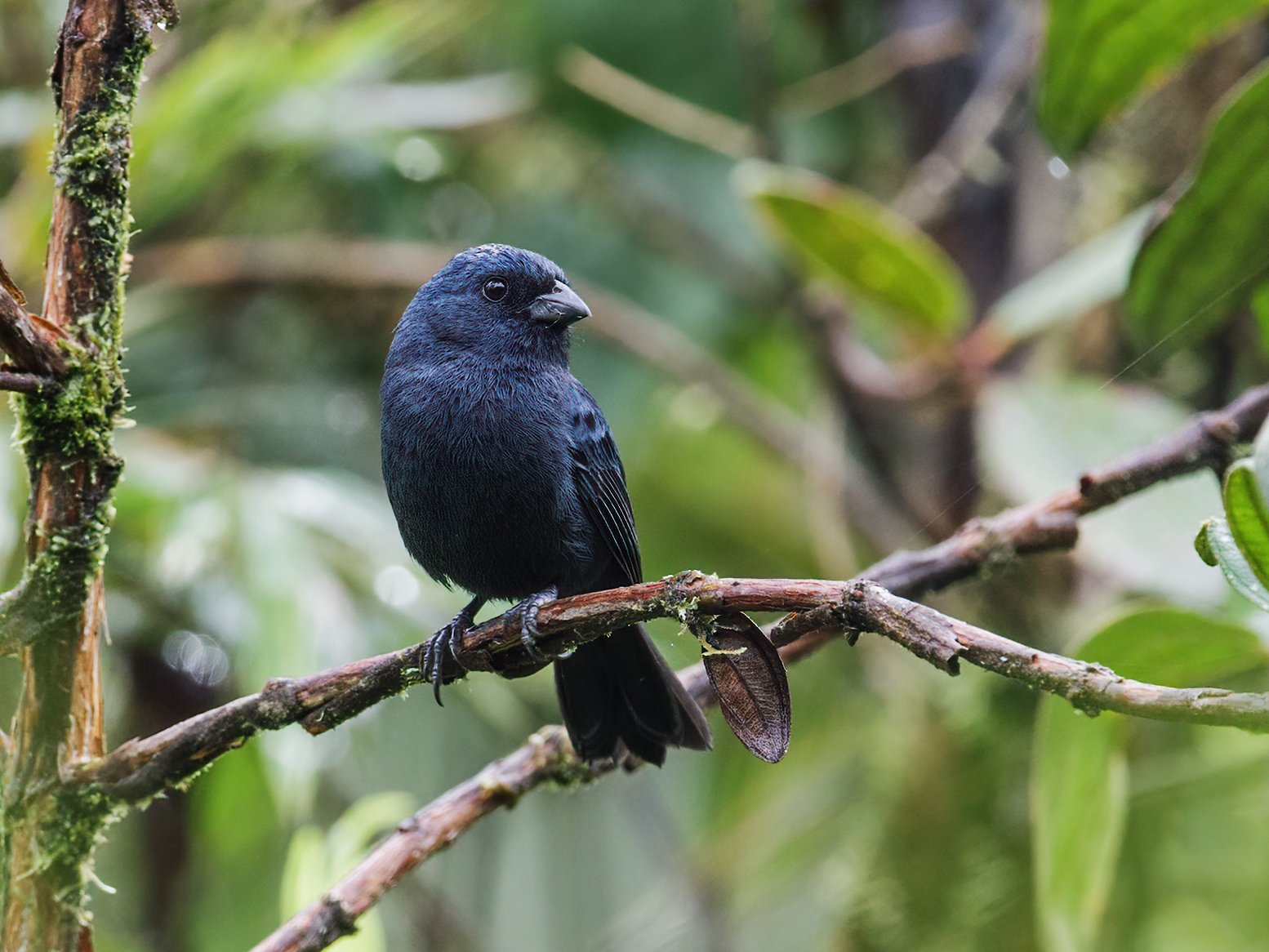
The Ecuadorian Seedeater is a small, dark blue seedeater of bamboo on the western slope of the Andes, from south-western Colombia to north-western Peru. It was long included in Blue Seedeater and is now treated as a separate species, on the basis of differences in plumage and song. It is scarce and local, and appears mainly where bamboo is seeding.
Voice
The song is a short series of clear, sweet whistles, sounding somewhat more inflected and varied than that of Blue Seedeater. The call is a sharp tsik.
Recording: Lelis Navarrete — CC BY-NC-SA 4.0 · xeno-canto
Identification
12–13 cm, with a short, thick, dark bill, slightly smaller than in Blue Seedeater. The male is uniform dark bluish grey to indigo-blue, with a paler bluish-grey forehead and eyebrow and white underwing coverts, visible in flight and when preening. The female is uniform warm cinnamon-brown, paler below, without streaks. Young males are brown with scattered blue feathers.
Confusion species
Blue Seedeater Amaurospiza concolor is almost identical, but occurs only in Central America. Grey Seedeater Sporophila intermedia is grey, with a pale bill and often a white wing patch, and lives in open country. Slaty Finch Haplospiza rustica is slate-grey, with a pointed bill, and also lives in bamboo. Band-tailed Seedeater Catamenia analis is greyer, with a yellow or pinkish bill, white tail spots and rufous undertail coverts. Females of Sporophila seedeaters are more olive-brown and less uniformly cinnamon.
Habitat
Bamboo (especially Chusquea) and dense undergrowth in humid montane forest, forest edges and overgrown clearings, at middle elevations in the mountains, roughly between 1000 and 2500 m; in north-western Peru also in semi-humid forest lower on the slopes. It eats mainly bamboo seed, as well as other seeds and insects. Little is known about the nest.
Where the bird is most at home, classified by the vegetation units of the Andes and the west coast.


Range and movements
In Colombia in the Andes of the south-west (Nariño). In Ecuador mainly on the western slope of the Andes and in the western foothills, locally. In Peru only in the north-west (Tumbes, Lambayeque and Cajamarca), discovered only recently. Absent from Bolivia and the Galápagos. Does not occur outside the guide area.
- Resident
- dark = core range, pale = thinly spread
How and when to look
In montane forest on the western slope of the Andes, look for bamboo that is seeding; several birds may then feed there together for a while. Outside such periods the species is rarely found.
Conservation status
Not evaluated as a separate species. The range is small and the forest on the western slope of the Andes is highly fragmented; the species may be vulnerable.
Scientific name
Amaurospiza aequatorialis | Sharpe, 1888
Sharpe described the species in 1888 and placed it straight away in the genus where it still stands. The genus Amaurospiza was introduced in 1861 by Cabanis. The genus name comes from Greek amauros, 'dark', and spiza, 'finch'. The species name refers to Ecuador (Latin aequatorialis, 'of the equator'), not necessarily the type locality. The specimen the first description was based on came from Pallatanga, Chimborazo, Ecuador.