All species › Passerines › Cardinals and allies › Ultramarine Grosbeak
Ultramarine Grosbeak | Cyanoloxia brissonii
Ultramarijnbisschop | Reinamora grande | Azulão
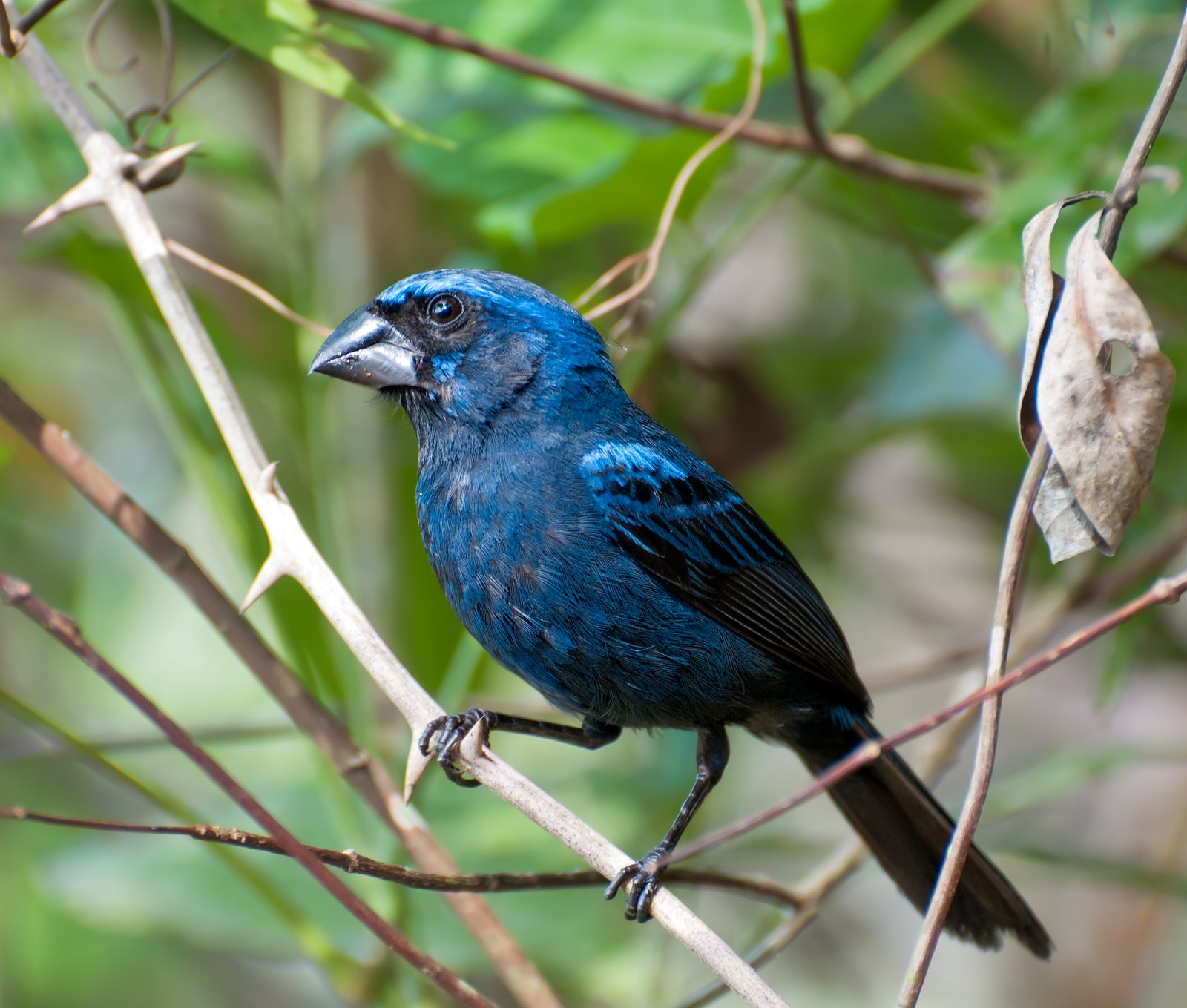
The Ultramarine Grosbeak is a stocky, dark blue grosbeak with a very heavy bill, found in dry forest and scrub east and south of Amazonia. In the guide area it lives in two separate parts: in dry valleys and lowlands of northern Colombia and in eastern and southern Bolivia. Males sing from a hidden perch in dense shrubbery.
Voice
The song is a series of clear, whistled notes that often runs down quickly and somewhat irregularly. The call is a short, metallic tchik.
Recording: Marcos E. Sosa — CC BY-NC-SA 4.0 · xeno-canto
Identification
15–16 cm, with a heavy, conical, blackish bill. The male is deep dark blue, with paler, bright sky-blue on the forehead, eyebrow, cheek, shoulders and rump; wings and tail are blackish with blue edges. The female is warm rufous-brown, paler and cinnamon below, without streaks or wing bars. Young males resemble the female and gradually acquire blue feathers.
Confusion species
Blue-black Grosbeak Cyanoloxia cyanoides and Amazonian Grosbeak Cyanoloxia rothschildii are darker, more blackish blue, with few or no pale blue highlights, and live in humid forest. Blue Grosbeak Passerina caerulea has rufous wing bars. Indigo Bunting Passerina cyanea is smaller, with a slimmer bill. Females of seed finches and seedeaters (Sporophila) are smaller and usually olive-brown, with a shorter, rounded bill.
Habitat
Dry and semi-deciduous forest, forest edges, gallery forest, thorn scrub, shrubby pastures and gardens, mainly below 2000 m. It keeps hidden in dense shrubbery and the lower levels of the forest, usually in pairs. It eats seeds, fruit and insects. The nest is an open cup low in a shrub.
Where the bird is most at home, classified by the vegetation units of the Andes and the west coast.


Range and movements
In Colombia locally in dry areas of the north (Caribbean region) and in the dry parts of the Cauca and Magdalena valleys. Absent from Ecuador, Peru and the Galápagos. In Bolivia in the eastern and southern lowlands (Chiquitano forest and Chaco) and in the dry Andean valleys. Outside the guide area in Venezuela, eastern and southern Brazil, Paraguay and northern Argentina.
- Resident
- dark = core range, pale = thinly spread
How and when to look
Listen in the early morning for singing males along shrubby forest edges and in dry valleys; the birds often sit low and well hidden.
Conservation status
Least Concern. The species is widely trapped for the cage-bird trade, which has made it scarce locally.
Scientific name
Cyanoloxia brissonii | (Lichtenstein, 1823)
Lichtenstein described the species in 1823 as Fringilla brissonii; because it was later moved to another genus, the author and year stand in brackets. The genus Cyanoloxia was introduced in 1850 by Bonaparte. The genus name comes from Greek kuanos, 'dark blue', and Loxia, the crossbill genus (Greek loxos, 'crosswise'). The species name honours the French zoologist Mathurin Jacques Brisson (1723–1806), author of a major work on birds. The specimen the first description was based on came from Bahia, Brazil.