All species › Passerines › Cardinals and allies › Amazonian Grosbeak
Amazonian Grosbeak | Cyanoloxia rothschildii
Rothschilds bisschop | Picogrueso amazónico | Azulão-da-amazônia
The Amazonian Grosbeak is the Amazonian counterpart of the Blue-black Grosbeak and was long included in that species. It lives in the understorey of lowland forest east of the Andes and differs mainly in song. Pairs keep to dense thickets and usually give themselves away by their slow, whistled phrase.
Voice
The song is a slow, clear series of whistles, often first rising and then falling, longer and more drawn out than that of Blue-black Grosbeak. The call is a sharp, metallic chink.
Recording: Niall Perrins — CC BY-NC-SA 4.0 · xeno-canto
Identification
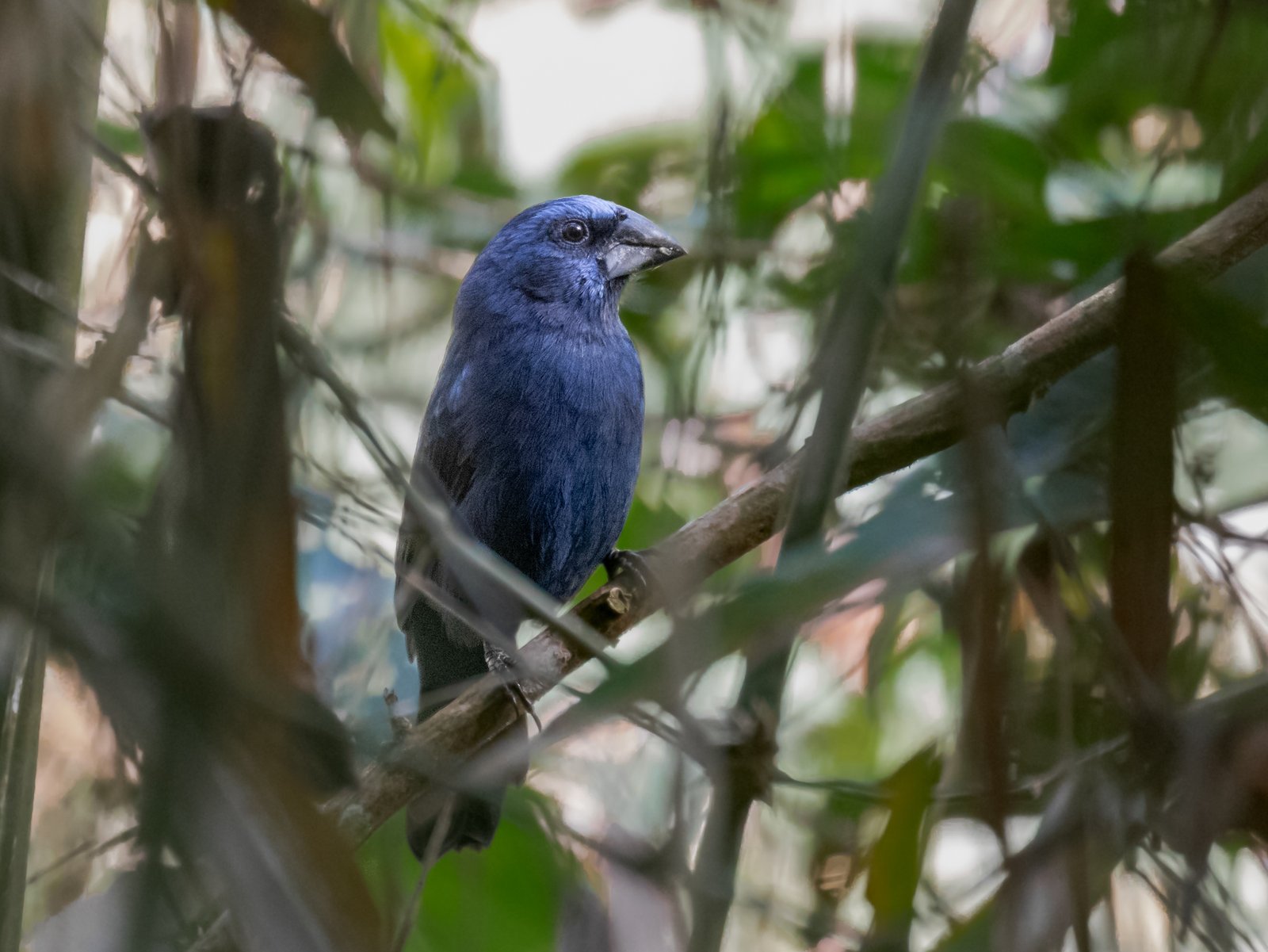
15–16 cm, with a very heavy, blackish conical bill. The male is dark blue-black, with brighter blue on the forehead, brow and shoulders. The female is uniform warm dark brown, slightly paler below. Young males resemble the female.
Confusion species
Blue-black Grosbeak Cyanoloxia cyanoides is practically identical in the field but lives west of the Andes; the song is the best feature. Ultramarine Grosbeak Cyanoloxia brissonii is brighter blue and lives in drier, open country. Blue-black Grassquit Volatinia jacarina is much smaller, with a thin bill. Female Chestnut-bellied Seed Finches Sporophila angolensis are smaller, with a chestnut wash on the belly.
Habitat
Understorey and edges of humid lowland terra firme and flooded forest, also second growth, bamboo and dense vegetation along rivers, up to about 1200 m in the foothills. It eats seeds, fruit and insects, low in dense cover, usually in pairs. The nest is a cup in a dense shrub.
Where the bird is most at home, classified by the vegetation units of the Andes and the west coast.


Range and movements
Colombia: in the Amazonian lowlands and the eastern foothills. Ecuador: in the eastern lowlands and foothills. Peru: in the eastern lowlands and foothills throughout. Bolivia: in the lowlands and foothills of the north and centre. Absent from the Galápagos. Outside the guide area in southern Venezuela, the Guianas and Brazilian Amazonia.
- Resident
- dark = core range, pale = thinly spread
How and when to look
Listen along forest edges and trails in the Amazonian lowlands for the slow whistled song from the understorey; waiting patiently at a gap in the vegetation gives the best chance of a brief view.
Conservation status
Least Concern. The species tolerates secondary forest and forest edges, but depends on understorey, which is disappearing locally through deforestation.
Scientific name
Cyanoloxia rothschildii | (Bartlett, 1890)
Bartlett described the species in 1890 as Guiraca rothschildii; because it was later moved to another genus, the author and year stand in brackets. The genus Cyanoloxia was introduced in 1850 by Bonaparte. The genus name comes from Greek kuanos, 'dark blue', and Loxia, the crossbill genus (Greek loxos, 'crosswise'). The species name honours Walter Rothschild (1868–1937), British banker, zoologist and founder of the museum at Tring. The specimen the first description was based on came from Caramang, Guyana.