All species › Passerines › Cardinals and allies › Blue-black Grosbeak
Blue-black Grosbeak | Cyanoloxia cyanoides
Blauwrugbisschop | Picogrueso negriazulado | Azulão-negro
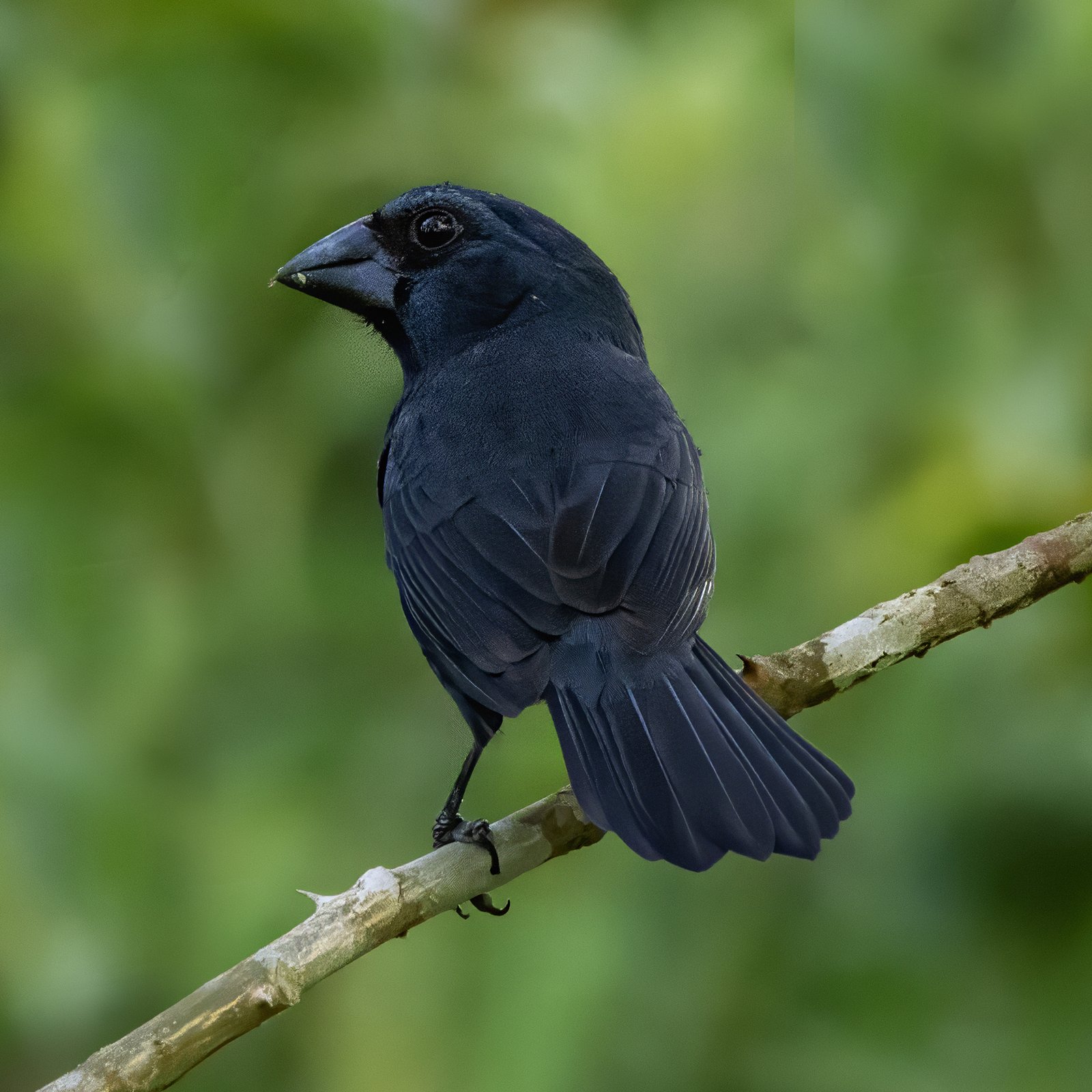
The Blue-black Grosbeak is a dark, heavy-billed grosbeak of the understorey of humid forests, from Mexico to western Colombia and Ecuador. Since the Amazonian birds have been treated as a separate species, Amazonian Grosbeak, it is restricted in the guide area to the side of the Andes facing the Pacific and the Caribbean. It is heard more often than seen.
Voice
The song is a short, clear, melodious phrase of whistles, often falling and repeated from cover. The call is a sharp, metallic chink.
Recording: Carlos Delgado JUMABITA — CC BY-NC-SA 4.0 · xeno-canto
Identification
15–16 cm, with a very heavy, blackish conical bill. The male is dark blue-black, with brighter blue on the forehead, brow, shoulders and rump. The female is uniform warm chocolate-brown, slightly paler below. Young males resemble the female and gradually acquire blue-black feathers.
Confusion species
Amazonian Grosbeak Cyanoloxia rothschildii is very similar but lives east of the Andes and has a different song. Ultramarine Grosbeak Cyanoloxia brissonii is brighter blue and lives in drier, open country. Blue Seedeater Amaurospiza concolor is smaller, with a less heavy bill. Female Chestnut-bellied Seed Finches Sporophila angolensis are smaller, with a shorter tail and a chestnut wash on the belly.
Habitat
Understorey and edges of humid forest, second growth, dense shrubbery along forest edges and shaded plantations in the lowlands and on the lower slopes, mostly below about 1500 m. It eats seeds, fruit and insects, low in dense cover, usually in pairs. The nest is a cup in a dense shrub.
Where the bird is most at home, classified by the vegetation units of the Andes and the west coast.


Range and movements
Colombia: in the Pacific lowlands, the Caribbean lowlands, the Magdalena valley and on the lower slopes of the Andes on the western side. Ecuador: in the west, from the humid north to the semi-humid regions in the south. Peru: at most in the far north-west. Absent from Bolivia and the Galápagos. Outside the guide area from southern Mexico to Panama and in northern Venezuela.
- Resident
- dark = core range, pale = thinly spread
How and when to look
Listen along forest edges and in secondary forest in western Colombia and Ecuador for the clear song from the understorey and wait for the bird to come briefly into view; in the shade the female stands out by her uniform brown colour and heavy bill.
Conservation status
Least Concern. The species tolerates secondary forest and forest edges and is therefore less sensitive to deforestation than many forest birds.
Scientific name
Cyanoloxia cyanoides | (de Lafresnaye, 1847) (GBIF: Cyanocompsa cyanoides)
De Lafresnaye described the species in 1847 as Coccoborus cyanoides; because it was later moved to another genus, the author and year stand in brackets. The genus Cyanoloxia was introduced in 1850 by Bonaparte. The genus name comes from Greek kuanos, 'dark blue', and Loxia, the crossbill genus (Greek loxos, 'crosswise'). The species name comes from Greek kuanos, 'dark blue', and -oidēs, 'resembling'. The specimen the first description was based on came from Panama.