All species › Passerines › Cardinals and allies › Dickcissel
Dickcissel | Spiza americana
Dickcissel | Arrocero americano | Papa-capim-americano
The Dickcissel is a sparrow-like member of the cardinal family from the prairies of North America, named after its song. It winters mainly in the llanos of Venezuela, where it roosts and feeds in huge flocks in rice fields. In the guide area it is a local winter visitor mainly in eastern and northern Colombia.
Voice
In flight and in flocks a low, buzzy brrrt. The song is a dry dick-dick-ciss-ciss-ciss, which gives the species its name; in the guide area rarely heard.
Recording: Valerie Heemstra — CC BY-NC-SA 4.0 · xeno-canto
Identification
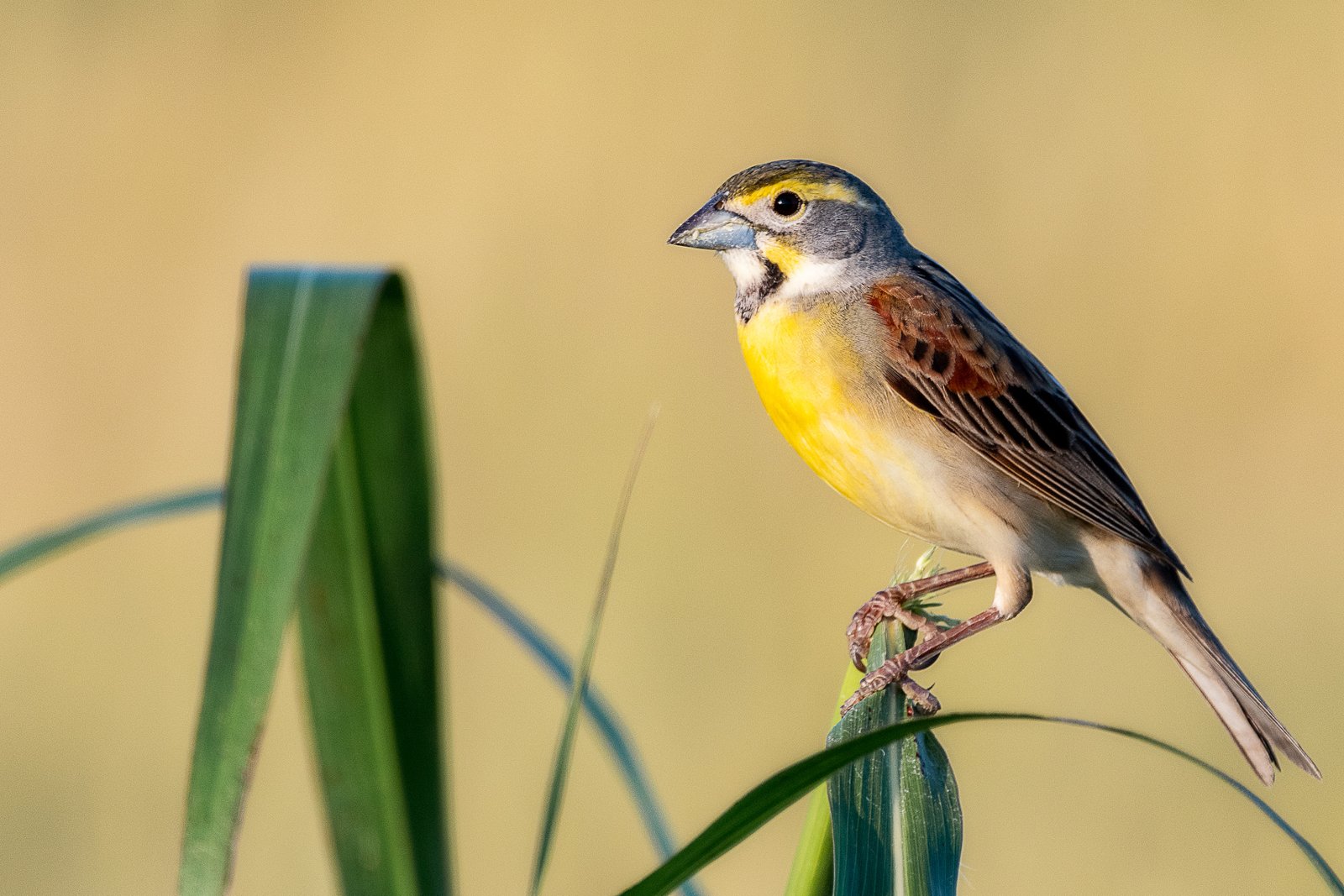
15–16 cm, with a fairly heavy, grey conical bill. The male has a grey head with a yellow supercilium, a white throat, a black V-shaped bib, a yellow breast, a rufous shoulder patch and a brown, black-streaked back. In winter the black bib is smaller or absent. The female resembles a sparrow, with a pale supercilium, a yellow wash on the breast, fine streaks on the flanks and a smaller rufous shoulder patch. Juveniles are duller and more streaked.
Confusion species
The female House Sparrow Passer domesticus lacks yellow and the rufous shoulder patch and has an unstreaked breast. Female Bobolinks Dolichonyx oryzivorus are more yellowish buff, with a striped crown and a more pointed tail. Grassland Sparrow Ammodramus humeralis is smaller and greyer, with a yellow spot in front of the eye.
Habitat
In winter in rice fields, grain fields, wet and dry grassland and savanna in the lowlands, mostly below 500 m. It eats mainly seeds of rice, sorghum and grasses and roosts in flocks in sugar cane, reeds or shrubs. It does not breed in the guide area; the nest is placed low in grass or shrubs in North America.
Where the bird is most at home, classified by the vegetation units of the Andes and the west coast.


Range and movements
Colombia: local winter visitor, mainly in the eastern llanos and the Caribbean lowlands, with large numbers in rice-growing areas. Ecuador: a few records. Peru: isolated records of vagrants. Bolivia: no or hardly any records. Outside the guide area the species breeds in the prairies of the central United States and winters mainly in the llanos of Venezuela, with smaller numbers from Mexico to Panama.
- Winter visitor (c. Oct–Mar)
- dark = core range, pale = thinly spread
How and when to look
Look between November and March in rice-growing areas of the Colombian llanos and watch at dusk for large, tightly packed flocks flying to their roosts. The buzzy flight call helps to pick out single birds among other seed-eaters.
Conservation status
Least Concern. In the rice-growing areas of the winter range the species is controlled locally as a pest, and prairie is being lost on the breeding grounds.
Scientific name
Spiza americana | (Gmelin, 1789)
Gmelin described the species in 1789 as Emberiza americana; because it was later moved to another genus, the author and year stand in brackets. The genus Spiza was introduced in 1824 by Bonaparte. The genus name is Ancient Greek spiza, the name of a finch, now assumed to be the Common Chaffinch. The species name is Latin for 'American', after America. The specimen the first description was based on came from New York, United States.