All species › Passerines › Cardinals and allies › Rose-breasted Chat
Rose-breasted Chat | Granatellus pelzelni
Roze granaatzanger | Reinita pechirroja | Polícia-do-mato
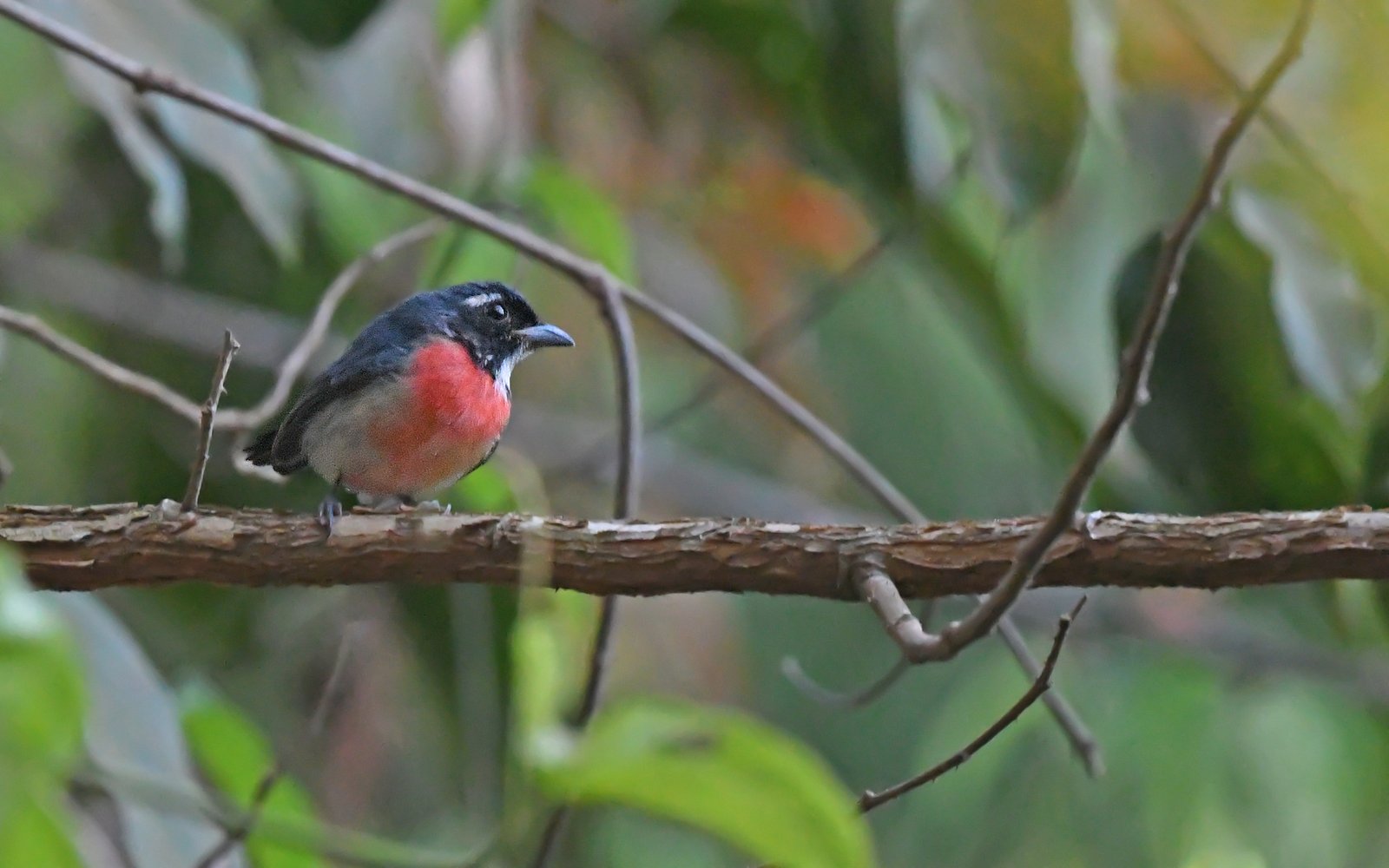
The Rose-breasted Chat is a small, long-tailed bird of Amazonian forest that was formerly placed with the New World warblers and is now placed in the cardinal family. The male combines grey-blue upperparts with a white throat and a rose-red breast and belly. It lives in the middle levels of the forest and often holds its tail cocked.
Voice
The song is a short series of clear, whistled notes, roughly chew-chew-chew. The call is a nasal, dry chek or a short rattle.
Recording: JAYRSON ARAUJO DE OLIVEIRA — CC BY-NC-SA 4.0 · xeno-canto
Identification
12–13 cm, with a short, fairly thick bill and a long, rounded tail. The male has grey-blue upperparts, a black crown and cheek with a white stripe behind the eye, a white throat with a narrow black border, a rose-red breast and belly and white flanks; the undertail coverts are rose-red. The female is grey-blue above, with a buff head and underparts and a wash of pink on the undertail. Juveniles resemble the female.
Confusion species
Hardly confusable. Red-crowned Ant Tanager Habia rubica is larger, reddish brown, without grey-blue upperparts and white throat, and lives lower in the forest. Females may recall a female seedeater of the genus Sporophila, but these have a shorter tail and a heavier bill.
Habitat
Interior and edges of humid terra firme lowland forest, also white-sand forest and the edges of flooded forest, mostly below about 500 m. It searches for insects in dense foliage and vine tangles in the middle levels, often in mixed flocks. Little is known about the nest.
Where the bird is most at home, classified by the vegetation units of the Andes and the west coast.


Range and movements
Bolivia: in the lowlands of the north and east. Peru and Colombia: at most locally in the far east; its status there is poorly known. Absent from Ecuador and the Galápagos. Outside the guide area in southern Venezuela, the Guianas and Brazilian Amazonia.
- Resident
- dark = core range, pale = thinly spread
How and when to look
Listen in lowland forest of northern Bolivia for the whistled song and the nasal call in mixed flocks; the male sometimes shows itself briefly with drooped wings and spread tail.
Conservation status
Least Concern. The species depends on continuous lowland forest and retreats locally through deforestation.
Scientific name
Granatellus pelzelni | Sclater, 1865
Sclater described the species in 1865 and placed it straight away in the genus where it still stands. The genus Granatellus was introduced in 1850 by Bonaparte. The genus name is a diminutive of Medieval Latin granatus, 'garnet'; probably after the red of the breast. Bonaparte published the name in 1850. The species name honours the Austrian ornithologist August von Pelzeln (1825–1891), curator at the natural history museum in Vienna. The specimen the first description was based on came from Ribeirão, Rio Madeira, Brazil.